|
|
Luke to Zuke
·
Jun 18, 2008
·
Anchorage
· Joined Apr 2008
· Points: 220
I have just recently went to the valley , --I can climb solid 5.9 and lucky days cruise 5.10+-- and of coarse, messed my self when I saw the nose. I was accompanied by a multi veteran valley friend of mine "J". Although we only had a day and a half of climbing, I said to my self and J, "that I could do the nose if you gave me a week of big wall pratice".. Something along the lines of "what? its not an easy route", said J,and thats the end of that ..Well most topos say that its a .."5.9 A2"..So is this true? is it a 5.9 and only A2,... I want to call b.s. but I have never even touched the base. SO if its a 5.10 or 5.10+. Why dont we call it that?...respect for the Harding?
|
|
|
Luke to Zuke
·
Jun 18, 2008
·
Anchorage
· Joined Apr 2008
· Points: 220
I guess i should have posted in Yosemite forum
|
|
|
SirVato SirVato
·
Jun 18, 2008
·
Boulder
· Joined Sep 2003
· Points: 405
I'm pretty sure it's 5.9 C1, no hammers on this. The aid is not hard at all. But IMO if you want the most bang for your buck, be solid on 5.10 or up. There are some friggin mega classic pitches on that route like. . .
the stovelegs(10), boot flake(10c), and pancake flake(mostly 10 with just a spot of 11 at the end of the pitch) Just to name a few. Hell, even the first few pitches are great at 10 something.
I don't know you but my only intro to wall climbing was C1-ing the first pitches of the bastille and hauling/setting up a porta ledge above the lip of the roof routes. The nose was my first wall. and I thought the most difficult part was the traversing and hauling.
That being said a mentally and physically strong climber shoud be able to do it with a week of training.
my .02
|
|
|
Greg Smith
·
Jun 18, 2008
·
Canon City, CO
· Joined Jun 2007
· Points: 100
The Nose. Basically, it is 5.9 C2. The harder you can free climb the better. You also need to know some aid climbing techniques that are not always straight forward when you are on the wall, such as pendulums and lower-outs. The most important skills to possess when climbing El Cap is fitness, faith, and being able to take and deal with a lot of physical and mental punishment and stress.
|
|
|
susan peplow
·
Jun 18, 2008
·
Joshua Tree
· Joined Jan 2006
· Points: 2,995
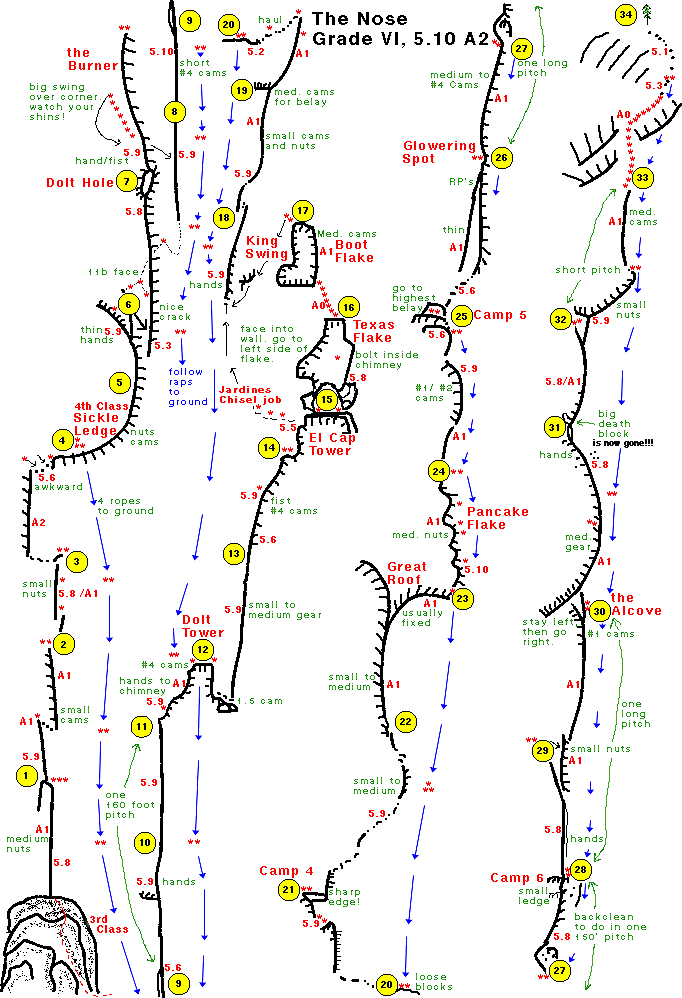
Old topo but you'll get the drift. It's really 5.9-10d C1/C2. All the stations are bolted. You don't have to have any free climbing ability to jug lines. You want to lead your pitches/blocks then start on aid climbing techniques. If you're a strong free-climber then free as many as you can and take the extra time for Dinty Moore and beer! The Nose itself is one of the easiest routes on El Cap (so they claim). If you're interested in getting into aid. Try starting in Zion or next time in the Valley Maybe Washingtons Column. That or blast up the Nose. What's the worst that happens....you come down? It is one impressive piece of stone! Suggested reading is Chris Macs book Road to the Nose supertopo.com/climbingareas… ~Susan
|
|
|
Luke to Zuke
·
Jun 18, 2008
·
Anchorage
· Joined Apr 2008
· Points: 220
So its a 5.8? ? I'm guessing from posts..that the reason its even 5.9 is because of the length...well isnt that what the grade is for..? VI??..I guess I just answered my question
|
|
|
Shawn Mitchell
·
Jun 18, 2008
·
Broomfield
· Joined Mar 2008
· Points: 250
You're missing something, Lucas, that everyone is implying, but not explaining directly: A lot of the pitches can be either aided or freed, depending on how hard you are able to free climb. While it's possible to aid everything harder than 5.8 or 9, you'll spend an awful lot of time in aiders (like I did in 1980...6 days). And you better have a lot of hand and fist size pieces. If you can climb 5.10 up there, you'll be able to free most the pitches and move a lot faster.
|
|
|
Cody Cook
·
Jun 18, 2008
·
Colorado Springs, CO
· Joined Jul 2005
· Points: 40
I've seen these sub-5.10 aid ratings for the Nose before. I haven't done much research, but I've always been curious - why is the free version so much harder (5.13+)? Is this "easy" version an actual variation of the free version (different pitches)? I assume the version discussed in this thread does not include the Changing Corners pitch, or the other more feared free pitches. Is this correct? How many pitches are actually different between the two lines (if any)?
|
|
|
George Bell
·
Jun 18, 2008
·
Boulder, CO
· Joined Jan 2001
· Points: 5,050
Good post, Shawn. I'd add that the Nose is one of the most exposed routes most climbers will ever do. If you have any fear of thousands of feet of exposure, it will gnaw on you more than any other popular route in the lower 48, outside of Yosemite.
Many people think from the rating that the climb is pretty reasonable. And for some it is. But many a climber has been humbled psychologically by the mighty Captain. Of course, if you are a BASE jumper you will laugh at the exposure. But a lot depends on how you can deal with it. I didn't sleep for 3 nights when climbing the thing!
I'd guesstimate the aid percentages are:
5.8, C1, 80% aid, 3+ days
5.10, C1, 20% aid, 1 day
5.14, 0% aid, trip to stardom
|
|
|
Luke to Zuke
·
Jun 18, 2008
·
Anchorage
· Joined Apr 2008
· Points: 220
Yea i guess your right..The nose has too many var. and ratings. People trying to free it..do it in 2 hours..yea this is the "most competitve non-competitive sport".
|
|
|
Shawn Mitchell
·
Jun 18, 2008
·
Broomfield
· Joined Mar 2008
· Points: 250
Great points, George. But I'd bet most parties will take 2-3 days even climbing 5.10. How common is it really for the skilled masses to tick the Captain in a day?
|
|
|
Luke to Zuke
·
Jun 18, 2008
·
Anchorage
· Joined Apr 2008
· Points: 220
so someone should make a chart for the nose..haha if you climb this hard, you will aid this hard, and do it in this time..therefore your rating is x
|
|
|
trundlebum
·
Jun 18, 2008
·
Las Vegas NV
· Joined Aug 2007
· Points: 85
Lucas:
~~~~~~~~~~
I think that the 'Mandatory aid' is only 5.8.
But no, you would never (or supposedly shouldn't) change a difficulty rating due to it's grade.
Difficulty is difficulty, length or commitment ie: grade is just that, the two should not effect one another with the exception of an all free climb that is so techinically demanding that a modicum of pitches may take a very long time to ascend free and cleanly.
~~~~~~~~~~
I am not sure exactly what your question is but let me take a stab at it.
First of all when considering doing an aid route a common question is what is the "mandatory free climbing"?
In other words what is the hardest free climbing that can not be aided, such as a face/friction pitch etc.
On the Nose 5.8 is the hardest mandatory free climbing encountered.
With regard to "respect for Harding":
This is not entirely the case. A good example of a an old aid route going free, is the East Face of Washington column. Originally done (by Harding) as an aid route it was later completely freed thus creating one of North America's most aesthetic and sustained free climbs of the times (and still today). As a free climb the nature of the route and the commitment to the ascent and climbing ethics/style changed so radically that it was given a new name 'Astro man'.
Referring to an ascent of 'Astro man' done almost entirely in aiders would be a misnomer as would climbing it all free and clean and calling it an ascent of the 'East Face'.
Bearing this in mind I am surprised that all these grade VI's that have gone entirely free have not been given a new name for their new (All Free) persona.
As too whether you could do the Nose ?
Of course you could !
You climb solid 5.9 and learning to aide C2 wouldn't take long.
However:
As you have noted the route carries a grade VI rating.
That means it will take a long time and a lot of commitment. Understand that theoretically you could have a 5.4 VI. It might mean it is a 78 pitch route in order for a 5.4 to warrant the VI rating. But 'No Mattah' a grade rating is one of commitment not difficulty. A grade VI is a grade VI no matter what the hardest pitch is rated.
Above, previous poster's have made some very good comments that you might be taking for granted due too the concise manner in which they were presented.
Greg Smith said:
"You also need to know some aid climbing techniques that are not always straight forward when you are on the wall, such as pendulums and lower-outs. The most important skills to possess when climbing El Cap is fitness, faith, and being able to take and deal with a lot of physical and mental punishment and stress."
You would definitely need to practise pendulums (both leading and following them) and lower outs.
But more importantly you need to understand what Greg means when he says "being able to take and deal with a lot of physical and mental punishment and stress."
That is what grade VI is all about!
Jed Pointer said:
"The #1 reason people bail off this climb is moving too slow, and the bail rate is high. However, the crux for most on a wall like this is not the free climbing, nor even the aid, but the "wall skills"
George Bell said:
"I didn't sleep for 3 nights when climbing the thing!"
Again reiterating that doing a grade VI is a huge physical and mental commitment.
Knowing you (as well as I do) Lucas, there is no question in my mind that with a little warm up time in the valley you could sail your way up most any moderate 5.10 and if you could maintain that free climbing standard up on the Nose...
(remember your dealing with huge exposure and most likely climbing under stress full conditions such as dehydration, lack of sleep etc.)
With some practise your aid skills would be sufficient to do the Nose, but that is not the point people are making.
The main point is this:
Unless your Tommy Caldwell and Beth Rodden, after the tenth pitch, there will be no water cooler, hot meal or porta ledge waiting for you. Instead there will just be twenty plus more pitches looming above you!
Understanding the idea of what grade VI really means can only be gained by getting out and doing some.
Putting it in perspective, try something like this:
Take a quart of water only, do the approach too 'Crimson Chrysalis and climb the route, then run over and do everything on the Brass wall, then run down too Dark shadows and do a few routes there. Are you hungry yet ? Are you tired or dehydrated ? Well you just made it onto the 'Dolt Tower' and you still have another 20 pitches to go !
Training for a grade VI is not all about technical ability, it's the suffr'n baby ;)
As Greg Smith said:
"...being able to take and deal with a lot of physical and mental punishment and stress."
PS. Lucas:
Where'd you get that expression "climbing is the most competitive, non-competitive sport..." ? :)
|
|
|
brevans
·
Jun 18, 2008
·
Ft. Collins
· Joined Mar 2008
· Points: 0
The exposure shuts down climbers who haven't experienced it before. I personally spent nearly half an hour sussing out a mantle that couldn't have been harder than 5.5, but 2500 ft. of air under my feet, wet tennis shoes and being plain terrified made standing on a shoddy yellow alien look good. I have not been on the Nose, but I feel that if you are confident climbing 5.9, ow and slab included then you will be fine technically. People bail off the Nose probably every other day from mid-May to late June and then the same cycle is duplicated in early fall. Get on the wall and you have made it farther than most people. Take the suggested rack then add some.
|
|
|
Luke to Zuke
·
Jun 18, 2008
·
Anchorage
· Joined Apr 2008
· Points: 220
Well i got that quote from a dear friend of mine. And I understand why my friend J said "what..its not an easy route" because.he knows ive never been up higher then eight pitches..But know i have the info. Thanks to all the people above..but just to let you know my name is lucas and im from alaska..and im one tough mother Fu---.. well all that aside, i think i could handle the "VI"..with practice of course
|
|
|
trundlebum
·
Jun 18, 2008
·
Las Vegas NV
· Joined Aug 2007
· Points: 85
Hmmmm actually
That would be cool, something like a 'Gray's Anatomy' with acetate overlays, each a different ascent style topo. And/or the same in a software prog.
(Ooooh Mr. McNamara... ahem... )
~~~~~~~~~~~~~~~
Hmmmm maybe someone should track down Dave Clendenan and see if he still has copies of his calculator.
Seems like a two cool a tool to have collecting dust. Must have been an effort to build it and a neat tool if Jed had it book marked.
~~~~~~~~~~~~~~
Jed Pointer:
"the Nose is a circus. But the goods are good, so people line up anyway."
yep it's a zoo,
But a 'must do' zoo !
People have been lining up since Harding put it up, and for good reason.
Few who ever stepped into the cue and topped out, have regretted it.
Man, What a route, what a legacy, 'eh ?
|
|
|
Fat Dad
·
Jun 18, 2008
·
Los Angeles, CA
· Joined Nov 2007
· Points: 60
Don't bother with it unless you're solid on Valley 5.9. There's too much 5.9/10a on the route (Stovelegs, pitches b/w Dolt and El Cap Tower, Pancake Flake, etc.) to do it efficiently unless you can. Having said that, there's lots of knuckleheads that don't let that stop them from trying. But it'll be alot more fun if your crack skills and fitness are polished.
Although walls are alot of effort, don't let the size take the wind out of your sails. Unless you like getting intimidated, when you're doing a big route, you just look at the pitch in front of you and where you need to get to on that day. It's always fun checking out where you're going to be climbing on the following days, but know that's going to be after you do what you need to for that day.
Kind of like eating an elephant...one bite at a time.
Show up to the Valley a week or two early and do your 5.9-10 crack circuits. If you feel good, jump in line and don't let other parties poach your fixed lines. There will be a lot of riff raff to fight your way thru on the lower part of the route, but once you get high in the Stovelegs, you'll be good.
|
|
|
Kevin Stricker
·
Jun 18, 2008
·
Evergreen, CO
· Joined Oct 2002
· Points: 1,330
Just a few comments to add.
I heard that the bail rate on the Nose is around 50%, I am guessing most of those are from Sickle. The first four pitches of the Nose are some of the hardest on the route. Tough flaring polished free climbing with some un-aidable "5.9" and a tricky pendulum. So climb to Sickle and fix ropes to the ground, then you can decide if you are ready for the rest of the challenge.
If you are solid on cracks then from Sickle to El Cap Tower is cruiser for the leader but challenging to follow, especially getting into the Stovelegs. Practice lowering out and penji's as well as crack jumaring.
In addition to getting psyched out by the exposure I am guessing a lot of people bail because of communication issues. Make sure you have a good partner with a sense of humor and a similar willingness to suffer.
Hauling sucks....it has always felt like the crux of a big wall to me. Make sure you don't take too much stuff. Also make sure you know how to body haul, tether the bag, and lower it out.
The only way you will know if you are up for the Nose is if you just go do it. I am guessing if you are from Alaska you have the gumption....find a partner and go for it.
|
|
|
Paul Hunnicutt
·
Jun 18, 2008
·
Boulder, CO
· Joined Sep 2006
· Points: 325
I'll just add that the climbing feels pretty hard after 1 or 2 days or jamming, hauling, swinging, the sun, big wall jitters, etc....
The technical crux is certainly the hauling and the lower outs. These can eat a lot of time and effort if you aren't smooth and don't know what you are doing. Trust me I know.
The aid is relatively straight forward, but again doing it fast takes some practice. The changing corner pitch probably was the toughest with tricky, tiny RP gear. I would bring Metolius offset cams if you have them - they work soooo well up there. I would also add that free climbing solid Yosemite 10 is the way to go. Who wants to aid the Stove Legs, Boot Flake, or Pancake Flake - not to mention the 10's near the top?
If not climbing 5.10 you should bring a few more big pieces and one #5 Camalot (#6 new) IMHO. For instance the King Swing pitch would be hard to aid without a #4 and #5, if I remember correctly. I almost pitched out of this and back over the swing as I was (like everyone I assume), backcleaning and my jamb slipped just as I took out the only cam I had in. Luckily I caught it as it took me FOREVER to get the swing.
Was it me or was anyone else astonished at how hard you had to run across the face? Soooo much fun though...almost worth not being able to get the crack for a few tries.
Sickle, Dolt Tower, and Camp 5 are what you are shooting for. Camp 4 bivy sucks.
I think this has been answered, but it is called 5.9 A2 because there is 5.9 climbing you have to do - which is not aidable. Probably accurate - thou the route is too damn long for me to really remember.
|
|
|
Luke to Zuke
·
Jul 8, 2010
·
Anchorage
· Joined Apr 2008
· Points: 220
Hey, thanks for all the posts ...this was some time ago.. but here in August I found a friend to do the nose with. Im hoping to do it in a day(fix to sickle the night before, and bring a small sleeping bag to share at camp 6 if we dont make it to the top) Since 2008, I have onsighted halfdome in a day,2009.(22hrs).. with NO WATER!.. thats what really slowed us down. Was lack of hydration.
Im hoping to do some warm ups in the valley before we try and tackle the nose.. first...gauge myself trying to lead "lazy bum"...if thats goes well, do the moratorium,east butt link up. I would like to get on steck/salethe, but we'll see how much time Ill have... Im only going to be there the 14th to the 22nd.
What do you guys think?... Halfdome in 22hrs last year-(im in better shape now too)- Is NIAD outa the question?
-Luke
|
|
|
Fat Dad
·
Jul 8, 2010
·
Los Angeles, CA
· Joined Nov 2007
· Points: 60
Yes. Not even in the same universe. Sorry. That should be pretty evident from just looking at a topo. A better test would be the West Face of El Cap. If you can do that in about 8 hrs. or so, maybe you could gut out the Nose in 24.
|

 Continue with onX Maps
 Sign in with Facebook