Mountain Project Logo
To save paper & ink, use the [Hide] controls next to photos and comments so you only print what you need.

Buffon's Needle Problem

5.10, Trad, 1000 ft (303 m), 7 pitches, Grade III,  Avg: 3.1 from 84 votes
FA: Dave Custer and S. Ruff, Jan 2015
Nevada > Southern Nevada > Red Rocks > Juniper Canyon > Jackrabbit Buttress
Warning Access Issue: IMPORTANT notes on Wet Rock and Human Waste DetailsDrop down

Description

The problem is geometric; its solution requires many techniques. Three amazing pitches grace this outing. Sew it up…

P1 the approach pitch. Step up and spiral right around the front of the buttress to gain a crack system in black rock on the right side of the buttress. Continue to the top of the buttress. Rope drag in the flakes may dictate an intermediate belay. If an oak leaf needle problem is preferred, this pitch can be shortened by thrashing up the gulley of choice. ~50 meters, perhaps 5.7.

P2 Up the corner/crack to the first trash compactor roof/chock-stone. Pass this on the left. Belay in the rubble pile above the chock-stone. The rope is sure to jam in cams placed in the roof; if you can keep the cams clear of the rope, the rope will jam in the roof crack itself. ~30 meters, 5.10ish, #4 camalot useful getting past the roof.

P3 Up the corner/crack to the second trash compactor roof/chock-stone. Pass this on the left. Near the top of the chock-stone, place gear and step left past the narrow band of black rock. What the heck are those rappel bolts for? If you belay at these bolts, consider the consequences of a leader fall in the cruxy moves off the belay. Move left of the bolts and up the tricky face and changing corners to a final trash compactor roof/chock-stone. Nuts and the thinnest cams are useful; this section protects better than it looks. Pass the chock-stone on the left to a good belay stance. 5.10ish, ~30 meters

P4 Up the tight, gently overhanging tight-hands crack/corner into the eye of the needle. Dimensional trickery permits needle threading. A short pitch, ~20 meters; the belay at the start of this pitch takes the same gear as the tight hand crack, so extra gear in the black metolius #5 (black) to yellow camalot may be in order. Once the needle is threaded, it is possible to escape due right for ~60 meters of 3rd class crossing Myster Z, then 20 meters 3rd class up and right to a down-climb into a gully—more oak trees and down-climbing. Or.

P5-7 Once the needle is threaded, continue up the wide crack/corner (wider than #4 camalot) which narrows, ramps left, and steps right into another crack/corner system. Near the top of this 2nd crack/corner system, step left into the left facing crack corner system that will become the final pitches of Rose Hips. About three 60 meter pitches will gain 3rd & 4th class slabs. Perhaps 5.7 in a spot or two, but mostly 5.4ish.

Descend by scrambling toward the Brownstone Wall and hiking the trail down Juniper Canyon.

Location

Find the point where a nondescript pink/white/black blob of a buttress descends to the creek bed at the mouth of Juniper Canyon—just left of a monstrous roof. This point is perhaps 30 meters from where the trail enters the creek bed. Rope up up and left of the true toe of the buttress.

Protection

“Standard rack" to #4 camalot. Consider some micro cams (metolius 00 and 0 can be placed). Add extra hand/thin hand cams for belay at the top of P3 if desired. Don’t forget nuts. There is a bolted rap station to oak leaves in the middle of pitch 3.

Photos [Hide ALL Photos]

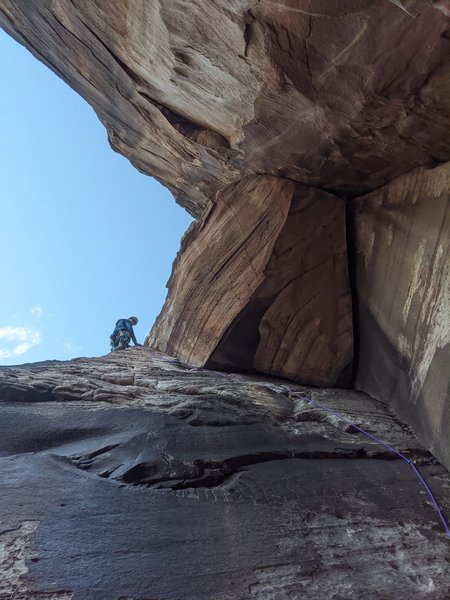
Pitches two and three from the top of pitch one. Pitch two climbs past the first chockstone on the left. Pitch three goes past the second chockstone, and then traverses across the wild exposed face to a smaller roof that is also passed on the left.
[Hide Photo] Pitches two and three from the top of pitch one. Pitch two climbs past the first chockstone on the left. Pitch three goes past the second chockstone, and then traverses across the wild exposed face…
Buffon's Needle Problem, p.4 -- threading the needle
[Hide Photo] Buffon's Needle Problem, p.4 -- threading the needle
Buffon's Needle Problem, p.4 -- through the needle
[Hide Photo] Buffon's Needle Problem, p.4 -- through the needle
More detail of the business pitches of Buffon's Needle Problem. P4 is not visible.
[Hide Photo] More detail of the business pitches of Buffon's Needle Problem. P4 is not visible.
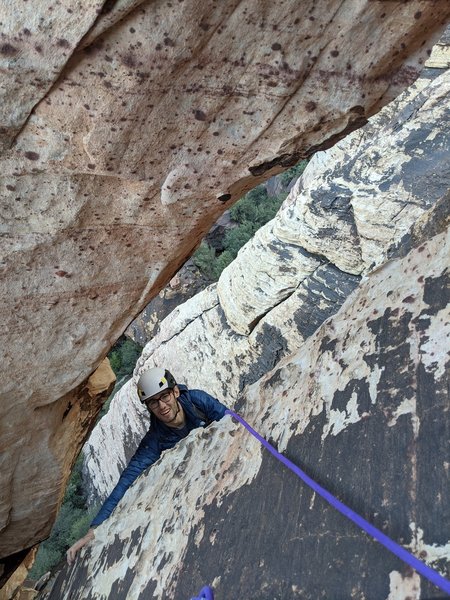
Tanner looking up through the eye of the needle while I've got him on belay.
[Hide Photo] Tanner looking up through the eye of the needle while I've got him on belay.
Leading the first business pitch. We scrambled up the gulley and traversed across a 5.easy ledge to gain the belay area from where this photo was taken
[Hide Photo] Leading the first business pitch. We scrambled up the gulley and traversed across a 5.easy ledge to gain the belay area from where this photo was taken
Overview of Buffon's Needle Problem
[Hide Photo] Overview of Buffon's Needle Problem
Cool exposure and position on second half of P3. Gear belay can be built under 3rd and final chockstone to mitigate rope drag.
[Hide Photo] Cool exposure and position on second half of P3. Gear belay can be built under 3rd and final chockstone to mitigate rope drag.
2nd half P3 traverse. Pic taken from rappel rings.
[Hide Photo] 2nd half P3 traverse. Pic taken from rappel rings.
The eye of the needle
[Hide Photo] The eye of the needle
2nd half P3, after the traverse.
[Hide Photo] 2nd half P3, after the traverse.
The first half of P3
[Hide Photo] The first half of P3

Comments [Hide ALL Comments]

Chris Saulnier
Cambridge, MA
  5.10
[Hide Comment] This route would be a classic if pitches 2-4 were on the ground. From the wash the climb looks improbable, but as soon as you top out the first pitch you realise how much fun you are in for.

Three pitches of fun 5.10 climbing with good jams and good protection where it counts. The traverse between roofs on pitch 3 is wild and exposed, with good small protection (nuts and a .1 C4). Pitch 4 is difficult with a pack but well protected - If you have a pack trail it below you.

This route should see more traffic than it does! Nov 27, 2019
Annie Hines
Aspen, CO and Davis, CA
  5.10
[Hide Comment] Awesome climb! Varied, nice belay ledges, lots of exposure, fun moves, and gear where you want it. Doesn't look that good from the ground, but have some faith, it's worth it. Dec 2, 2019
J B
Cambridge, MA
  5.10a
[Hide Comment] I went into this route wondering whether the star rating was exaggerated because most of the voters are friends with the FA (we are too). I was glad to be proven wrong. This route is very fun. P2, P3 and P4 are full of gymnastic varied climbing. The belays are comfortable, and the gear is excellent through all of the difficult parts.

We didn't use any nuts, but I enjoyed having BD 0 and 00 micro cams for P3. The micros aren't really essential for safety in my opinion (there's good gear about a body length below and a clean fall line), but they take the edge off a tricky part.

We did the walk off the the right. It was kind of long and unpleasant. I would probably just climb to the top and link into the brownstone wall if I did this again. Nov 12, 2020
Jia
Cambridge, MA
 
[Hide Comment] Don't let the first pitch deter you. Consider it a technical approach to reach three excellent and consistent 5.10ish pitches, all with very different characters. P2 was a straight up roof pull, P3 was a delicate airy high exposure dance, P4 was an interesting double crack system that culminates in popping through "the needle" to the other side. Gear was great throughout. Nov 12, 2020
John Hovell
Mammoth Lakes, CA
  5.10-
[Hide Comment] It’s hard to justify giving this route more than 2 stars given the constant rope management/drag/snag potential on nearly every pitch and the fact that there’s maybe only 100 ft of good climbing for a 1000 ft route. It’s cool to see the climb go on all natural pro but I wonder if a few bolts might go a ways toward protecting the fragile sandstone and as a side benefit mitigating rope drag. Would it make sense to have bolted rappel/belay anchor at the top of P4 that could be used to both belay and then rappel the route? There didn’t seem to be any good belay options there - either hanging at the top of the hand crack or in the wide crack but it would require lots of big gear (4’s and 5’s?). There is a photo here and chalk evidence of climbing/belaying way off to the right (contradicting the route description) but it creates massive drag and wear on rock and rope alike. As alluded to in the description it’s possible Make P1 about~30 feet by taking a well-trodden gully just up canyon from what must be the recommended start. Maybe then this could be a better 3 pitch route with a rappel? Even then the rope drag management is significant concern given the roof cracks and arete where the bolted rappel station is. Lastly I didn’t measure the pitches but P2 and P3 seemed much shorter than 30 meters. Movement in P3/4 was pretty fun and protecting the second half of P3 on gear seemed unlikely but worked great. Nov 18, 2020
RandyLee
On the road
[Hide Comment] P2 doesn’t eat ropes if you drop in a BD 0.3 (could probably have taken 0.1-0.4 or a small nut?) in a small crack left of the roof as you pass it.

The 3rd pitch was one of the best I’ve done in a long, long time!

P4, well... I hope you like tight hands. Dec 26, 2020
Caitlin Mac
Tempe
 
[Hide Comment] Starting Description:

If you want to do the first pitch, rope up right off the true toe of the buttress. If you wanna skip it, walk up to the top of pitch one from the left side of the buttress.

Rack(BD size):
3x (#0.75-1 - this is literally what the first two or three belays take, and cracks, you could even have four #.75 if you want), 2x (#2-3, 0.5), and 1x (#00-0.4, #4) + nuts and lots of long slings (if you plan on simuling, I’d bring 12+ long slings, and as many double length slings as possible.

If I did this again, I’d do the first pitch (the directions lead me to accidentally skip it), and link p2 with the first half of p3, belaying at the bolted anchors. Then you can ether belay in the normal spot at the top of p3, or after you thread the needle at the top of p4. ( lengths of pitches were way overestimated, and easy to join if you are good at extending/placing pieces to control drag) Feb 23, 2021
Risto Thomas
Salt Lake City, UT
 
[Hide Comment] I absolutely loved the first 4 pitches. Make sure you have at least 1 bd 0, .1 and .2. The roofs protect super well. I didnt expect the second roof to be as slabby. Pitch 3 traverse was more mentally exhausting than physically for me. Pitch 4s overhanging tight hand crack felt like a splitter out of indian creek. It was burly and a little awkward. Definitely wish i brought the ol mocs over TC pros so I could jam in the #1 crack easier. Mar 10, 2022
Mike Weber
Las Vegas, NV
 
[Hide Comment] Amazing Route, I found that avoiding rope drag through the first roof pull to be a challenge. Pulling the second roof of pitch 3 isnt a rope drag issue, especially if you stop at the bolts to belay since it is way out left. I linked pitches 3 and 4 with plenty of rope to spare and it was amazing. I belayed from the bottom of the eye of the needle(save a #1 and a #2 if you do the same)which wasn't the most comfortable but it allowed us to move a few feet out right to the nice ledge once the follower arrived to the anchor. We stayed left for the last couple pitches and found #4 and #5 cams essential for the anchor spots but the #5 could be avoided if you are willing to simul to the end with a few runouts on easy terrain. Found the 00/.1 cams to be helpful multiple times. Mar 21, 2022
tooTALLtim
Vanlife
 
[Hide Comment] Our ideal rack: no nuts, the smallest micro cams possible, singles to #4, doubles of 0.75 and 1.

Definitely wouldn't break up the second, easy chockstone pitch and needle pitch, would be quite awkward to belay at the base of the needle. Belaying from the bolts was chill with the first piece being the anchor bolt. I think that combining both pitches from the top of P2 would not incur too much rope drag. Apr 18, 2023
Ryan Smith
Cincinnati
 
[Hide Comment] Does anyone think it would be possible/desirable to add rap stations starting from somewhere after the needle? The slabs above that really don't add anything other than access to Brownstone Wall imo, and pitches 2-4 are super fun on their own. I'm not local, I just thought this route was pretty cool up to there.

(edit: new bolts are not allowed here, as pointed out in another comment)

Also, I was expecting rope management to be tricky based on comments here, but it seemed pretty straightforward. Don't let that possibility keep you off of this thing, just be thoughtful about it. Jan 13, 2025
[Hide Comment] I prefer that there be no rappel bolts. There are already plenty of other gentrified climbs out there. Jan 13, 2025
Ryan Smith
Cincinnati
 
[Hide Comment] Totally hear you on that, Dave. The adventure was fun on its own terms. Thanks for putting this route up! Jan 16, 2025
Eugene Kwan
Cambridge, MA
  5.10
[Hide Comment] The needle problem is interesting but the rest is not. There's a lot of stuck rope potential. Meh.

Also, the "approach pitch" is superfluous. We started in the alcove at 36.11437, -115.48890 and climbed through to the bolt anchor. The moves off the belay are totally fine. You can do the rest of the needle in a single pitch from there. This climb would definitely be improved by rap anchors there. I doubt even the landed gentry want to besmirch themselves with the filthy pitches above. Apr 27, 2025