
 Continue with onX Maps
 Sign in with Facebook






Top rope anchor setup with mussy hooks.



|
I have been climbing for about 3 years now. TR, lead moderate sport and trad. Recently a few folks I climb with will set up top ropes in a way I’ve not seen in any books or other sources. They are clipping slings or girth hitching directly to the mussy hooks, instead of rings or quick links. Similar to the example below, I’ve also seen the standard two quick draws on the mussy, generally one sling with lockers. Is this becoming a common practice? Is there a source out there that recommends building a TR anchor on the hooks vs the links?
Interested in people’s thought, yay or nay? 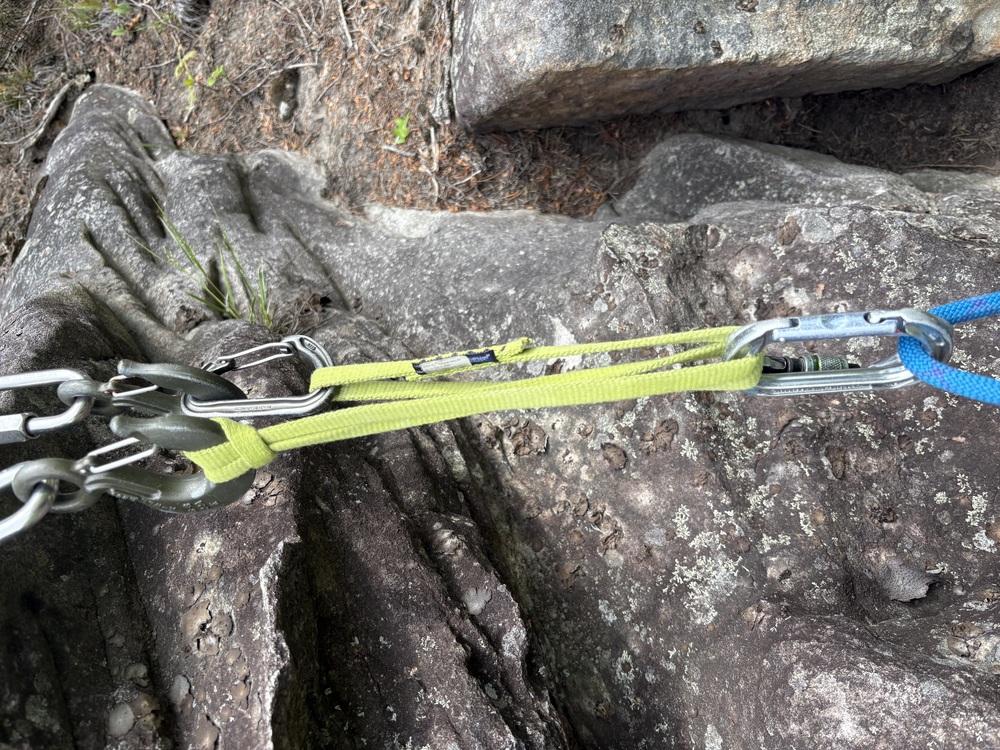 |
|
|
Overall this anchor is fine and is likely more than you need for top roping. There are potential problems with any anchor. For this one #1) looks like you have a sliding X. That's fine but it's not redundant if any part of the webbing rubs through. There was an example of this happening at Devil's Lake sometimes in the last couple of years #2) cleaning seems like it would be a bit annoying in that you'd run the rope over the girth hitched sling. Easy enough to clean if you anchor yourself into the fixed gear, but it makes that process a little more complicated. Compare that to an anchor where your materials are on the chains or bolts. The last climber comes up, clips the ropes into the musseys while still on belay, calls take, then cleans the anchor while sitting on the rope through the musseys. This anchor requires the extra step of using personal tethers All of that is to say. I find this anchor "fine". I'd climb on it, but I wouldn't personally build it this way if I had other options |

|
To me, the reliance on a single sling is problematic. It violates the redundancy guideline for no reason. If it is a top rope, you have all the time in the world to set up a bomber redundant anchor. Second, clipping the carabiner to the mussy hook violates avoid clipping biner-to-biner guideline, because the gates can interact and potentially un-clip. Third, it is a best practice to arrange the webbing so that if one or the other anchor points failed, the remaining anchor could hold the load. Here, if either the girth hitch or the lone biner on the mussy hook escapes the hook, you are done. If I had to climb on this, I would climb very statically and gently, and one lap only. |
|
|
I agree with BG's assessment. The anchor is fine but will create some frustration when cleaning. A simple improvement would be to use carabiners on the links above the hooks and to tie an overhand in the sling to isolate the strands and make it redundant. I don't suggest building anchors on the hooks because of the additional steps needed to free them up for lowering when you want to clean your climb. I only like using hooks for cleaning/ lowering routes. When I take people out climbing I like to use closed systems and avoid "minimalist" set ups. I don't mean excessive anchors but ones with enough gear to make them bomber for a day of top roping but not going over the top with redundancy. If you friends still want to use "minimalist" anchors they could use something like a SWAMP anchor or a "Sliding X with limiter knots". Everything is also situation dependent; I use different systems for different circumstances on a regular basis. I will try to edit my post later today with some photos of the anchors I mentioned if I have a chance to. Edit 1: Here is a link to the AMGA video on top rope anchors. Edit 2: Photos of better anchors SWAMP Anchor (The girl hitch can be easily swapped for a carabiner, I was working with what I had on hand)   Sliding X with limiter knots  Standard over hand and figure 8 TR anchors  |
|
|
Just clip the mussies and put a locker above them and clip the middle strand between the mussies on it. No reason to make things more complicated than that. This is a little silly. |
|
|
Ricky Harlinewrote: That is not a great choice, as discussed in depth after an accident with this type of anchor a couple years ago: https://americanalpineclub.org/news/2023/12/12/the-prescriptiondecember-2023 |
|
|
Kate Sedrowskiwrote: From the article:
This could have happened with any anchor type. There is a similar accident from Tahoe where we have more details and in that case the climber went above the anchor which allowed it to come unclipped when she fell. Do not undo the mussies and do not climb above them when the locker is not present. Every anchor has its pros and cons; having the added requirement that you ought to not go above the mussies without the locker present is a non issue, but it does need to be communicated to anyone who will be cleaning the anchor, that much is true. |
|
|
Hard hard “no” in my book! There are better anchor choices to pick from than what is shown in the photo. If I saw this anchor in the wild, I’d personally shake my head. As a bare minimum rule of thumb, I teach that you don’t clip your personal anchor setup into the bottom most thing on the anchor, whatever that last thing might be (mussy, fixed/community carabiner, rap rings, chain link). The reason being is that the person who cleans the group’s personal anchor setup needs to use that last thing on the anchor to lower off the route and you’re creating an unnecessary obstacle for them to do their job. There are plenty of alternative “closed” clip-in points to use on the anchor itself that are better choices... the hanger, the top quicklink, any of the numerous chain links and the bottom quicklink. With all these “closed” options, there is zero reason to build a personal anchor setup where the “open” mussy hooks (or any lowering carabiner) are used as clip-in points. To me this anchor choice shows lack of knowledge and mentorship. I am very happy to spend as much time as needed with any climber on Zoom talking about anchors and giving you better options than this anchor for your climbing toolbox. Please reach out via private message. |
|
|
Ricky Harlinewrote: Sure, absolutely true, but also from the article: "Delap noted that the addition of a locking carabiner to a mussy hook belay was inappropriate for the system. In this case, the locker probably brought the rope above the plane of the hooks, a mistake when considering the “open” nature of mussy hooks. “The best thing you can do is always stay below the mussy hooks, both with your anchor setup and your body,” Delap writes. “So be a pro, keep it low.” Just saying that a blanket statement that putting a locker above the mussies is the best way to build an anchor on mussies is not a great suggestion, especially in the Beginner Climbing forum. |
|
|
What you have pictured is not becoming common practice, and if a climbing partner of mine did that I would ask them wtf they were thinking. My preferred method is two QDs on the quicklinks above the mussys, clipped on the outer side of the mussys. This leaves the mussys free for cleaning and prevents any pinching when weighted. No slings, knots, or "anchor building" necessary. Make one a locking draw if it makes you feel better. If you plan to TR a lot and don't want to wear out gear, get some steel caribiners for the rope side of the draws. |
|
|
Kate Sedrowskiwrote: Valid point, thank you for the constructive discussion. |
|
|
Climbing is full of tools and techniques that experienced climbers accumulate over many years. But when you’re just starting out, it’s important to recognize that you don’t know what you don’t know — and that gap can be a serious safety risk. For newer climbers, my advice is this: focus on mastering the foundational principles of climbing, specifically around safety and anchor building. Buy the climbing books, watch all the videos, find a mentor, hire a guide, join a club. In my view, the gym environment creates a false sense of security. Outside, it’s the real deal, where some mistakes are made only one time. Lean on the foundational principles as a guide when you have to make decisions so everyone in your group makes it back safely at night. |
|
|
This definitely falls into "safe enough, but whoever did this doesn't quite understand anchor building" |
|
|
Never clip into the mussies for top roping unless a last resort. ie if you don't know how to/can't build something safer then just TR directly off of the mussies. At ASCA we prefer people to use the mussies to TR rather than building a complicated abortion like this with rando carabiners added and slings on the mussies. Something random like this can cause confusion and an accident when it comes time to clean the anchor. Also, ie There is at least one additional failure point introduced for no good reason. The only good thing about this anchor is that there is mostly two of everything (except the sling). Better to clip directly into the hangers or quick links with 2 slings (or other redundant rig) that extend the anchor point below the mussies. Then, when its time to clean you can just lift up the rope into the mussies, take in the slack, then with the anchor you built unweighted you can safely clean it without ever going off belay. While I can appreciate girth hitching the mussies as creative if short on biners (and perhaps safer than clipping into them) it shows this anchor builder doesn't quite get it yet. |
|
|
Anna Brownwrote: I 100% agree and would never build an anchor like this. I’m not exactly sure why the person did it this way. We had more than enough gear so it was a choice. |
|
|
Big Redwrote: What confused me was why someone with a decade of experience would do this. It can’t be much quicker and making it redundant doesn’t add much gear |
|
|
Sebastian Lindquistwrote: Sometimes folks have been climbing for a long time and doing things "the way they've always done it", which also happens to be not the best way. Or maybe they didn't have the usual gear they use on their harness when they got to the anchor, so they improvised. Or sometimes people who know what they're doing will do something a little funky, knowing that it's not ideal but safe enough. If you ask them and they insist that this is the best way to make a TR anchor, I would question their competency. |
|
|
Big Red is absolutely right. Experienced climbers can develop habits or have techniques that don’t align with the basic fundamentals. Choose your mentors carefully and take personal responsibility for mastering the foundational skills of climbing. The goal is to fill up your "toolbox" so you can make informed safe decisions regardless of the gear you have on your harness or the fixed anchor configuration you have in front of you. The challenging thing with climbing is there are 10 different ways to accomplish the same goal and everyone has different knowledge and experience. Basically, we all have a different "toolbox". The person who built this anchor doesn't need to defend it. We all get to make our own choices when climbing and this was their choice. For me, this is not a "you're going to die" anchor. Instead it's a "you could have made better choices" anchor that isn't build using the fundamentals of anchors as guiding principles. |
|
|
Sebastian Lindquistwrote: Nay, nay, nay! For reasons explained... So easy to set up a bomber TR in a situation like this. Why choose this? |
|
|
looks fine but IMO girthing the quick link and then just clipping the sling through the right mussy would be better. girthing the mussy seems like it could work loose given their weird shape. |
|
|
It's not a death anchor, but it's a stupid anchor. There are so many single points of total failure. Each is unlikely, but all it takes is one. We've all built sketchy trad anchors when we had little to work with. Why not make a totally bomber anchor when the resources are there, especially when it's TR and everyone should just be safe and have fun? |


