
 Continue with onX Maps
 Sign in with Facebook






tying webbing looser around a tree


|
|
There was a recent accident at Tahquitz where two people died when they rapped off of a tree and the old tat broke. It might be helpful to realize that when you tie webbing around a tree, you get exactly the same physics advantage by extending the webbing as you do with a gear anchor when you make the angle between the strands small. (That is, the angle has exactly the same effect on how much strain there is on the webbing. However, the strain on the wood is the same regardless of angle.) 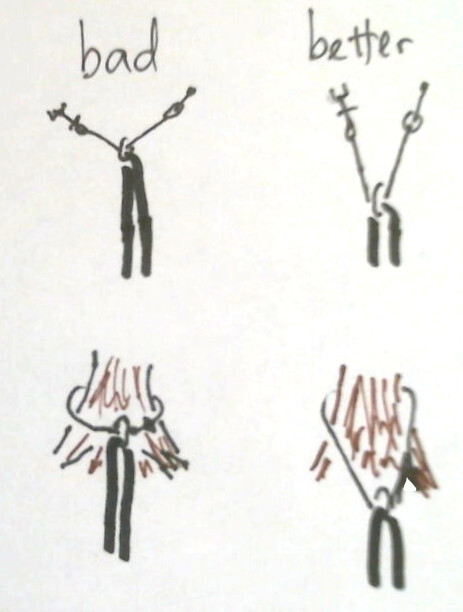 Of course this is secondary -- the main things are to not depend on old tat, make sure the tree is big, alive, and well-rooted, and tie at the bottom of the trunk rather than farther up, where you have a longer lever arm. But, all other things being equal, the longer loop of webbing that forms a smaller angle at the bottom is better, because it produces less tension in the webbing. I would imagine this is counterintuitive for a lot of people -- a nice snug tie might seem better intuitively. A looser sling is also less likely to kill the tree by constricting it. And sometimes you find webbing that's so tight that it's even hard to squeeze a biner in there. In the case of the Tahquitz accident, RMRU did some load testing of the webbing to determine its breaking strength. But keep in mind that that doesn't even equate to how much weight you can hang off of it. If you hang 200 pounds from the webbing, in a configuration where the angle at the biner is wide, you could easily have 1000 pounds of tension in the webbing. |

|
I agree with the benefit - Ben. If you’re leaving tat that might get used after months of being out in the weather, minimizing the angle is a great idea. It’ll be good enough for a longer period of time. And I suspect most people setting such anchors are limited on available slings. Still, I think your point might be to not try to conserve sling usage - just make the trip into town the next day to buy more slings if needed. And, Sigh. Even the sling with a minimized angle will eventually fail. My bottom line is people really just need know their limits about discerning whether in situ slings are good enough (never for some). When angle actually matters, I think most of us can’t really tell. When we can not tell, we should be conservative, accustomed and prepared to backing up the in situ slings with a fresh one or two from our kit. |
|
|
I agree with your post, Bill. Bill Lawrywrote: I see people on here talking about cutting up slings -- presumably expensive dyneema slings? -- to tie around a tree. Well, if that's all you have, I guess that's what you've got to do. But personally although the bulk of the slings I carry are shoulder-length dyneema ones, I always do carry some other cordage, because it just makes you more flexible. In addition to a long cordelette for anchors, I generally carry one double-length sling made out of a piece of nylon cord tied with an offset overhand, because it's just a useful thing to have handy for multiple uses, either to leave behind or to use and clean. For instance, if I need a big long extension arm for one piece in a gear anchor, I can untie the sling and use it at its full length. I also have a small bundle of webbing permanently in the bottom of my pack. It's just something I always have, along with a small first-aid kit. Probably weighs three ounces.
Right, it wouldn't make sense to tell people to evaluate the reliability of old tat based on the angle. In every case where I've come across other people's tat, it's always been tied tight. However, if people need to be influenced a little to be more conservative in these situations, it's probably helpful for them to realize that the tension in a tightly tied loop is potentially massively amplified. If they just imagine that the tension is equal to half their body weight or something, they may have a hard time imagining that it could possibly break. Heck, if it was just going to be half my body weight, I could test it sufficiently just by grabbing it it both fists and pulling hard -- a shoelace or a piece of dental floss would hold half my body weight. I would also just say that if you're going to leave behind some webbing tied around a tree, it's a good habit to always make it a longer loop. It's a public service that at least incrementally reduces the chance of death for other people who may use what you left behind without backing it up. |

|
I’d rather cut an expensive sling than carry extra stuff, gear isn’t too much. If I had to bail all the time that may change it. |
|
|
Greg Daviswrote: Not to be argumentative -- everybody has their own style and preferences -- but I don't really consider the double-length tied nylon sling to be extra. It's just one of my slings, and I use it like any other double-length sling. There may also be a lot of people who don't bring a knife when they climb. |
|
|
Stupid question -- what is a "tat"? thanks |
|
|
Ben Crowellwrote: Ah, makes sense. |
|
|
Eric Metzgarwrote: Slings/cord/or other soft goods (fabric/nylon/etc) that have been left behind on the cliff/mountain. Usually as part of an anchor, often as part of a rappel anchor. |
|
|
The single webbing sling can be seen on this Youtube video starting at the 02:50 mark.This was posted over two years ago and at that time the original green color wasn't readily visible then either from what can be seen in the clip. Looking at the location, it would also seem to be an awkward stance at the tree for a party of two wanting to rappel, but this might hint at why both descenders may have been hanging off the fixed sling together? It is sobering to read about this accident. My condolences to all those affected. |
|
|
Leap Frogwrote: It also looks like, on a normal day, one would have to “go out of your way” to clean it. |
|
|
Bill Lawrywrote: The tat was off route, there’s a ledge on which to belay for Upper Royals Arch, the tree is back and up around the corner from the ledge and start of URA. |
|
|
 Eric Metzgar wrote: Not a stupid question. Something brand new would not be referred to as tat. More typically used to refer to something which shows sign of exposure to the elements (which happens pretty quickly). Edited to say: tatty/tat seems to be same lingo era as manky/mank, both probably UK origin. |
|
|
hmm word origin may be tatterdemalion |
|
|
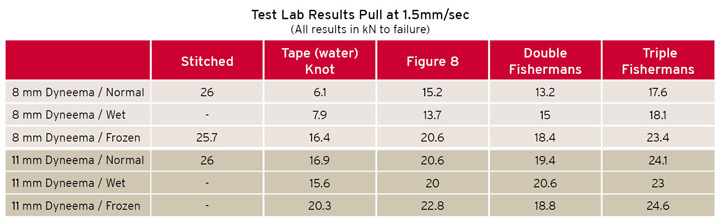
Greg Daviswrote: Are you suggesting cutting and tying a dyneema sling around a tree? Do you trust any knot tied in bare dyneema? |
|
|
|
|
|
 |
|
|
Greg Daviswrote: Thanks for sharing this - super useful to know!
|
|
|
Thanks for the answers. I interpreted the "figure 8" in the chart as a rewoven figure 8 bend, also known as a Flemish bend. Generally an offset bend is not a great choice tied in webbing if you are leaving it behind, even a flat overhand. Use in-line attachments as they don't capsize like you said. It looks like they used dyneema webbing, not cord, in that table, "stitched" being the giveaway. I don't think round dyneema cord (sans Nylon sheath, like the "tech cords") is readily available for climbing applications. |
|
|
Here's the link to the DMM knotted dyneema sling tests. |
|
|
Ben Crowell wrote: Except they (DMM) say: "The accompanying video illustrates quite well how in certain knots the ends of the webbing simply pull through, rather than the sling dramatically breaking at the knot. " And: "Overall, we should stress that we strongly recommend that you do not construct your own Dyneema® slings by tying lengths of loose Dyneema® tape together. " |
|
|
Skibowrote: Thanks for the correction. I deleted my post, which was wrong. |


