|
|
GabeO
·
Oct 30, 2018
·
Boston, MA
· Joined May 2006
· Points: 302
By the way, look again at my definition. Just because it's bolted from the ground up doesn't mean it has to be trad. What makes it trad in that case is that it's bolted specifically for the needs of that first ascent, with bolts only where necessary. A sport climb is crafted for the community, with future ascents in mind. That may include getting up it however you can, and then adding bolts if needed.
But there are also plenty of sport routes that got bolted bottom up with the assumption that that would be perfectly good for the community - especially before people realized that that method usually resulted in crappy bolt positions.
GO
|
|
|
Marc801 C
·
Oct 30, 2018
·
Sandy, Utah
· Joined Feb 2014
· Points: 65
Mike D wrote: When did this definition get added to the lexicon of climbing terms? Mid-late 80's - not long after sport climbing started in the US.
When I started climbing, sport climbing meant bolts and trad climbing meant removable gear or pitons (if the climb was old enough to have fixed gear).
We did not consider bolts placed on lead to be trad. Those climbs were just bolted in the accepted style. Rap bolting was frowned upon or illegal at the places I climbed 20 years ago. You were misinformed.
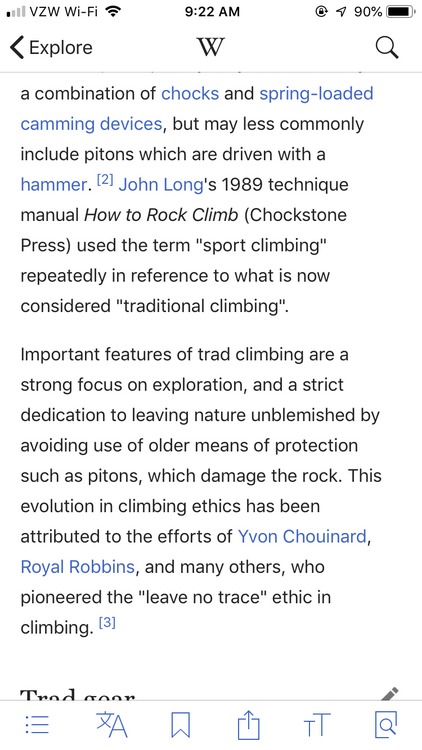
A sport climb bolted ground up with a hand drill is still a sport climb. But not all bolted climbs are sport climbs. In the Wikipedia page on trad climbing is the term "bolted trad" if that helps you understand.
|
|
|
Marc801 C
·
Oct 30, 2018
·
Sandy, Utah
· Joined Feb 2014
· Points: 65
Mike D wrote: I said rap bolting was frowned upon, I did not say illegal. Mike D wrote: Rap bolting was frowned upon or illegal at the places I climbed 20 years ago.
|
|
|
Mike D
·
Oct 30, 2018
·
Boulder, CO
· Joined Oct 2015
· Points: 845
The Wikipedia article on trad climbing makes it pretty clear that the definition of sport and trad climbing has changed since 1989.
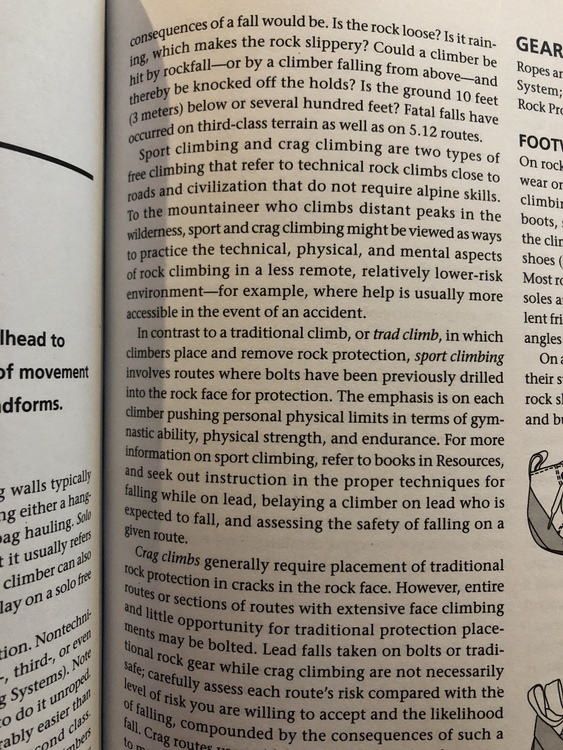
I learned to climb from fairly old school climbers who may have been using older terminology. My climbing text book was the 1992 edition of FOTH. That the new edition defines trad as using removable pro suggests that a lot of people still use that definition.
Freedom Of The Hills (2017 editition) says trad uses removable pro.
|
|
|
Mike D
·
Oct 30, 2018
·
Boulder, CO
· Joined Oct 2015
· Points: 845
Marc801 C wrote: Mid-late 80's - not long after sport climbing started in the US.
You were misinformed.
But not all bolted climbs are sport climbs. In the Wikipedia page on trad climbing is the term "bolted trad" if that helps you understand.
Edited: I was wrong, it’s not that the definition of trad has changed, it’s that trad is a new term. It used to just be called climbing, either crack or face. When I started climbing in 1994, at least in California, all bolted climbs were called face climbs. Sport climbing was a sub genre with closely spaced bolts. Crack climbing was placing removable gear on lead. I just read through the ethics chapter in the Pinnacles guidebook (2007 edition). It really sums up my approach to styles of climbing and bolting issues. Given that many of my friends were involved in the production of the book, I’m not at all surprised. Don’t think for a second that I’m anti sport or anti trad. In the past week, I’ve done climbs that involved bolted face, trad pro, sport, mixed routes, and bouldering. I like to climb everything.
|
|
|
DavisMeschke Guillotine
·
Oct 30, 2018
·
Pinedale, WY
· Joined Oct 2013
· Points: 225
I would have to agree with some of the older generation who classifies TRADITIONAL (trad) climbing as climbing without any kind of fixed protection, on lead, ground up. Once upon a time, pins were considered clean, as they could be removed. Yes, some of those pins could not be removed, but the general idea was they could be taken out of the rock and reused higher on the rock. Later, true clean climbing came in the form of hexes, nuts, and even later, cams. In my mind, traditional climbing is clean climbing, leaving no trace, so that subsequent ascents are able to enjoy the route in a state that most closely mirrors what the first ascentionist experienced. At least that's why I enjoy climbing.
The idea that routes should be retrobolted in order to make them accessible is lowering the rock to meet your standards, when you should be upping your standards to meet the difficulties the rock offers. I think this is the idea that creates tension between generations that hold different ideas of what climbing means to them. The watering-down of difficulty is why many in an older generation of climbers are outspoken, and rightly so. The dichotomy of this debate is that differing opinions are brought forward, but no ground is covered and no consensus is reached. In my mind, the prevailing thought would be to respect the FA and the style in which the climb was originally done.
And there's always that old adage about opinions and orifices...
|
|
|
Frank Stein
·
Oct 30, 2018
·
Picayune, MS
· Joined Feb 2012
· Points: 205
Mike D wrote: Historically, all bolted climbs were considered sport climbs. The new definition came from sport climbers who probably wanted a ready excuse as to why they couldn’t do a route with longer runouts. Wait, what? The term "sport climbing" originated in the 80s in the U.S.. Sport climbing itself originated in Germany specifically & Europe in the 70s, but there it was known as "climbing." Bolted routes certainly existed looooong before then.
|
|
|
Marc801 C
·
Oct 30, 2018
·
Sandy, Utah
· Joined Feb 2014
· Points: 65
Mike D wrote: Before I started climbing in 1994, all bolted climbs were considered sport climbs, at least after that term came into vogue. No, they weren't. It's as simple as that. You keep insisting otherwise - I'm not sure why.
|
|
|
Andrew Krajnik
·
Oct 30, 2018
·
Plainfield, IL
· Joined Jul 2016
· Points: 1,739
DavisMeschke Guillotine wrote: I would have to agree with some of the older generation who classifies TRADITIONAL (trad) climbing as climbing without any kind of fixed protection, on lead, ground up. Once upon a time, pins were considered clean, as they could be removed. Yes, some of those pins could not be removed, but the general idea was they could be taken out of the rock and reused higher on the rock. Later, true clean climbing came in the form of hexes, nuts, and even later, cams. In my mind, traditional climbing is clean climbing, leaving no trace, so that subsequent ascents are able to enjoy the route in a state that most closely mirrors what the first ascentionist experienced. At least that's why I enjoy climbing.
The idea that routes should be retrobolted in order to make them accessible is lowering the rock to meet your standards, when you should be upping your standards to meet the difficulties the rock offers. I think this is the idea that creates tension between generations that hold different ideas of what climbing means to them. The watering-down of difficulty is why many in an older generation of climbers are outspoken, and rightly so. The dichotomy of this debate is that differing opinions are brought forward, but no ground is covered and no consensus is reached. In my mind, the prevailing thought would be to respect the FA and the style in which the climb was originally done.
And there's always that old adage about opinions and orifices... Might that be the one suggesting into which orifice one's opinion could be placed? Or the one pontificating on the ubiquity and aroma of said opinions and orifices?
|
|
|
rgold
·
Oct 30, 2018
·
Poughkeepsie, NY
· Joined Feb 2008
· Points: 526
Mike D wrote: When did this definition get added to the lexicon of climbing terms? When I started climbing, sport climbing meant bolts and trad climbing meant removable gear or pitons (if the climb was old enough to have fixed gear).
We did not consider bolts placed on lead to be trad. The lexicon hasn't changed, you just didn't understand trad climbing. Heading up a crackless slab with a drill in your pocket and a hammer without any clear idea of when, where, or whether you can stop to drill protection is about as trad as it gets, and was part of trad climbing many years before sport climbing was even a twinkle in the eye of power drill equipped rap bolters. (If you count the placement of rings in places like the Elbsansteingebirge, which no one has ever accused of being a sport climbing venue, the use of bolts as part of very demanding trad ethics goes back a hundred years.) The whole "respect the first ascent" concept began with this type of bolted route. The issue arose when the FAists skipped stances they could have drilled from on the lead (for whatever reason). How that principle should apply in general has been and will continue to be up for discussion.
Meanwhile, a lack of a clear idea of the defining characteristics of trad climbing makes many of the arguments an exercise in non-sequitors.
The reality of contemporary climbing is, as Robbins prophetically observed, that "sport climbing is the child that wants to eat its mother." The question is whether the climbing community is going to support two genuine genres, or whether the attitudes associated with sport climbing will eventually permeate trad climbing and so erase almost all of the distinction between the two. Those who have argued against bolting trad climbs are not arguing against sport climbing at all---there are few if any contemporary trad climbers who don't enjoy sport climbing as well. The argument is about preserving two vibrant genres that people can choose between, rather than a homogenized landscape with only one type of climbing available for those who can't journey to very remote locales.
|
|
|
Mike D
·
Oct 30, 2018
·
Boulder, CO
· Joined Oct 2015
· Points: 845
Marc801 C wrote: No, they weren't. It's as simple as that. You keep insisting otherwise - I'm not sure why. I edited my post. We called them face climbs. Sport climbs were closely bolted. It was John Long who referred to them as sport climbs in his book.
|
|
|
Mark E Dixon
·
Oct 30, 2018
·
Possunt, nec posse videntur
· Joined Nov 2007
· Points: 984
rgold wrote: The argument is about preserving two vibrant genres that people can choose between, rather than a homogenized landscape with only one type of climbing available for those who can't journey to very remote locales. Very well said. I sport climb 99% of the time now, but feel strongly that trad venues should be preserved and that eventually their loss would be deeply regretted.
|
|
|
Marc801 C
·
Oct 30, 2018
·
Sandy, Utah
· Joined Feb 2014
· Points: 65
Mark E Dixon wrote: Very well said. I sport climb 99% of the time now, but feel strongly that trad venues should be preserved and that eventually their loss would be deeply regretted. +1, as this reflects my current status as well. I'm not even bothered by needing to bring some trad gear to the sport routes in City of Rocks. [For those not aware, the prevailing ethic at CofR is to not place a bolt if there's a trad placement at that spot. It gives rise to some curious racks, like 12 QDs, a finger sized stopper, and a #4 cam.]
|
|
|
ed esmond
·
Oct 30, 2018
·
The Paris of VT...
· Joined Jan 2010
· Points: 0
Sks Ggs wrote: “SO, I've been wrestling over the ethics and logic of my area with bolting and the idea "it was done on gear, so never bolt it" …”
First of all, there are no “ethics” and no “logic” involved in situation you’ve described…
You’re living in wacky-CT world. It’s not the same reality as the rest of the rational universe. We can debate for pages and pages about “what is trad?”
These FA’s weren’t done in a “trad” style. They were done in a “nut-case wackjob style…”
I’ve been climbing for decades, and rule has always been, “respect the style of the FA.”
It’s a great rule:
But, what if the FA doesn’t deserve any “respect?” What if the FA’er never showed any “respect” for anyone else’s FA’s?
Why must we all be prisoner to a set of rules that protect some jack@ss, who never followed the same rules?
I’m not suggesting it’s ok to add bolts to “man-up, big-ball, scare-fests.” They have their place. And, as others have suggested; if you want to bolt something, find a new climb.
But, CT is a totally different situation, It’s not Yosemite, it’s not North Carolina. It’s crazy CT, with crazy rules set down by one crazy guy….
ed “is it ‘trad’ to chop bolts on rappel” e
|
|
|
Healyje
·
Oct 30, 2018
·
PDX
· Joined Jan 2006
· Points: 422
GabeO wrote: Sorry, that's just not accurate... And your substitute explanation is also not really accurate.
The original distinction, and acrimony, between trad and sport was strictly about ethics and tactics with bolts more a matter of additional gas on the fire. The tactic of hanging or 'dogging' on routes was the primary source of the friction and discord between the two camps as the trad camp didn't recognize dogged ascents as legitimate FAs done by 'fair means'. Rapbolting was yet a further, but again entirely secondary, friction point in the "discussion" given it was a ground-up world at the time.
And all the distraction here about the use of any and all fixed pro prior to the advent of sport climbing is pretty much just that, a distraction, as most of that pro was placed on lead and wholly bolted routes were very much the exception to the norm. Overall those routes really have nothing to do with the discussion and their relevancy basically starts and ends with saying almost all the routes put up in the U.S. before the crew at Smith started rapbolting in earnest were and are trad routes.
|
|
|
Topher Dabrowski
·
Oct 30, 2018
·
Portland, OR
· Joined Jul 2014
· Points: 2,685
ed esmond wrote: Sks Ggs wrote: “SO, I've been wrestling over the ethics and logic of my area with bolting and the idea "it was done on gear, so never bolt it" …”
First of all, there are no “ethics” and no “logic” involved in situation you’ve described…
You’re living in wacky-CT world. It’s not the same reality as the rest of the rational universe. We can debate for pages and pages about “what is trad?”
These FA’s weren’t done in a “trad” style. They were done in a “nut-case wackjob style…”
I’ve been climbing for decades, and rule has always been, “respect the style of the FA.”
It’s a great rule:
But, what if the FA doesn’t deserve any “respect?” What if the FA’er never showed any “respect” for anyone else’s FA’s?
Why must we all be prisoner to a set of rules that protect some jack@ss, who never followed the same rules?
I’m not suggesting it’s ok to add bolts to “man-up, big-ball, scare-fests.” They have their place. And, as others have suggested; if you want to bolt something, find a new climb.
But, CT is a totally different situation, It’s not Yosemite, it’s not North Carolina. It’s crazy CT, with crazy rules set down by one crazy guy….
ed “is it ‘trad’ to chop bolts on rappel” e If you base your decision to respect or not respect a FA based upon his/her behavior then that would perpetuate the same evaluation of you as a FA ad nauseam.
Don't act like the individual you despise.
|
|
|
GabeO
·
Oct 31, 2018
·
Boston, MA
· Joined May 2006
· Points: 302
Ska Ggs wrote: Everything mentioned makes sense ... I like some traditions as much as that rusty piton you cant trust. You clip it and play by the rules, but know it the back of your head there is probably a better way to do this, then just keep climbing and just dont fall ...
I guess I just have issue with the FA really getting to dictate the nature of all future climbs? is there no grey area?
My area only has small amounts of rock to climb, there is literally nothing left to FA ... but it seems a person who climbed a route 60+ years ago (not uncommon in northeast) shouldn't be able to say how everyone else in the future gets to climb a rock... but also maybe he/she should.
It may play into the ego and reason why one(or more*) particular First Ascender in our area got banned for chopping bolts everywhere he wasn't allowed, cause he didn't like other people climbing in a different style ... why some people chop bolts no matter what, even if the 'community' agrees they like them, the FA'rs get to rain down their righteous justice on everything ... which is why I take issue with the idea.
Northeast is just a weird place to climb when most other areas look at climbing a little differently. One thing I definitely learned is ... I'm just not hardcore enough Boy I wish DMT was around. Dingus had a lot of good stuff to say over the years, but IMO one of the best things he wrote about was what the hell is going on with an FA. Who "owns" the rock? Why does it have to stay however the FA put it?
I can't possibly do justice to what he would say (maybe some of you can track down some of his better posts on the subject) but the short version is that the questions above have it exactly backwards. The reality is that everyone does whatever the hell they want - bolt, chop, rebolt, snake routes from each other. Nobody owns the rock, and nothing (aside from bolting regulations in some areas) is keeping you from doing what you want. However with that said...
There is a lot to be said for leaving a route as it is. Think of it as a combination of respect for the vision and work that went into a route, and also a practical consideration to keep the bolt wars from sprouting up and destroying all the rock everywhere.
Cheers,
GO
|
|
|
Mike Slavens
·
Nov 1, 2018
·
Houston, TX
· Joined Jan 2009
· Points: 35
Healyje wrote: Why not just say you’re for retrobolting routes you’re otherwise not prepared to lead. Cause that is not what I was trying to say. I am a scaredy-cat and no one has ever made the mistake of calling me bold. But I'm not talking about climbs I'm not prepared to lead. I'm talking about routes that never, EVER get climbed by anybody. I'm talking about climbs that go years if not decades between ascents, I'm talking about climbs that have lichen growing on the lichen its been so long since it got climbed. And I'm not talking about gym bolting an aid ladder, just a few bolts to knock it down from an "X" rating. I'm talking about climbs that are described as "some of the best climbing in the canyon but don't even bother with a rope as you're essentially free soloing it".
I'll use the example of Kor's bolt on The Bulge in Eldo. I think its safe to say that route is about as far from an over bolted sport route as you can get. However, that bolt was so badly needed that the community berated the great Layton Kor to put it in. If he got it wrong maybe Willie Weekend The Warrior might have got it wrong a few times as well.
If you read my comment I was advocating for leaving even those routes alone as a necessary evil. My point was I can support the concept as a whole while disagreeing with certain aspects of it.
|
|
|
Marc801 C
·
Nov 1, 2018
·
Sandy, Utah
· Joined Feb 2014
· Points: 65
s.price wrote: Could be Mason. But I rapped in to place it. So according to many here on MP that would disqualify the route as trad. I'm with Mason on this one - route repair after the FA. I think the people disqualifying the route as trad are referring to *establishing* and protecting the climb on rap *prior* to or as part of the FA. Recall that there are some climbs in the Gunks that are considered totally trad yet the pro for the FA was placed on rappel. In one case it wasn't even bolts but 4 or so pitons.
|
|
|
Topher Dabrowski
·
Nov 1, 2018
·
Portland, OR
· Joined Jul 2014
· Points: 2,685
s.price wrote: Define this scenario.
Last year I established a 3 pitch line ground up. The line is a mix of bolts and gear including 90 feet of hard offwidth as the second pitch.
Above this is 30 feet of fairly easy terrain leading to a small flake just below the crux 20 feet of hard thin moves to the next decent stance and bolt. That flake took a great small stopper so I did not hang on it to place a bolt during development.
Shortly after the FA that flake blew out on a buddy and he took the long ride and longer hike out with a broken ankle.
A week later I hiked to the top of the route, rapped in and sunk a bolt to replace the missing flake.
Is the route no longer a trad route? Mixed route
|

 Continue with onX Maps
 Sign in with Facebook