
 Continue with onX Maps
 Sign in with Facebook






Alpine Rappel Question
|
|
I'm new to all this, so I'm reading books, watching films, and just plain soaking up as much information as I can. One thing that has been bugging me is this: When you complete an alipine climbing route, are you leaving rap gear on the mountain? Or is there a particular setup that allows you to rappel and retrieve your gear? Just something that I've been wondering. |
|
|
Common alpine routes have some premade rap anchors, mostly webbing and cordelette, from prior parties. New alpine routes, or when you get off route accidentally, require you to build an anchor for each rap. This can be as easy and inexpensive as using nylon webbing or part of your cordelette, or require leaving nuts or *gasp* cams! |
|
|
Additionally, many alpine routes walk off an easier way down the mountain. Some require rappels, some walk-offs, some a combination. |
|
|
Read up on and practice v-threads and snow bollards too. |
|
|
I have rappelled directly off of large rocks in the past. It depends. |
|
|
I'm in the same boat as Jared, with being new to Alpine climbing. I've had a couple things bothering me as well. When setting up a rap with webbing around blocks and what not, is it ever ok to run the rope directly through the webbing? I know you're never suppose to do just nylon on nylon, but when I was climbing in RMNP I saw 1" webbing raped around blocks without any rap rings or beaners left on them. |

|
Ethan L wrote: is it ever ok to run the rope directly through the webbing? short answer is yes, but don't get in the habit of doing this. Ethan L wrote:But how what's the limit in difference in diameter? I mean if I were to use a 9.2 as my lead line, what's the smallest I could go with the tag line, while still being able to use it in an overhand knot for a rap? use a double fisherman knot to tie lines of different diameter together. |
|
|
Tom Howes wrote: use a double fisherman knot to tie lines of different diameter together. Why is this? I've tied ropes of different diameters together before wih a double overhand, and it didn't capsize or begin to fold any more than if the ropes were identical diameter...elucidate me! |

|
Ben Brotelho wrote: Why is this? I've tied ropes of different diameters together before wih a double overhand, and it didn't capsize or begin to fold any more than if the ropes were identical diameter...elucidate me! Me too..I use an EDK all the time. Although in all fairness, I do it with ropes that are 8.5 and 10.0 and not with a rope and a thin pull cord. |
|
|
Thank you Tom |
|
|
JaredCamps wrote:I'm new to all this, so I'm reading books, watching films, and just plain soaking up as much information as I can. One thing that has been bugging me is this: When you complete an alipine climbing route, are you leaving rap gear on the mountain? Or is there a particular setup that allows you to rappel and retrieve your gear? Just something that I've been wondering. If some one reciently did the route and left some good gear use that. |
|
|
Ethan: Following up on Tom Howes' answer regarding running a rope directly through a sling: |
|
|
Some tips for DIY rappel anchors: |
|
|
When it comes to alpine abseil descents you have two types: 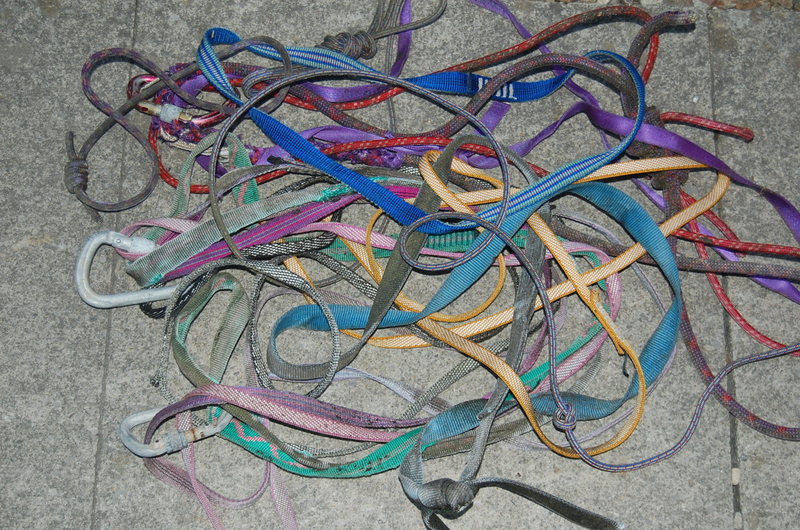 If you don't completely trust an anchor, but improving it is going to require either more time or gear than you really want to commit, then it is time to deploy the 'unweighted back-up'. You build a bombproof back-up anchor and then connect it LOOSELY to the existing centre point or to your abseil ropes. The heaviest person then abseils first, bouncing a bit on the way, whilst the remaining lighter person stares intently at the abseil anchor as if their life depends on it (which it does!). Bearing in mind the only rule - make your own decisions - the last man/woman then decides whether to trust the existing anchor and abseil extremely smoothly and carefully or whether to improve it and leave more gear behind. This is their decision and MUST NOT be criticised. |
|
|
Jared, |
|
|
Thanks for the input, everyone. This definitely sheds some light on the subject. I've always been a pretty strict Leave No Trace follower, so this idea of intentionally leaving gear behind threw me for a loop. Thanks again. |
|
|
Ethan L wrote:I'm in the same boat as Jared, with being new to Alpine climbing. I've had a couple things bothering me as well. When setting up a rap with webbing around blocks and what not, is it ever ok to run the rope directly through the webbing? I know you're never suppose to do just nylon on nylon, but when I was climbing in RMNP I saw 1" webbing raped around blocks without any rap rings or beaners left on them. This is fine for your own safety. But when you pull the rope, you will burn the webbing and leave a potentially serious hazard behind for others. If you do come across a rap anchor made of webbing or slings without any biners or rap rings consider it unsafe. |
|
|
Ethan L wrote: Question 2 is I'm looking into purchasing new ropes to have a lighter set up. One with a thicker lead line, and a smaller diameter tag line. I know that you don't want the differences in diameters to be to great when tying the ends into an overhand. But how what's the limit in difference in diameter? I mean if I were to use a 9.2 as my lead line, what's the smallest I could go with the tag line, while still being able to use it in an overhand knot for a rap? Hard to say for sure what difference in diameter is ok with an overhand (edk). Stiffer and slicker ropes will be less secure than soft and dirty ropes. So there is no exact rule. If in doubt, use a double fisherman's |


