
 Continue with onX Maps
 Sign in with Facebook






Kalymnos Anchor Failure


|
This sounds horrific on multiple levels and there should arguably be a separate thread in the Injuries and Accidents forum to discuss the attempted rescue. My thought here was to limit discussion in this thread to the topic of a two bolt anchor completely failing while the climber was lowering off of it. It will be interesting to hear the findings of the metallurgical analysis. Seems like there's potential that it's related to this: Ourania Cave Bolt Failure-Crag Chemistry (but is also likely too early to tell) |
|
|
 The accident report states the leader was lowering from the anchor, and had removed the top 2 quickdraws. The anchor failed, and then the load was transferred to the next highest bolt, and it also broke (and the leader hit a ledge). Bolts were stated to be 10mm of unknown brand. With all the visible threads and the large hex nut, we call this design a "wedge" bolt. They have a reverse cone on the far end and a split ring. The cone is pulled up into the split ring as the nut is tightened. We routinely use a 316 stainless version on granite. I sometimes use a 304 stainless version on granite. (They are called "expansion bolts" in the article). I'm not sure if these are carbon steel or 304 stainless. If these are relatively common wedge bolts from a hardware store, they may have cut threads instead of rolled threads. [Edit to correct:] See Dan Merrick's post on cut vs. rolled threads on page 2 of this thread. Andy Kirkpatrick wrote an excellent article on this accident and the attempted rescue: https://andykirkpatrick.substack.com/p/beyond-help [link now fixed] It includes better photos of the broken bolt. The hex nut clearly shows PETZL. However, sometimes a new nut is used to replace an old rusty one, so the bolt might not be a PETZL. And this route was bolted about 24 years ago, so one would need to know the PETZL product history from that time to possibly identify the bolt. |

|
Yikes. Scary stuff. Lowering would be a pretty low load on the anchor. Will be interesting to follow... |
|
|
Yikes is right!! Since I like to climb on Kalymnos I will be following this terrible tragedy. |
|
|
My prediction, based on the stub of bolt, is that the bolts were over tightened, torqued so hard that failure was initiated in the metal of the bolt, likely by someone giving the bolts a check and tighten rather than during initial installation. The link to Kirkpatrick's article gets page not found as of 5 pm Pacific, 3/29/26. |
|
|
Mountainproject software has a tendency to create bad links. I managed to fix it after some tries.... |
|
|
The link in AK's to the first hand account is a sobering read. Some food for thought there for sure. I'm not sure if over torquing the bolts was the primary issue. Could have contributed. 10mm bolts of those type are pretty burly. My guess is they aren't marine grade and they suffered from long term exposure. Hopefully someone with some savvy will get a look at the busted pieces. Double yikes. |
|
|
Harvested the photo's of the hardware from AK's site. Here's a couple of close ups:   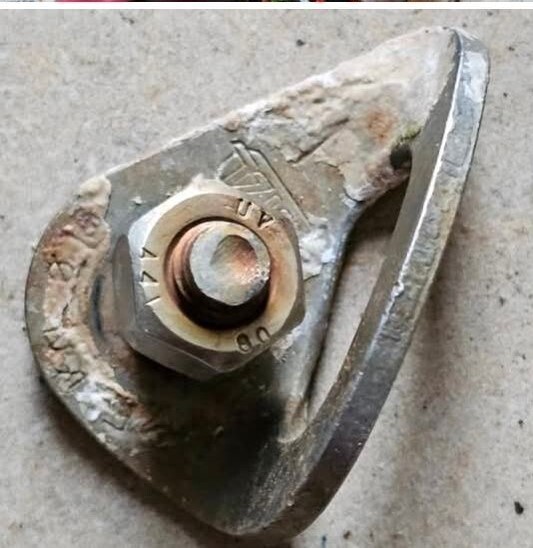 I'm not sure what the stamps on the nut mean. Guessing that "80" is stainless steel class 80 (high tensile strength?) but unknown if 304 or 316. Anyone know what the other stamps are/mean? That stud bolt end looks fairly corroded and not a fast fracture type failure (only a slight bit of "fresh" metal)? Scary looking. 24 years of exposure to that environment? The hanger shows some interesting accumulation of some type of deposit. Anyone know which route? Some of the routes at that area (Jurassic Park) were developed in 1999 and 2001 and on. |
|
|
What an awful tragedy. So sorry for the climber involved (who did nothing wrong) and his friends and family. It looks like Team Rebolt has been working on this issue and will continue to do so, so big kudos to them. It makes me wonder how many time bomb anchors and bolts we have along Spain’s coastal regions (and elsewhere)… I have seen plenty of corroded, manky stuff out by the sea. |
|
|
Everything about that anchor photo looks corroded, rusty, and overall terrible to me but there are comments on the linked ig post saying it looked fine so nobody would have known there was an issue. I basically only climb in desert areas so wondering is the look of that anchor normal for something next to the ocean? |
|
|
Adam W wrote: That anchor actually looks comparatively good as far as Kalymnos hardware goes. (Or Mediterranean limestone hardware in general) Since first visiting the Greece and Spain a few years ago, I’d been gradually retuning my perception of what a badly corroded SS bolt looks like and trying to get over my initial reaction that was similar to yours with each subsequent visit. They get much worse, but lots of people climb on them without really being phased by it. (but this event definitely makes me question that norm) I also doubt this was overtorquing. My guess is SRB attack, (like I linked in the op) but we’ll have to wait and see for the metallurgical analysis. |
|
|
Brian the route was called St Stavvas. They talk about that in the instagram link in the first post. I have not climbed at Jurassic Park but looking at those photos it appears that some of the tufa solution has precipitated, not sure if that is a correct term, onto the bolts and chain. |
|
|
Calling David Reeve. |
|
|
Brian in SLC wrote: A4L is 316 L - A2 is 304, A4 is 316 I would have guessed that 80 means 80mm bolt, which seems odd since you could swap nuts, but on the other hand if Petzl sold the bolts as a combo with the hanger (I think they did), maybe they did label the nut with the bolt length? |
|
|
The AD on the nut is the manufacturer’s mark, whichever one petzl was using at the time. The A4L and 80 indicate the steel grade, and as Greg said, is the same as 316L. It will be interesting to see the metallurgical analysis on the failed bolts as it’s well documented that manufacturers in the 90’s played it fast and loose with their material grades. |
|
|
A quick magnet test on the stud would tell you if it's 316. If non-magnetic or very mildly magnetic, then it probably is 316. If the magnet sticks, then it's something else. Paging David Reeve... |
|
|
Greg Barnes wrote: 80mm is the bolt length. |
|
|
The recovered hardware will be subjected to metallurgical analysis, until then, material grade and quality remains speculative despite the stamped markings. The visual indication of the snapped wedge bolt suggests SRB for which there are known locations in Kalymnos where high sulphate environments exist. Secret Garden being one sector. |
|
|
Body weight? Lowering--dang! Those would snap with the tap of a hammer I suppose? |
|
|
I've been following along pretty closely. |
|
|
I saw a guy arguing hard recently that nobody should ever worry about 2 bolt anchor failures because they are redundant, attempts were made to explain that not every anchor out there is safe or installed correctly. I hope he reads this thread. The argument was started on a post about attaching a prusik to the belay side of the rope when getting lowered after a lead if the top anchor is suspect. I don't know if this would have helped in this situation but it's certainly a good tool to have in the box. |


