
 Continue with onX Maps
 Sign in with Facebook






Gym climber did not clip into autobelay, fell 50 ft


|
This video is harrowing. What a relief that the climber is expected to make a full recovery. So lucky. What a sobering reminder to always check your attachment point. |
|
|
That was awful. I hope he has a full mental and physical recovery. “There but for the grace of my HP go I”. I once got a few meters up gym route when it dawned on me that I wasn’t clipped in. It was a gym that didn’t have those big blocking aprons—the autobelay biner was simply clipped to an eye bolt down by the floor. Sobering. In the OPs video, there is a woman on the right who seems to be observing what was going on… but didn’t raise the alarm??? Hard to really know. Good to keep an extra eye out on the actions of others in the gym—but see something, say something. Here is another scenario to be aware of that happened at a gym here in Barcelona last year… The guy was maybe 2/3 of the way up a wall of similar size as in the OPs video when the biner came off of his belay loop (was it nose hooked initially???) and the autobelay reeled up into the device at the top. This meant that gym staff couldn’t attempt the typical “rescue” of attaching a rope to the autobelay and letting it out and up to the stranded climber, or climbing up to him with it attached. (Perhaps they could have tried using a nearby autobelay cord and angling it over to the climber…) The guy eventually fell off, was very injured, but thankfully will recover. This made me think that gym staff ought to be around with their harness on and with a PAS or sling already on their harness. Worst case, they could then run up a parallel easy route and clip the PAS to the stranded climber’s belay loop, then you would both come down together on one autobelay. We have one gym in the area that has basically zero adult supervision (you could use a body belay here and staff likely wouldn’t notice) in which case I have started carrying a long sling and locking biner with me just in case a pick off might be required. Any other thoughts? Techniques? P.S. With autobelays, I have gotten into a pretty good habit pattern of being the guy who undoes the twists in the autobelay ”tape”. Just taking on that little “service” helps ensure I have clipped in completely and that the tape retracts normally. |
|
|
I did the same thing in 2017 at Miramont North in Fort Collins: Didn’t clip in to the autobelay and fell from the top. Tried to grab the autobelay webbing (which ran down the ground) with my right hand. The autobelay unwound and I couldn’t hold. I ripped the triangular canvas thing from the wall. My first reaction was to look around to see if anyone saw it happen. No one did. So I continued climbing. This is the route: 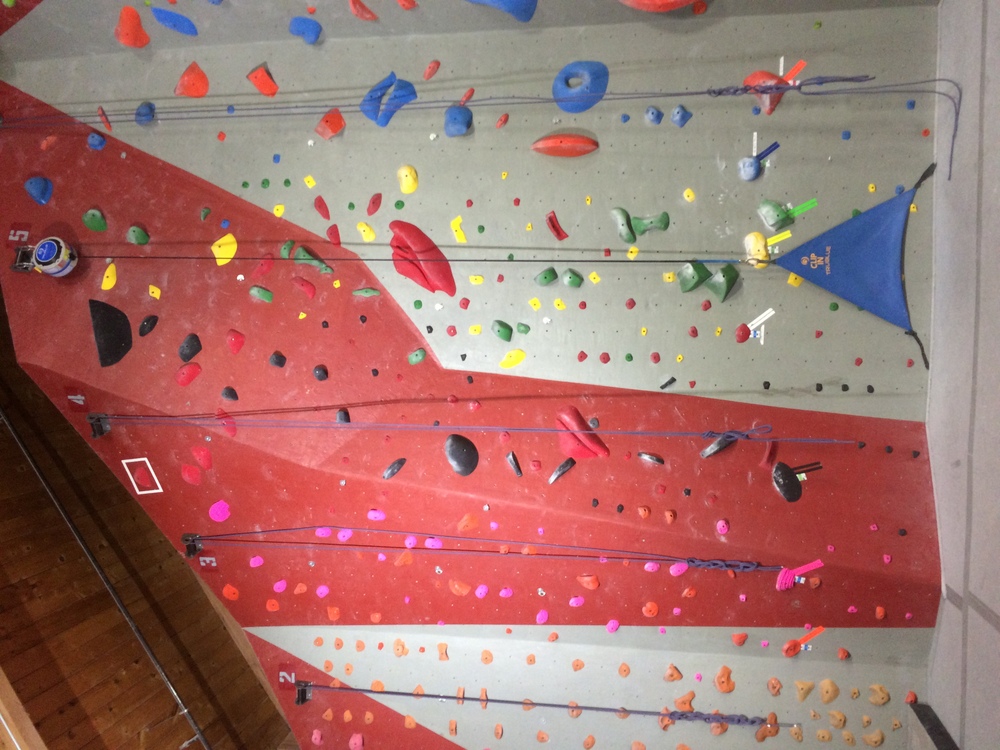 I had climbed the black route, 10 something, left of the autobelay. The last moves were pretty strenuous and not down-climbable by me. The scariest thing was a few days later I did the same thing on a route to the right of this photo. Climbed up about 2/3 of the way before realizing I wasn’t clipped to the autobelay. That time I called for help and was able to clip in to a draw. The staff person climbed up to my right and somehow passed to me the autobelay, and I lowered down. I was in the habit then, and still am now, of bouldering pretty high up on the lead walls on 10s and easy 11s and downclimbing. So I can see myself comfortably climbing to the top, not worried about falling, and not realizing I hadn’t clipped in to the autobelay. |
|
|
Ivan Rezucha wrote: Sounds like you really shouldn't be doing this as you've proven twice that you're not responsible enough to do it without fucking up |
|
|
Maybe I’ve learned? It’s been 8 years since… |
|
|
This video is a couple years old there is a thread or two on here about it already from when it happened |
|
|
This is a really interesting document. Apparently, Norway was experiencing a high number of autobelay accidents, so they created a list of best practices which successfull reducing these accidents. They are definitely not followed consistently at climbing gyms where I live in Switzerland. https://www.theuiaa.org/documents/safety/Autobelay-NorwegianGuidelines_2024.pdf |
|
|
Adam W wrote: Oh dang, I just came across it and was horrified. My bad for not checking the date. It's from 2024. I defer to the other threads. Hope the climber did indeed make a full recovery! |
|
|
Yeah, I bit on it, too. Indeed, hopefully the climber is recovered and back at it. Still, maybe this redundant thread popping up as it did will serve as a timely reminder for someone… |
|
|
Ivan Rezucha wrote: Ivan, I’m really glad you chimed in here and shared your experience. I’ve heard about auto-belay incidents over the years and have always wondered what the real “failure point” tends to be — so I genuinely appreciate you speaking up. I’ve never actually had the chance to talk directly with someone who’s been through it. A lot of what I’m curious about comes back to pre-launch habits and checklists across all areas of climbing — partner checks, doing a quick tug test on a loaded Grigri to confirm it’s threaded correctly, pre-loading a rappel before committing, etc. I auto-belay a lot, and my routine is pretty consistent — I don’t really believe in “always” or “never” in climbing systems, but this one is about as close to always as it gets for me. I visually confirm I’m clipped to my belay loop, then I click the twist-lock twice to confirm the “closed system” before I ever leave the ground. In your case, did you have a similar pre-launch routine and just missed it in the moment, or is that not something you typically build into your climbing practices across the board? Coming from the snow and avalanche world, there’s a massive focus on the human factor and how it can positively or negatively influence decision making, even when people “know better” and have solid systems in place. I’m curious if you see any parallels here: distraction, familiarity/normalization, rushing, complacency, social pressure, etc. Not asking to second-guess you at all — more trying to understand what the moment felt like and where the chain broke. Again — I really appreciate you being willing to share. Mostly I’m trying to understand what your normal habits look like and whether this was a rare breakdown in an otherwise solid system (or more of a gap in the system itself). I agree the neon triangle is a great step and anything that adds a layer of redundancy helps — but I also feel like the pre-launch checklist is the bigger piece long-term. Thanks again for contributing here. I think your perspective is going to help a lot of people tighten up their process and avoid the same kind of close call. |
|
|
There was someone in 2021 at ascent in fort Collins Colorado who passed from her fall. Granted she was mentally not there and had a lapse in judgement. |
|
|
I suspect that people who fail to clip in to an auto belay can be put into one (or maybe more) of three groups: clueless newbies caught up in the awesomeness of what they are doing; mentally defective people (including under the influence of "substances") who shouldn't be climbing; and folks who are comfortable soloing in other settings. There is a well known adage in climbing and other dangerous settings, "complacency kills". I assign that to the third group. Yes, this is judgmental and harsh. Feel free to change my mind. |
|
|
I'll repost this link because I think it's important. By thinking about this things that demonstrably work to reduce these accidents, we gain insight into how these accidents happen in the first place. https://www.theuiaa.org/documents/safety/Autobelay-NorwegianGuidelines_2024.pdf I think it's easier to do than we might like to beleive. |
|
|
This kind of video really sticks with you. It’s scary how something serious can happen in just a second of distraction. Glad he’s going to be okay. |
|
|
Jason Antin wrote:
|
|
|
I've also started doing a "click-it cricket" where I squeeze the carabiner gate as if to open it and listen for two clicks: one on squeeze and one on release. Twice, this revealed that the auto-locker had failed to fully lock, even though it appeared to have locked. Chances are that this would have fixed itself as soon as I started moving, but I don't want to take chances. So it's now an "every time" habit: every time I attach or manipulate a carabiner on my belay loop, it gets a click-it cricket, whether it's attached to a rope or a belay device or a third hand or whatever. |
|
|
L Kap wrote: Autobelays can create a false sense of routine because you’re used to them being there every time, but they still require the same deliberate check as tying into a rope. It’s one of those simple steps that’s easy to skip when you’re distracted or climbing solo, which is why gyms keep pushing the clip and tug habit before every climb. Incidents like this really underline how important that pause is, even when you’ve done it a hundred times before. |


