
 Continue with onX Maps
 Sign in with Facebook






Tying in with two ropes for two-person glacier travel
|
|
I have a funky idea for increasing ease of crevasse rescue when traveling on a rope team of only two people and I'd like to hear some thoughts. The basic idea--depicted below in the lovely drawing of two mountaineers with cool orange helmets--is each person ties into the end of one rope (or clips in with a carabiner) and then clips to a bight knot on the second rope at the desired spacing and coils the remainder of that rope. One rope gets brake knots to help arrest a fall (blue rope) and the other (red rope) is left knot free for ease of hauling or ascension. 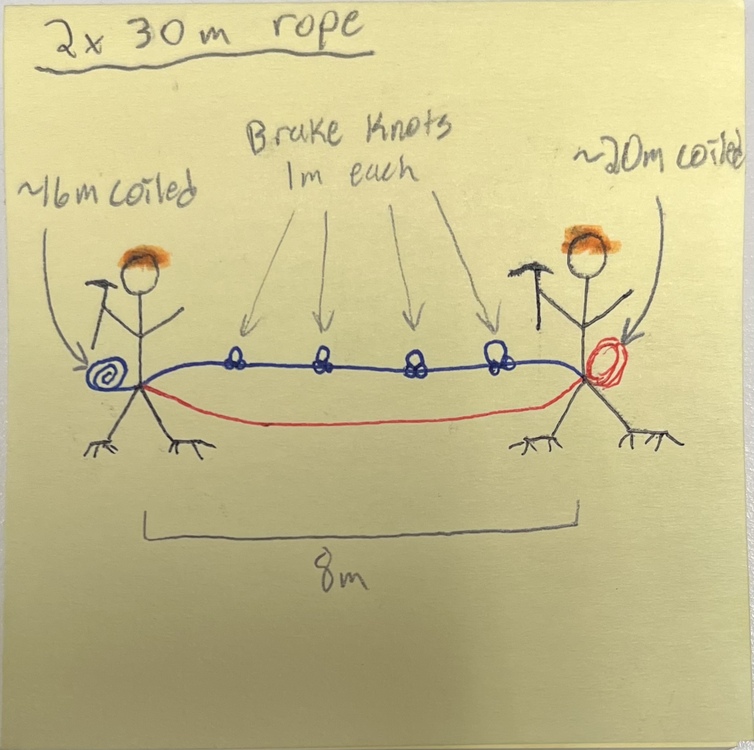 Here is my list of pros and cons: Pros:
Cons:
I looked around to see if this was already a thing and all I found was this Norwegian Water Resources and Energy Directorate glacier safety guide, starting on page 9. It's a bit of a confusing description but seems pretty similar to what I am describing. Am I completely missing a major drawback here? Is this a thing people already do? Let me know what y'all think! |
|
|
One rope that the team is tied into + separate rope(s) for haul systems is pretty common, but tying into both isn’t something I’ve seen. |


|
What problem are you trying to solve? |
|
|
Just trying to improve the efficiency of a system that already works pretty well, but may have room for improvement. The “problem” with brake knots is that they reduce the efficiency of a rescue when you have to pass the knot. This system seeks to maintain the added security the brake knots offer while dropping the need to past the knots. |
|
|
Twice as much rope in your feet to get snagged on crampons, get tangled, present a tripping hazard. One rope is already enough of a pain in the ass. Honestly even if you don't tie brake knots, it's usually easier to pull someone out of a crack by dropping them a clean line and hauling on that. When someone goes in a crack, it's pretty common for the load line to cut deeply into the lip. Dropping a clean line gives you the ability to prep and pad the lip, all with the line unweighted, and then haul your partner straight up and out on the clean strand with less friction. In your proposed method, now both ropes are loaded and cut into the lip, so it doesn't really solve the efficiency piece. |
|
|
In a 2 person system with a 60M rope, you both can carry adequate body coils that can be used an an unincumbered free line for extractions. A two rope system would be heavy and cumbersome. |
|
|
Matt Zwrote: Fair enough, I can see this being annoying.
My thought for addressing this was to anchor the knotted rope, and you should be able to get enough slack into the unknotted rope (extending the anchor, etc.) to move it to a prepped and padded part of the lip as you describe. As I'm thinking about it more, though, it seems fairly likely that the two ropes would twist enough to be bound together in the cut part of the lip, and you may not be able to get the unknotted rope out. I'd be interested to do some testing. Thanks for the thoughts, these are exactly the sorts of considerations I was looking for! |
|
|
Hey Luke, cheers from a fellow Spokanite. How often are you falling into crevasses?! This feels a bit like a solution in search of a problem. If the risk is high enough to be doing this kind of stuff, I would just go home. The better bet is to keep your systems simple and avoid the most heavily-crevassed sections of the glacier. Another note - 8m is not enough separation for a two-person rope team. |
|
|
Hey Luke, I use a system like this, but not with both ropes tied to both people during travel. I will use one rope to tie both parties in, where one climber is tied into the very end, and the other has extra coils to use for a rescue. You can use brake knots in this rope. The second rope will be carried by the climber who is tied in the very end, so they have sufficient rope for a rescue. They will stuff this in their bag or coils on their chest. One climber ends up having more rope, but for a 2 person system it should be enough for either party. Make sure you actually test various rescue situations (drop loop, drop end, etc.) with your rope lengths to be certain the person with less rope has enough. Any 2 person system is fairly advanced and requires both climbers to be very competent at crevasse rescue, I only climb as a party of 2 with a few folks who I have practiced this with regularly. |
|
|
Steven Rwrote: What length ropes are you using in this context, and why 2 ropes instead of 1 rope? One reason I can think of for this is a ski party, where you are going to unrope on the descent and you don't want only one rope with one person? For 2-rope systems, Petzl shows a nice diagram of simply tying the ropes together and putting this knot between climbers. Each person then carries sufficient rescue coils to implement their preferred rescue system. 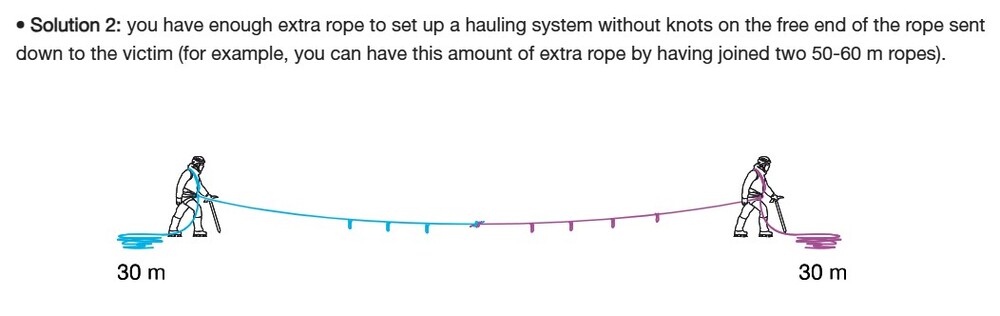 |
|
|
Kyle Tarrywrote: In my case 2x30m mammut glacier cord. I have tested the methods I use (drop end) with this setup and it works in practice. Could also tie both ropes together like you show, but yes the reason I do this is mostly for ski descents, also because I do own 2x30m mammut ropes vs a single mammut glacier 60m. |
|
|
Steven Rwrote: Makes sense! Thanks for the additional info. Seems like tying them together per Petzl would work well and give both rescuers equal coils to work with, but if your system works then I don't see why it would be a problem. Depending on your partner spacing and brake knot usage, you might not have enough rope left over for a full drop loop? If the people are 12-15m apart and you have some knots, the remaining rope in coils (<15-18m) may not reach the fallen climber. Tying a knot in the middle would potentially improve this scenario, if that is a benefit in the context of where and how the rope is being used. |
|
|
Kyle Tarrywrote: Totally, yeah the drop loop can be borderline depending on who falls in, I do prefer the drop end system though. also if my partner falls the full length between us in, then we’re likely in a pretty bad spot as is hah. |


