
 Continue with onX Maps
 Sign in with Facebook






Clipping in to a carabiner
|
|
The gym I go to has top-rope climbers clip in to a triple-locking carabiner with a captive eye. Is this safe? I'm just now starting back up after a several year break. I had a bad bouldering fall that took a long time to recover from and I never felt the same afterwards. I finally am getting the urge to climb again, but I think PTSD has made it hard. The gym I used to go to had all climbers tie in with a rope, but the gym in the new city I live in makes top-ropers use this carabiner system. Is this safe? It feels extremely sketchy to not have the rope attached to my harness. It gives me intense fight-or-flight feelings. Thanks  |
|
|
Safe for top roping, doubly so since it is an anti-crossloading carabiner. Some exception for stupid kids who might fiddle with the carabiner while being lowered— tying in is still safer for birthday parties and whatnot even if it would be convenient to use a carabiner. Not ideal for lead, although reasonably safe with an anti-crossloading carabiner and/or carabiner rated for full strength crossloaded. Mostly useful for LRS and scrambly/adventure stuff. |
|
|
Definitely safer than bouldering. |
|
|
You could add a second biner if they allow it and if it makes you feel there is less risk. |
|
|
How can you tell its an anti cross loading carabiner? I've never seen this sort of biner on gear sites, so I figured it was for all sorts of rope uses. Follow-up question, would having the carabiner constantly putting force on the same portion of rope wear down the rope faster/pose a danger? How can I tell if the rope is good to go? |
|
|
That's probably a steel carabiner, something like this. It's stronger than the rope and the harness, even if it's aluminum. The rope is fine. You can ask the gym how often they swap them out. They're usually pretty conservative with the interval. |
|
|
According to the recommendations of the German Alpine Club this appears to be an insufficient carabiner. Here's the source, translate at your own descretion. A triple locking biner belongs to the "medium safe" category, and allegedly there have been several well documented accidents with this kind of carabiner used for connecting the harness to the rope for climbing. Especially repeated loading as well as rotations create a greater risk. There's a reason that the triple lockers of auto belays usually have a swivel. That mitigates this unclipping risk. What the German Alpine Club recommends for top roping on a carabiner:
My personal recommendation, echoing Clint Cummins: Ad a second opposite non-locking carabiner. |
|
|
That's not safe enough for auto belays anymore in my gym, now they use 2x triple action with a swivel. If it's under constant tension like an autobelay it's potentially safer to just have 1 carabiner compared to TR, as it's less likely to flop around and interact with the gate. But in a TR situation, there will be moments of slack and that could lead to the failures described by the DAV. Personally I'd rather tie in, but it's probably fine until it isn't. Certainly not what I'd like to see as standard practice. My gym's autobelays: 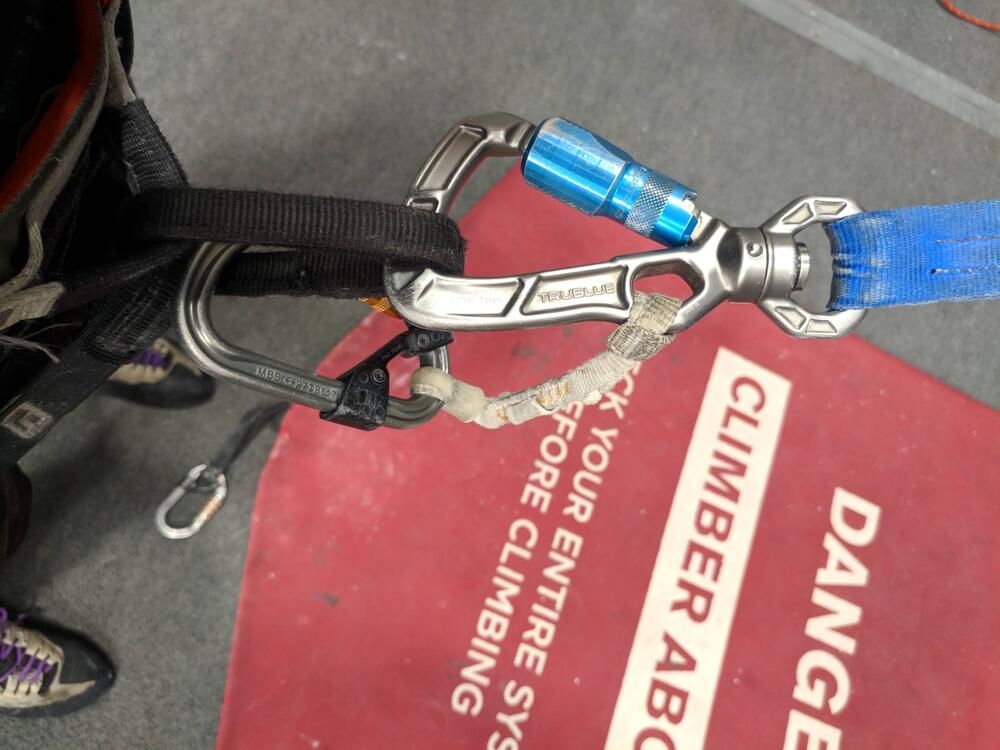 |
|
|
The auto belay is more dangerous than the carabiner |


|
I’m pretty sure the primary purpose of the extra carabiner on the autobelay is so that it’s always attached to something. It reduces the likelihood that someone lets go of the carabiner and it ends up stranded at the top of the route. Regarding the question from the OP, it’s quite safe and will result in less wear on both the rope and your harness. |
|
|
I used to go to a climbing gym that used carabiners like that. I would clip it through the waist belt and then the leg loops. Going top down will leave the gate facing out. It feels more secure than having the carabiner flopping around on the belay loop. |
|
|
Thomas Gwrote: It can't cross-load because the rope is tied into a separate eye from the one clipped to the harness. |
|
|
It’s fine. |
|
|
Nate Awrote: Sorry, incorrect. The purpose of the 2nd triaxial biner on autobelays is to have TWO clip-in points attached to your harness. As said, there are ways that a single triax has not been clipped correctly or come unclipped. Our gym uses a nonlocker on the autobelay floor tarp's clip-in loop, clipped to the webbing/pivot point hole, to keep the webbing from escaping up the wall. One of these is visible on the red tarp in K Go's photo. Autobelays are a logical place for a secondary biner since, unlike a toprope or lead belay, there usually isn't anyone doing a partner check. |
|
|
Steve Belfordwrote: Seconding this, but I wouldn't describe it as waist belt and leg loops. Most modern harnesses have a loop sewn into the waist belt and a bottom loop connecting the two leg loops. The belay loop is sewn through both of these. Feed as he describes through these upper and bottom loops exactly as you would thread your rope to tie in, to end up with the gate facing out. 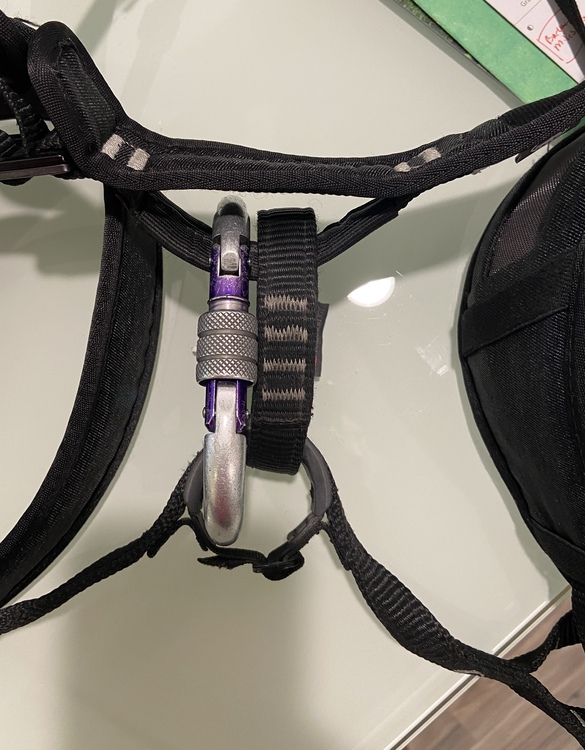 This will mimic the way you tie in with a rope and feel much more secure. Personally, I'd have no qualms with the gym rope, although I would certainly assess how the knot was tied. You can inspect the rope loop too. If there is something about it that makes you feel uncomfortable, go ask when it was last changed out. Nor would I have any fears about a single locking carabiner for lowering and toprope forces. |
|
|
Just one more data point with a couple of slightly blury photos... this is the TR setup at Sharma's gym near Barcelona. This is how you will find the TR hanging. You detach the Grigri and attach to belayer's harness (triple action locker). Climber has two opposite and opposed massive steel biners that would be pretty tough to crossload. Seems bomber to me. My only complaint is that the thick semi-static ropes tend to expand with heavy use and become difficult to pull through the Grigri. Perhaps a slightly thinner rope, or more frequent replacement would be the solution?   |
|
|
Have the same setup at my climbing gym and those biners are weird to me too. They make loud noises like the gate/locking mechanism is bouncing around when you fall with just minor slack in the system. My partner came off the wall the other day after one of these horrific sounds and we inspected his belay loop and saw some part of the biner snagged his belay loop and ripped/frayed part of it. Seems like when there is some slack the biner slides up the belay loop moving the action around? or it flipping from cross loaded to the right orientation once weight hits it? Just a guess. I'd rather tie in too but oh well. |


