
 Continue with onX Maps
 Sign in with Facebook






Lightweight integrated prussik/pulley system prototype


|
|
Another thread drifted toward this, which will be better discussed here. The design brief was an integrated prussik cord/pulley combo that would be lighter than a 'biner/snatch block/ prussik. Playing around with parts I have lying around, I came up with: A Seamless eye-to-eye Technora friction cord, an aluminum Low Friction Ring (LFR), and an alloy toggle to close the system so the LFR acts as a snatch block. The proportions need to be tweaked: a smaller toggle is desirable for that size setup, but the system would work with a smaller friction cord for skinnier rope (working on that), and LFRs come in all sizes, so it can be dialed to any rope diameter. Pics:  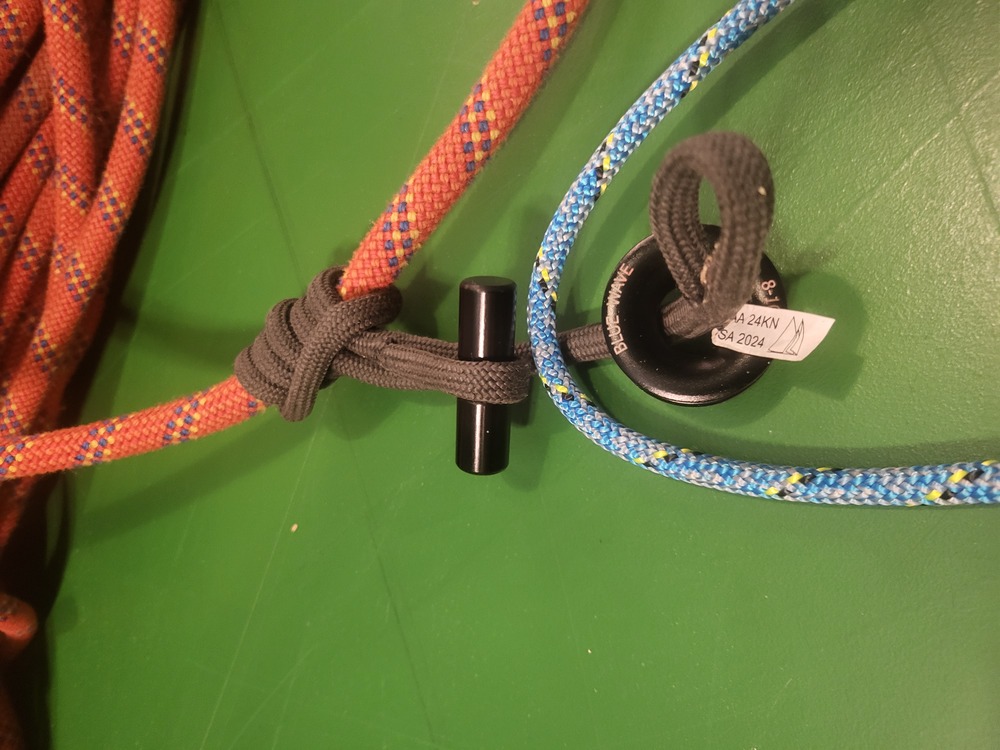 One potential pitfall is that the LFR can't be secured, and is in danger of being dropped by chilly hands. I'm away for a long day of sailing, so won't be back to respond to comments till tomorrow. Thoughts? |

|
Interesting. How easily does the LFR turn when under load? |

|
Ben Zartmanwrote: Even though heavier, but using a carabiner instead of the toggle might make the system more secure - clip through the eye and enclose the prussik. |
|
|
Hey Ben, So happy to see this and contribute. 1-I guess the main application would be lightweight crevasse rescue/improvised rock rescue situations...this could be light/small enough to carry in a small bag which woudl protect the ring. 2-I think friction is an important consideration. Some tests to see how effecient those rings are would be cool. I think in the sailing world there are carbon pulleys with very efficient bearings that are quite light. https://www.harken.com/en/shop/fly-soft-attach-blocks/18mm-fly-soft-attach-block/ (That block might not be appropriate but it weighs 7 grams...) 3-It might be necessary to have different rings sizes for different diameter cords. Using 9-10 mm rope would not be the same as a 6 mm specialized haul rope. 4-I wonder of one of the sailing pulleys, that combines a carbon wheel with a bearing and side plates, could not be used? For example, perhaps you could splice a long cord through one sideplate, a short loop through the other side plate, and then toggle the two together to close the system? See this prusik, and this harness, for toggle configurations. https://us.grivel.com/products/magic-ring https://www.blueice.com/products/choucas-pro-1 5-I'd be the first to admit that using a toggle for a load bearing haul point would be spooky...but if the main rope were running through a progress capture device, and this pulley was used only to take in rope, if the toggle failed there would be no back slip. Here is a link re-posted from the last thread about a French mountain guide creating somewhat similar systems (Thanks for that link Terry E) https://www.sebastien-constant.com/shop/equipment/?lang=en 6-Last... If you can get something like this together, I would definitely buy one :) |
|
|
Thank you for this. |
|
|
amariuswrote: At this point, a tibloc and a roll clip would be way more fuctional IMO. It also would likely be a much more efficient hauling system. |
|
|
Mr Rogerswrote: Hey Mr. Rogers, I've considered it but...I'm not sure the roll clip adds up? I don't think the diameter of the pulley in the roll clip is enough for it to be really efficient (the diameter matters). Also, a Petzl Partner is 56 grams and a Rocha locking carabiner is 45 grams so you get a lighter (or basically equivalent) set up that is locking, more efficient, and more versatile. Also, why use a tibloc instead of a prussik of some kind? Unless you are already carrying the tibloc for simulclimbing, for example? If a system such as that proposed in this thread has a good efficiency, it could be a great weight saving set up for moving on glaciers. |
|
|
Bruno, |
|
|
Thanks for all the replies. To address some of the questions, in no particular order: The system as pictured (technora cord, LFR, and toggle) weighs 49g, or 1.73 oz. This would change a tiny bit with a smaller toggle (having some made soon), and different diameters of LFR. The LFR turns really nicely inside the cord--there's a lot of sailboat applications where LFRs are being used this way instead of blocks with bearings, though those still excel in smooth running. I'll try to find time to try one under load with this specific application. A toggled connection is stronger than a carabiner (the pictured toggles failed to break at 19,000lbs in a testing lab--the testing line broke instead), so there's no need to fear loading up a toggled connection, where the rope will be the weakest link. I believe toggled connections are poised to come into wide use and acceptance in the climbing world--they're already being seen here and there, as the links posted above show. If designed correctly, they are very secure and the contingency of an accidental opening is very remote. I use toggled connectors for professional climbing all the time. Harken Fly blocks aren't super-strong, compared to an LFR on a sling, and they're super-expensive compared to LFRs. They also don't have an opening function, which usually adds weight. For occasional crevasse-rescue use I'm just not sure the juice would be worth the squeeze. If a really smooth ball-bearing block system was desirable, you could just set up a four- or six-leg handy-billy with a progress-capture camcleat and clip it to a prussik or Tibloc. These exist in every size for backstay adjusters, vangs, etc., but they're not meant to get banged up on rocks and crags. Remember we're talking occasional emergency use. For lots of hauling on a wall or something, there's better systems than this--here the only purpose is a lightweight, strong, packable emergency setup. |
|
|
Ben Zartmanwrote: very different mindset than items that can be used for more than one purpose. Usually the way i like to carry kit, but if thats the goal, well understood. A little e-bag ready to go. |
|
|
Mr Rogerswrote: I usually like to have things with more than one use too, so this is out of my usual mindset, but the ski mpuntaineering guys I'm talking to just want light, reliable, and packable, and will sacrifice durability and versatility to achieve it. I think the biggest challenge is making it easy to use when cold and scared: there has to be a minimizing of faff and of parts to drop. Working on it.....suggestions welcome. |
|
|
Did a quick test yesterday, with the refinement that the toggle is on the lower loop, so the LFR can't fall off. Here's a quick video: https://www.youtube.com/@ZartmanRigging/shorts I don't have an easy way to compare friction as opposed to a rollclip or dedicated pulley, but when I put a second LFR under the first to make a mulitple-part tackle, with my 6mm RPL prototype as a progress-capture on the harness, I could easily lift my bodyweight. Not that that configuration would ever see use in real life, but it was just to test the LFRs.  With only one LFR on the toggled cord, as in the video, it spun when the blue rope was pulled. With the other parts added, the LFRs didn't spin, but friction was still not huge. The most friction was at the progress capture RPL (predictably)
|
|
|
That's great Ben--you can put me on the list to buy a couple of these! If you know anybody with a load cell (or if you have one yourself) you could perform a simple effeciency test. For example, you could suspend one of integrated the prusik/pulleys vertically (no need to attach it to a second rope) and pass a cord through the pulley. Then you could attach one end of the pull cord to some weight (50 kg? 80?). On the other end of the pulley you could put the load cell, or even a heavy duty luggage scale, and then wind the cord at a constant rate with an electric drill or similar device mounted to a fixed surface (would a windlass work?) My understanding is that pulling the cord at a constant rate is important for the efficiency tests, but maybe some engineering types can chime in with more information or ideas. If you know the load, and the force required to lift it, you can calculate the efficiency. Anyway, that all might be too much trouble, but an efficiency number of some kind would be really helpful to understand how this system would function. Also, if we're talking about a system that one could keep in a small bag clipped to your harness and then deploy for crevasse rescue in a mountaineering or ski touring scenario, we could easily come a lightweight integrated system with a 6mm pull cord, a couple of your pulleys/prussiks, and a progress capture device like a nano taxion, all threaded and set up, and sold as one unit in some kind of sexy Tyvek bag with a clip in loop. That would be very cool. Feel free to PM me for more ideas. Bruno |
|
|
Bruno, can you clarify the intended use for this? I am not sure I understand the application. It seems incompatible with common modes of progress capture, and less effective than a micro/nano-trax, so I don't think it's an appropriate solution at the masterpoint. If being used as the tractor, a small wiregate and prusik loop is ~40g and you're probably already carrying them, so is this intended to have a small (unproven) efficiency increase for similar weight? Since you're likely to carry a prusik loop and some wiregates on most route anyway for other purposes (rappelling, various rescue tasks, clipping protection etc.), you'd probably keep those on your harness even if you did bring one of these, so it would be a net increase in weight I think? Trying to understand how a single-use item that isn't applicable to other common climbing/mountaineering situations is a net weight reduction... |
|
|
Hey Kyle, Sure, I'd be happy to elaborate. One thing to bear in mind is that I'm based in the Alps, and climb mostly in Switzerland, France, and Italy. I see this primarily as a tool for crevasse rescue. In my view, especially with climate change, crossing high, crevassed, snow-covered glaciers represents one of the biggest risks in the Alps. My usual glacier rope system is to travel with a single line with large stopper knots and plan to haul on a drop C or dropped line with the free end of the rope. For this set up, I really like a microtraxion, and I always have one on a glacier, on it's own dedicated carabiner. I also always carry a pulley, also on its own dedicated carabiner. In fact, I have two of each, so my partner always has the same. If weight were not prohibitive, I'd happily carry two pulleys. This device would allow people on glaciers to have access to very lightweight, highly efficient pulleys. Instead of carrying just one pulley, or improvising pulleys with carabiners, one could reasonably carry two pulleys, and that would make hauling much easier. The difference in friction between hauling with pulleys or hauling with carabiners is huge. And because hauling somebody from a crevasse is already difficult, I think it would absolutely be worth it to have lightweight, low-friction pulleys like those described here (if they are in fact equivalent in efficiency to something like a Petzl partner). I also think many people would be very interested in a small, lightweight, dedicated crevase rescue hauling system that they could carry clipped to their harness when walking or skiing on glaciers, and immediately deploy to haul a partner from a crevasse or help a partner climb out on their own. Mammut made a product like this (immagine a block and tackle set up with lightweight cord) but it was heavy and bulky. Others are thinking along similar lines (see the link to the French guide with a similar system). Carrying one of these devices (or two) in place of a dedicated pulley and carabiner and an additional prusik would indeed save weight. For example: Petzl partner + Sm'd + Beal Jammy = 56 + 46 + 25 or 127 grams. You could easily carry two of these integrated pulleys/prusiks for the same weight. Of course, if you are willing to use carabiners in place of pulleys then this device would not save weight, but I would consider the additional weight well-worth the ease of hauling in a difficult and stressfull situation. Happy to answer any more questions. |
|
|
Bruno Schullwrote: Can you elaborate what your hauling system looks like with a drop-C to the fallen partner, assuming that both people have a microtrax (and possibly one additional pulley)?
I don't believe that anybody has measured the efficiency of this setup?
Aren't you going to carry a few lockers and friction hitch cords (or slings or whatever) anyway, for other situations and contingencies? I think these "weight savings" are misleading because you're counting components you're going to carry anyway, and you're not going to leave them at home just because you have this thing. Typical minimum climbing/belaying setups often have 3 lockers (clove, plaquette, rope). There's no need to carry an extra locker for your 2nd pulley, just use one of those. We also typically carry slings, which can easily be used as a friction hitch, and wiregates, which can be used for pulleys and other parts of a haul system that don't need to be fail safe. A Petzl Nanotrax (53g) is only 4g more than this (49g per Ben above). You don't need another carabiner or friction hitch because you already have a bunch of them. |
|
|
Kyle Tarrywrote: Happy to elaborate. Of course there are lots of variations but my starting point is usually the following: Anchor (skis/picket/poles/ice screw) --> fixed to main line with stopper knots --> free loop of rope dropped to climber --> climber attaches their pulley to the loop --> ascending strand of loop comes up and passes through microtraxion on anchor --> free end of rope runs down to tractor point and pulley on asending strand of loop --> pull away from crevasse to haul = C + Z. The proposed device could potentially replace pulleys 1 and 2 in the picture below. If each climber had two pulleys, one could add mechanical advantage. 
Correct. As I emphasized several times in my previous posts, this would only make sense if the proposed device had a high efficiency.
Sure, I always have some other carabiners and other gear, but the last thing I want to do in a rescue situation is search around on my harness looking for stuff, dropping gear, and so on (or "faffing around" as my British partners would say). That's why the microtraxion and the pulley that I and my partner carry each go on their own dedicated carabiners.
See point above. Also, I don't want my belay set-up involved in the haul system. What if one needs to rappel down to the person in the crevasse? Of course slings can be used as prussiks, but thin dyneema slings on lightweight glacier ropes are not always the best solution. Wire gates as pulleys is really a poor idea.
Again, see my points above. I always carry a Partner on glaciers but it would be nice to carry two pulleys for a similar weight. I don't like the nanotrax. I find it too small to handle comfortably with gloves. And remember...there's no right/wrong here. To each his/her/their own. If you're not into the idea, cool, don't buy one! |
|
|
Bruno Schullwrote: Hi Bruno, Thanks for the suggestions, and for the diagram in a later post. I had envisioned the person in the crevasse self-hauling out, rather than someone above. I guess it'd be nice to have one kit that can do both scenarios. I have no experience with crevasse rescue, so I'm putting this together as people consult about their needs. I'm thinking to not only offer a finished crevasse-rescue kit inside a dedicated bag, but to offer all the parts separately for those who want to mix-and-match. I'll for sure DM you if you're willing to sweat out details and specs. While I have access to load cells and hydraulic rams, I don't know enough about pulley efficiency to do a meaningful test. I might outsource that to SATRA, who does all the UIAA testing for my other products, if they offer that kind of thing. I have some batches of machined parts in the works, so there should be updates in the coming weeks. |
|
|
For what it's worth, Peak Innovations is about to release a crevasse rescue kit—a pre-built 5:1 system featuring efficient pulleys, with the entire kit weighing in at around 70 grams. |
|
|
Ben Zartmanwrote: Measuring approximate pulley efficiency is extremely easy to do at home with very basic equipment. Photos of a basic test setup here: https://www.alpinesavvy.com/blog/pulley-vs-carabiner-whats-the-difference Similar testing of progress capture here: https://www.alpinesavvy.com/blog/progress-capture-efficiencies-of-various-devices This should all be trivial for an entity that is selling climbing gear to the public. |
|
|
Kyle Tarrywrote: Non of the methods used in these articles would be remotely suitable for a quoted efficiency rating. Friction being the largest variable and having significant variation between rope construction, materials, and hummidity. To accurately determine pulley efficiency would be quite the scientific undertaking. https://www.ropelab.com.au/pulley-efficiency/ Richard from rope test lab (an authority on this matter) does some testing here and has a nice experimental design and while for most good enough, the lack of any wider testing with a range of different ropes leaves a lot of questions. This is both a physics, engineering, and textile science question, there is nothing trivial about it. |


