
 Continue with onX Maps
 Sign in with Facebook






Easy vs moderate snow difficulty ranking
|
|
I am sure what the snow grades are supposed to mean. Steep Snow I guess is when you need multiple ice axes/tools—no experience with that. But I'm not sure what the cutoff is between "easy" and "moderate". For example, Colchuck Peak via Colchuck Glacier is listed as "easy snow" but at its steepest point is above 45 degrees. To me this is very different terrain than, for example, Mount Saint Helens via Worm Flows (also easy snow), where I agree with the rating even though it's avalanche terrain and a fall could have bad consequences in the wrong conditions (max slope ~35 degrees). When listing routes, what makes a snow climb easy, moderate, or steep? The slope angle, exposure, consequences of a fall, typical conditions, etc.? |
|
|
My opinion:
Slope angle is the only factor that matters. Conditions can and will vary wildly. Where exactly is the transition from snow to ice and when exactly do snow grades change into alpine ice grades is a tougher distinction. Moderate snow and AI2 is really just a difference of texture. Here’s a Link to Alpinist with a brief description at the bottom. |


|
Yeah, it might be worth having an angle instead of an adjective on this site, but most people don't carry inclinometers and are terrible at estimating steepness. Worth noting you're on a website for technical climbing, which snow almost never is, so MP will be all over the place. Some people will call everything easy snow because it's not technical climbing, and some people will have little to no experience with it so they will rate it harder. My suggestion is that if you're sketched out by certain angles of snow, check a map tool like Caltopo's angle shading to get a concrete idea, instead of relying on random internet opinions. |
|
|
iPhone has an inclinometer built in with the app called “measure” you can lay it across a trekking pole for a decent average of the terrain you’re standing on. |
|
|
I think you're numbers are off.. 70 degrees is really steep. Is there even such a thing as snow steeper than 70 Degrees? |
|
|
Nick Goldsmithwrote: In maritime climates very steep slopes will hold snow (although not usually sustained over 70 degrees). You might even find yourself climbing overhanging snow, for example if there is no way to bypass a cornice. |
|
|
Sam Beeduhlwrote: YouTube is overflowing with video of people on 40-50 degree snow front pointing and using a pair of technical ice tools and belaying in pitches. And rappelling back down them. Below is me on Mt Robson. Higher there was a section 30 feet high starting at 70 degrees and finishing with a mantel shelf maneuver off a near vertical spot. Technically I wouldn't call the mushrooms "snow",they are kind of o soft snow/ice. Riming is the mechanism that builds these features. A single 70cm axe was and still would be an appropriate tool.  |
|
|
That's kinda what I am getting at. For most people 50 to 60 degrees is steep snow. Anything over 60 degrees is really steep and anything over 70 is extreme. |
|
|
Nick Goldsmithwrote: Sounds good to me. Snow SLOPES exceeding 60 degrees are uncommon, due to the fact that snow starts consistently sluffing (angle of repose) at 50-55 degrees. Whence the slope angle below a cornice is generally in that range. The Cordillera of Peru are one exception to that general rule, where the prevalent climatic conditions push that angle up a good 5 degrees or more. I can't say about the Himalaya, or Alaska either. In the Alps and Canadian Rockies just about all the great snow/ice faces top out slope angle wise at 55 or just a bit past. In those places where angles surpass 60 degrees for a half pitch or more, the snow/ice depth is sufficient for plastic flow akin to that present in glaciers. Examples would be the North faces of the Triolet and Mt. Fay. The bulges that occur on alpine mountain faces such as those come and go. Sometimes these features also meet all the definitions to be a glacier. If someone with a better (read:real) glaciology background wants to add, or correct me, please do. I think an understanding of these processes is useful for Alpinists. Riming creates it's own, sometimes substantial, snow/ice features. And of course combinations of these processes occur, all subject to the influence of base terrain features, wind, etc.. |
|
|
I hold firm to my opinion. Anecdotally: I have climbed a 20-30 foot section of vertical snow to exit a burgschrund onto a steep slope headwall around 70 degrees sustained for 2x 60 meter pitches before the angle eased into 60 degrees and lessening for a 3rd rope length pitch on the Price Glacier. These pitches I followed with a broken collar bone from rockfall earlier on route. Also, I have climbed a 30-40 foot section of 70 degree slope where the surface of the snow was sun-cupped and the tops of the sun-cups were overhung. This was approaching Bear Mountain’s Direct North Buttress right near the 1st pitch. We did bail from pitch 4 and rappelled over said snow. Both experiences were in the Washington Cascades on Northern aspects. By comparison, the Fischer Chimneys of Mount Shuksan, when filled with snow, was much easier at around 55-60 degrees for 300’ which I up and down-climbed without rope. If my numbers are wrong I will gladly accept someone else’s factual inclinometer readings as proof. Nick, I respectfully think that “easy,” “moderate,” and “steep” are enough classifications and that “really steep” and “extreme” need not be added except for perhaps overhanging snow which could simply be stated as such. Regardless, without data and factual information it’s all just subjective anyway. Degree angle and distance would be a lot more useful than subjective words. I’d be happy to see 5-10 degree increments incorporated into snow angle difficulty grades. Such as 65-75 degree snow. “Moderate” is the worst perpetrator of the ego. Anything “I” have climbed is steep and anything less anyone else climbs is only moderate. Perhaps what I claim to have climbed is a dead giveaway of exactly my point. Eric, I appreciate your invitation towards any glaciologists or other snow experts. I love learning and reading these sorts of things. |
|
|
Alex Fletcherwrote: I will probably never do anything like that. The steepest snow I climbed was that last 20' over the cornice to get to the col by Blue Lake Peak on the Birthday Tour. I'm content to call it easy snow if I climb it and I'm not scared, and moderate snow if I climb it but it feels scary. I agree that mountain project should replace the subjective grading system by maximum slope angle or some other objective measurement. |
|
|
Easy Snow: Subjectively no need for a belay but self arrest skillz required (and will work). Moderate Snow: Styrofoam but roped up and the leader will belay the second. The 4th Class of snow. Soloing may be easier, but ur gonna die if you whip. You can't self arrest as it's too steep. Difficult Snow: Steep as shit and though you may be able to climb it, you'll sure as shit wish you had pro and real anchors. Usually real ice depending on conditions because it's too steep for real snow. That's how this noobologist sees it lol. |
|
|
Zay in Monterey wrote: Yep. You can't really self-arrest on snow that steep and it's real ice late in the year. It's borderline but easy/moderate depending on conditions seems fair given the number of accidents. |
|
|
I think easy moderate and difficult are too subjective. I routinely solo grade 3 water ice occasionally solo grade 4 and have soloed grade 5. I have friends who Solo 5+ regularly. Their interpretation of easy and moderate is rather tweaked. I am absolutely not an expert at real snow climbing as I mostly climb waterfalls and am in the north east. I guess what I am getting at is that one person's easy is another person's desperate. When we climbed the NE ridge of Buck in the Tetons and came down the e face I thought that was easy but would call it steep snow. One of our party was really gripped and would call it really hard. Lots of people die on that rt. I suspect that the folks who died may not have called it easy. |
|
|
All gradings in mountaineering activities ARE subjective. Measured snow/Ice slope angles are subject to change, sometimes not by enough to make any real difference, sometimes by enough to make a very real difference. Not to mention the actual condition of the frozen H2O, which can also sometimes contain within it unfrozen water. |
|
|
Eric Craigwrote: A single seventy centimeter ax is hardly ideal for 70° snow when you can practically run up by daggering. |
|
|
That's a very narrow perspective. Which is the way it is in 2025. And you can "dagger " with a 70cm axe just fine. In some cases daggering with a 70cm axe is more effective than a shorter tool, and I do mean daggering with the pick. Yeah I have jogged up steep hard snow on my front points. On a bit less steep water ice too. |
|
|
I think knowing steep snow is a good barometer; the first couloir on Triple Couloirs is steep snow. It’s like pure 60° for at least 800’-1000’ feet. The old chute on Mt hood is 50-55°(?) and just that specifically is what I would consider approaching the higher end of moderate snow. West rim on hood’s south side has similar moderate snow terrain. I do not know what easy snow is. (/s)
|
|
|
Seth Morganwrote: This is a great example of how varied people's opinions are on angles. TripleC first couloir averages below 45 degrees when measured. Old Chute on Hood is closer to 35 but can form an ice step or much steeper in the choke depending on conditions. No judgement to Seth, I've made wildly inaccurate statements in the past and then gone back, checked a mapping tool, or had friends go up and disprove my statement. Another example is variation in short sections based on underlying terrain and snow pack. The OP said Colchuck glacier gets to 45 at the top. I've skied it in April and it was nowhere near that. Maybe 35 at most. However, I have no doubt that in the right conditions it would be 45. Snow pack varies considerably season to season. For example, there is a couloir I skied in Eastern Oregon that did reach 50 for bit, but I went back another winter in low snow pack and that steep section was an overhang beneath a giant chock stone. As couloirs melt out at high elevation they may steepen or mellow considerably. Yes, we could stop and use an inclinometer, but most people are not going to do that due to time constraints or because they feel insecure if the snow is steep relative to their experience, and that measurement is a single snapshot in time of a single point on the route anyway. Long story short, angles would be ideal but probably not practical or consistent. If we stick with the current adjectival grading of "easy, moderate, steep" then we have to accept that it is subjective. A Yosemite climber on their first alpine excursion will feel differently than a seasoned guide in the PNW. However, a movement mode as the benchmark could make some sense. I would think easy snow is terrain where you walk, moderate is where you can use tools in cane position, or steep is where you move to high dagger or steeper. Of course there will be some variation in angle where one person will switch modes and it doesn't accurately grade steeper snow, but that's better than nothing. |
|
|
If you want a rebuttal; old chute stat is skiing it in February in deep snow. The top portion of it is of course more mellow like you suggested but there is some distance of moderate snow. The Colchuck Glacier is 35-38° with an inclinometer on a ski pole. But that is just one grab point. 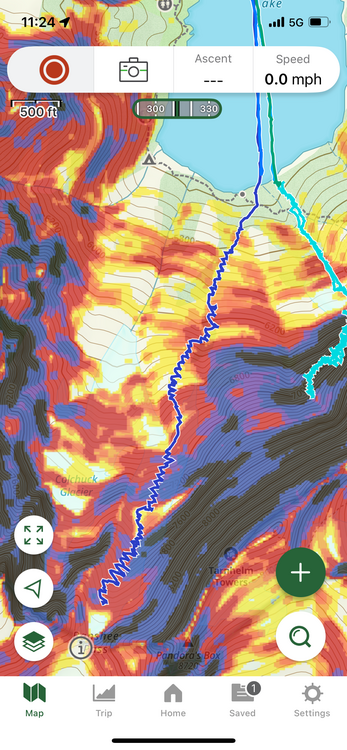 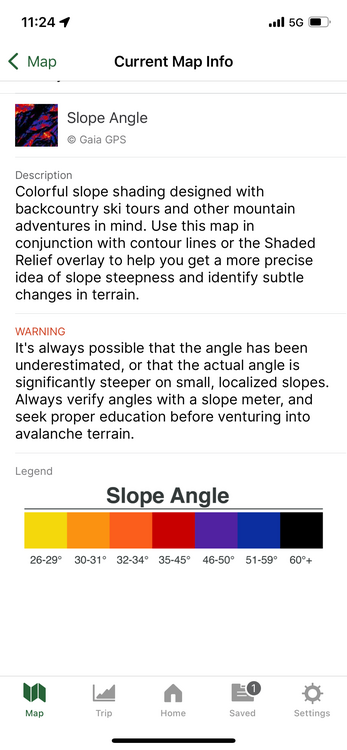 It also has pitches 46°-50° according to the slope shader you referenced.
I’m PRO 1 AIARE trained which I assume you are as well so I’m aware of “eyeball” error in slope steepness. My opinion on slope angle is that I measure it. Edit: I also did the old chute in flipflops with a Hawaiian shirt on; didn’t drink water even once |


