
 Continue with onX Maps
 Sign in with Facebook






Clipping bolts with quickdraws--possible subtleties?
|
|
Yep, I'm probably overthinking this... here goes anyway. OK, so we all know the basic idea that, when clipping up a sport route, you clip the bolt so that the rope side carabiner has the gate opening opposite your direction of travel. That is, if the route is angling up to the right, clip the bolt so that the rope side carabiner opens to the left. Lately, with a pretty knowledgeable (I think) climbing partner, we have started a sort of ongoing debate/analysis that this general rule leaves out some subtleties possibly worth clarifying. Thus I will ask some questions... First, with the type of bolt hangar in the picture below, all things being equal (e.g., route goes straight up) would this be the best way to clip the quickdraw?  The idea above is that the bolt side carabiner is less likely to unclip itself from the hanger if it gets weirdly rotated by the rope, or if you kick it just right with your foot, or whatever. As opposed to this way...  ...which, apparently (says my friend), increases the probability of the bolt side carabiner unclipping from the hanger. Are the above observations true? Or not? (Basically, are hangers designed to be clipped in a certain direction? And, if so, do route developers take this into account when placing the bolts?) Now, suppose you had a route angling up and right as in the picture below. Would you clip they way we have all probably been taught, like this?: 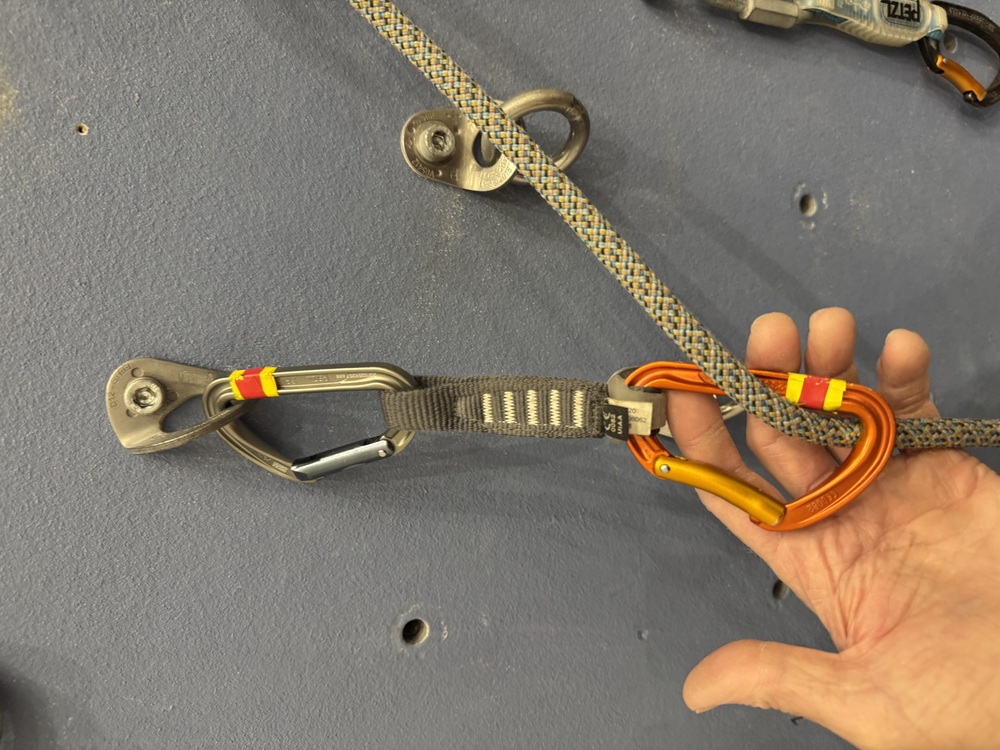 ...The idea being that the rope is less likely to unclip during a fall. Or would you clip like this...? 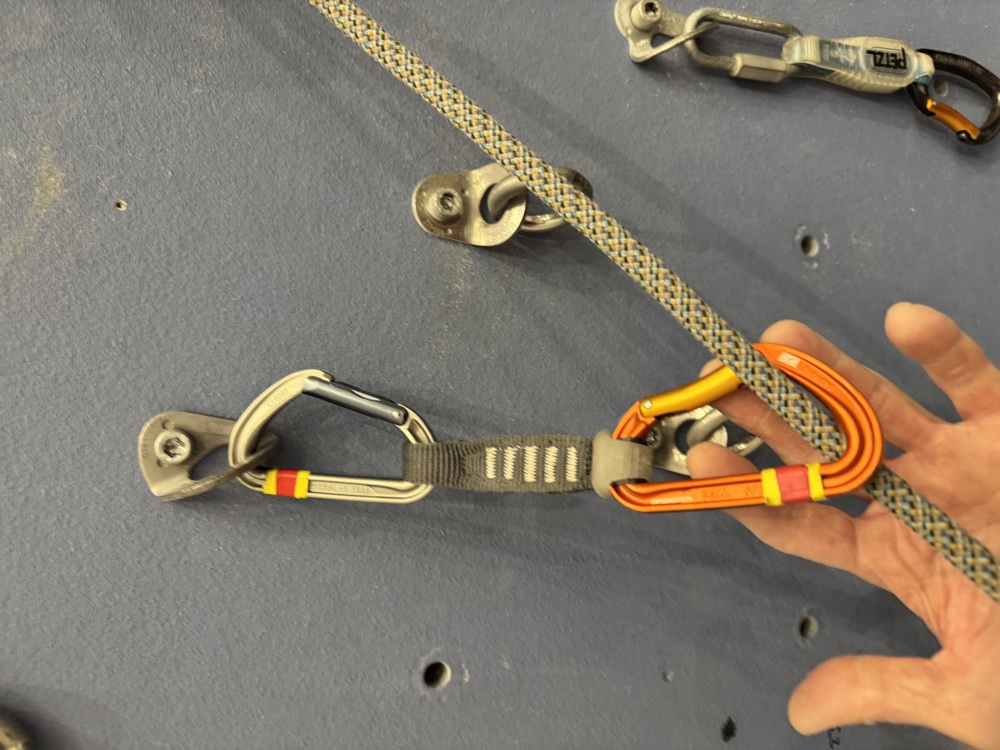 ...for fear of the possibility of the bolt side carabiner coming unclipped. Bottom line: which has the higher probability of happening: 1. Rope coming unclipped from the draw, or...? 2. The quickdraw coming unclipped from the hanger? Personally, I have always looked up and clipped the bolt based on my general direction of travel--going right, clip with gate opening left. My friend, on the other hand, would undoubtedly choose the option shown in this last photo. An exception might be if I am generally angling up and right, but there is a hard move up and left before I actually move right higher up, then I will clip the draw with the gate opening right to protect against the rope unclipping in a possible fall off to the left of the bolt. (Hopefully, that makes sense). Also, if it is indeed a critical clip, there's nothing like that special quickdraw with two lockers on it. Opinions? P.S. And maybe something else... does anyone still use draws with the carabiners having an opposite orientation (as opposed to the ones depicted in my photos with same direction orientation)? I personally hate them, but maybe they have a place? P.P.S. Yeah, I know. Too much leisure time on my hands tonight. |


|
If I'm clipping an expansion bolt with a hanger like above, I almost exclusively clip up through, with the QD gate always facing right. I've seen, read, and experimented and believe this to be safer than clipping "spine to the line" or having the QD gate face left. I'll only face the QD to the left if the gate rubs funny the other way. If it's a glue-in, then I clip "spine to the line". If I'm pumped, I clip the bolt as fast as I can any way I can. |
|
|
This topic has been discussed on mp with videos, here for example: Your friend might be getting his info about keeping gates facing right from this: https://www.youtube.com/watch?v=TXvLlrfT1W8&t=120s Whether the gate is facing left or right, you can just as easily maneuver the bolt side biner to become unclipped either way, so I just always clip with the spine towards the direction of travel. If you notice in all of the videos, each demonstration of unclipping the bolt biner involve rotating the draw upward gate-side. |
|
|
I clip whatever way is more comfortable to clip the rope into the draw. If you are worried about it unclipping on the bolt side, wouldn't it just be easier to flip the top carabiner? |
|
|
Isn't the bolt side coming undone much more rare? If the route traverses right I would think concern about the rope side should trump the concern about the bolt side. Curious to hear from others. |
|
|
I understand the mechanism by which a draw can unclip itself, and i acknowledge that i only have 5 years of climbing experience but has anyone actually had that happen & how often has this come up? Not to brag but I don't really mind whipping (comes from being dumb, not brave) & I've never had a draw unclip. I hang the draw without really thinking about the direction of the route. |
|
|
Jeremy Lwrote: A friend of a friend had their draw come off the bolt side and they took a huge fall and broke their ankle. plenty of videos of the rope side coming out in a fall. Not common, but certainly not unheard of. |
|
|
I've seen those videos, agree that the rope side coming out is probably more common than the bolt side. Could be from it being back clipped or just the direction of fall (traverse v vertical). I just don't really spend that much time worrying about how to hang my draws & wonder if I should be more cognizant. |
|
|
Appreciate the conversation. And thanks for those links, james james. I somehow forgot about or missed that MP thread. |
|
|
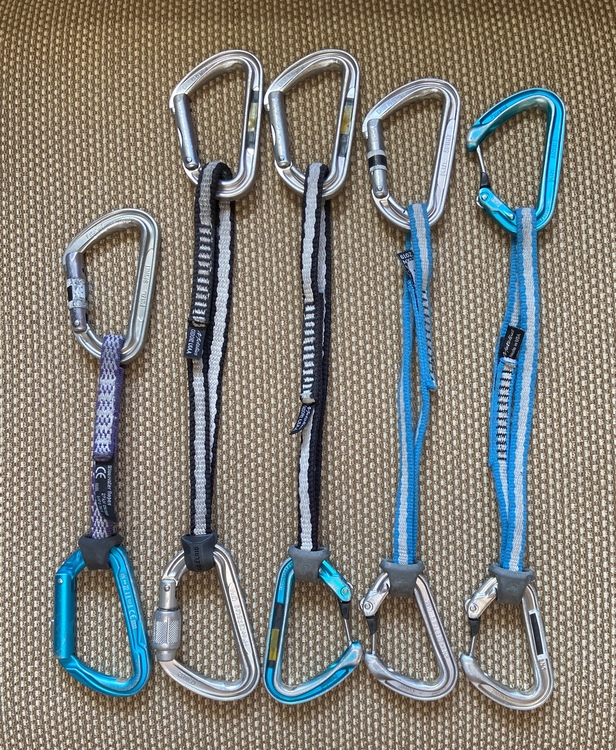 Daniel, I think the key issue with carabiners coming unclipped at the bolt end derives from the stiffness of the short dogbone. Something a bit longer and unstructured is far less likely to rotate with climber and rope movement. As to unclipping at the rope end, two of the quickdraws I carry have lockers (the one on the far left is a sliderlock). Jeremy, you absolutely should give more attention to the direction of the gates. There are a number of documented accidents from draws detaching, breaking and unclipping. Edited to say: it doesn’t matter how often a failure mode happens. If it happens to YOU, you will be the one 100% affected. Climbers need to be aware of failure modes and minimize situations where a failure can occur in a life and death circumstance. |
|
|
Another issue to think about is on routes where there is significant rope drag, gear can get twisted into weird positions and the rope can apply decently large forces to it while contorting it in unexpected ways. All sorts of weird stuff can happen. Two experiences that happened to me personally (and my climbing experience is not that vast): 1. I had a rope come out of a draw while climbing UP. This was in the gym, no less. I was climbing over a gradual bulge (so the rope was dragging on the wall) and the moves involved keeping my body very close to the wall. Something with how the rope pinched the draw against the wall and my body sliding against it. No harm done as I got to the next bolt, but it was a bit startling. 2. Again, in the gym. I was doing a difficult climb that again involved sliding my body very close to the wall. While I climbed up, the draw I was passing clipped onto the laces of my climbing shoe (which then meant my foot was statically attached to the wall - think about that). I didn't notice until my foot almost pulled me off the wall as I climbed up. The climb was at my limit, so too difficult to downclimb. Luckily, the next draw was close enough to clip and take on (lucky it was in the gym!) If I had whipped, though (or had my foot pull me off the wall), it could've been real ugly. Maybe the laces would break before it ripped off my foot? Another documented experience to chew on: "First time a quickdraw has ever come undone! ..." (I think they meant in their personal experience). Sport climbing is still dangerous. Low likelihood events with high consequence are worth worrying about. |
|
|
phylp phylpwrote: You really want to be careful with the open slings with a keeper at the bottom. There have been several occurences when the bottom carabiner can be only attached to the rubber keeper rather than through the sling, if that biner clips into the loop. (I'm not describing it very well, maybe a search through the forum to find the threads where this is talked about?) Here it is: https://vimeo.com/29836772 https://www.alpinesavvy.com/blog/dont-put-rubber-bands-on-an-open-sling |
|
|
hifnowrote: Yes, I’m well aware of this. To me it’s a non-issue. |
|
|
Hi All, When I am trying to flash a bolted route and not sure the best way to climb up, left ,right, straight up?, I clip 2 draws on the bolt with opposing gates so I know if I whip nothing will come unclipped and I can concentrate on climbing and not falling! Hope that was helpful, happy climbing Mike A. |
|
|
Jeremy Lwrote: I had the bolt-side carabiner break in a fall (it rotated, and got stuck, so instead of unclipping, it broke, same difference). I was up high-enough on an overhanging route, so I was not injured. Someone submitted it to ANAM, would have been ~2012 or 2013. |
|
|
To answer the original question: In the scenario you are describing, if you know that this is coming up, because you see the spot from the ground, you can also rack your draw with the top and bottom carabiner gates facing in the opposite directions, so the bolt-side biner is clipped in a way that makes it less likely to unclip from the bolt, while the rope-side biner is facing in the way that is optimal for the direction of travel. |
|
|
Lena chitawrote: Another trick is to clip a second draw to the bolt in the opposite orientation. This obviously only works if the hanger is large enough for two draws. |
|
|
More good conversation… some are starting to repeat techniques, though. Probably a good thread for this particular Forum (and me!) Thanks, phlyp phylp… on rare occasions I have just used alpine draws here and there… no stiff dog bone to rotate things around as you point out. Funny thing… when I started back climbing about 12 years ago after a LONG hiatus, I didn’t even know what a quick draw was, let alone that there was a right or wrong way to clip them. I also had no idea what the hell a Grigri was… among many, many other things. Big learning curve initially. |
|
|
I appreciated the discussion above. I'm embarrassed that I was unaware of the possibility of upper biner detaching from hanger. Rope side unclipping seems more likely, but I can't base that on empirical data. If I'm approaching a bolt and have no idea which direction I'll go from there, here's my decision tree: Would it be a clean (albeit big) fall onto next bolt down? If yes, just clip and move. Should I be treating this bolt as my only effective piece of protection? If so, then a single locker is my gold standard. If drag is an issue, then an open alpine draw seems like the next best option that's typically on my harness. Likelihood of fall is often a factor, and I'm not one who always puts a locker on the first bolt. Being pretty risk-averse, it's not uncommon for me to downclimb and re-orient a draw during an onsite attempt. Not sure this has ever saved my bacon, but it's an effective way to get my head together. Often when swapping leads, I or my partner will flip a draw around based on how we plan to climb. Seems to happen more often when there's a big height difference between climbers. With a little practice, this only takes a second. Nobody's ever whined about me doing this to their draw. |
|
|
I think it's worthwhile pointing out that alpine draws can also come unclipped in a fall. They flop around a lot, and it's not hard to imagine the rope catching on it at just the wrong time and pulling through the gate. I believe there was a Weekend Whipper a couple years ago where that happened on a trad climb (maybe the one with the fall on a finger crack where a bunch of gear failed and also some stuff came unclipped?). Adding a second biner to the rope side in the opposed direction probably reduces that likelihood to ~0. I've done that on trad climbs after a runout, when often an extra biner is easy to come by (e.g. the cam's racking biner). |
|
|
Peter Czoschkewrote: I think it's worthwhile pointing out that alpine draws can also come unclipped in a fall. They flop around a lot, and it's not hard to imagine the rope catching on it at just the wrong time and pulling through the gate. I believe there was a Weekend Whipper a couple years ago where that happened on a trad climb (maybe the one with the fall on a finger crack where a bunch of gear failed and also some stuff came unclipped?). There are some examples of this in the other thread someone linked above (I think it also has the link to the video you are referencing). It also has one of the scariest accident reports I have read, because the affected climbers didn’t do anything out of the ordinary, they just got unlucky. One had TWO alpines unclip themselves (rope side), decked, and got a severe TBI with permanent effects. Quote from other thread: Terry Ewrote: Quote from accident report: “As improbable as it sounds, what also seems to have happened is that the force of the fall, likely exacerbated by vibration and slack created by the gear that failed, caused the rope-end carabiners on both of Crills’ eighth and ninth pieces (along the diagonal traverse) to unclip from their respective slings. That left the high point of the rope as the seventh piece of protection that Crill had placed. This piece was too low to arrest the fall, and he fell all the way to the ground.” I read that a couple years ago when it was posted on the other thread. It (and the video you are referencing) stuck with me and really changed my perception of the probability of alpines coming unclipped. Edit: Link to video of a cam coming unclipped after the top piece pulls. The rope was clipped directly to the cams racking carabiner; the carabiner stayed on the rope but unclipped from the cam. If you click on the video right when the page opens, the paywall shouldn’t stop you from watching it. https://www.climbing.com/videos/weekend-whipper-big-trad-climbing-fall/ |


