
 Continue with onX Maps
 Sign in with Facebook






Suggestion: add chains at the last pitch anchor of 5.6 Cat in the Hat in Pine Creek Canyon at Red Rocks


|
|
A couple of weeks ago, we rigged a biner block rappel, and our rope got stuck at the anchor of the last pitch on CITH. We were caught in an unexpected storm after dark, and had to cut the rope. I learned that we were not the first or the last people who had this problem - that pitch is notorious for stuck ropes. A quick search on forum:
One part of the problem is the lack of good rappeling instructions. There are many ways to rappel this route, and the descriptions one could find seem contradicting and confusing. Another problem, is that the P6 anchor is on top of the rock, and the rope is likely to get pinched as it goes down over the edge and rubs the rock. I suggest putting two permanent chains on the two bolts on the right, with one single rappel ring at the end of the chains. This will extend the anchor beyond the rock edge, creating a single redundant master point for rappeling that is not obstructed by the edge of the rock. 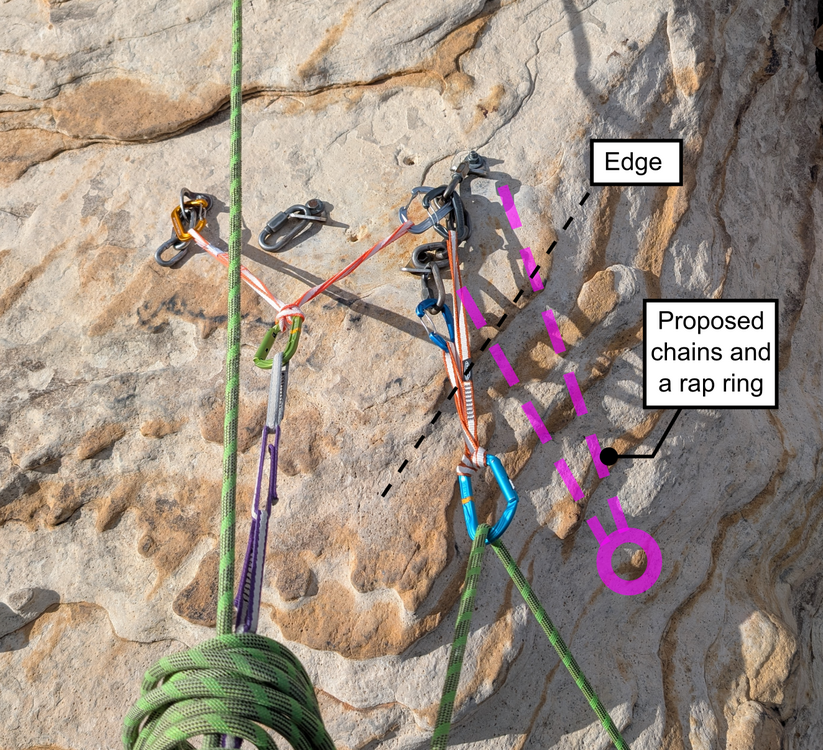 Here is also an schematic from the HowNot2 Bolting Bible to further clarify this.  |

|
Go for it |

|
 |
|
|
Isn't there a whole separate anchor to rap from? Maybe I'm misremembering. |
|
|
or folks could finish the full version of the route, topping out mescalito and walking off the back side. https://www.mountainproject.com/photo/114191463/descent-options-from-mescalito but if you want to buy some chain and a few quick links, and install a better rap anchor, go for it i doubt any one will mind, and since the bolts already exist no issues with bolting in red rocks and all of those ethics issues of adding bolts to existing climbs. |
|
|
Go for it dude! But next time you head up there, check the weather first so you don't get stuck in an "unexpected" storm that was predicted the entire week prior. (I bit my tongue the first time you wrote that. I just couldn't this time.) And one more bit of valuable Rock advice that I learned when I was just visiting here once (on CiTH to be exact), if a rap does not require 2 ropes , just do single rope rappels. |
|
|
Roman Kiselevwrote: doesn’t the rap line from here go left? That’s my memory and what is suggested from the rope wear/dirt going down left instead of off to the right. The anchor configuration also suggests taking the line towards the camera or slightly to the left, and not right as pictured. If people were consistently going where your proposed chains are, there would be evidence/rope grooves over the lip, and hangers would likely orient that direction. It’s probably been 15 years since I did that rap so forgive me if I’m wrong. |
|
|
Edit: Cross posting on both threads - After reading a bit to refresh on this route and on your details in another thread, my remark below to use double ropes on CITH may just reflect an old bias I used to have about a 70 m rope. The CITH rap descent covers complicated terrain. Long raps increase risk of a stuck rope. Skinny tag lines are notoriously hard to pull if there is any rope drag. Being forced to cut the cords and do shorter raps may have been fortuitous (not the right word). Single rope raps on a 70m without biner block is probably the best way to avoid stuck rope on descent of CITH. Good for you for getting yourselves down safely. As said elsewhere, perhaps let the gear go and reflect on it as a valuable learning experience. Sometimes, I bring an extra rope or tag line to do longer raps. Still, after seeing the descent terrain, it can be best to stow the extra cord for the descent unless the one rope brought is too short. Or just stick to shorter raps when available and manage pile after pile of excess rope.
|
|
|
Roman Kiselevwrote: Likely 10,000 people have rappelled successfully from CITH without getting ropes stuck. So I'd say "notorious for stuck ropes" is a stretch.
I've only done this route once, but I recall that the raps were straightforward...Handren's overview photo and topo of the route make the raps perfectly clear. "One can find" this info in the guidebook. I found it simple to do the raps with a single 70 M rope. Your own problem and likely other's may have arisen in trying to do one long rap off those anchors instead of doing the short rap to the top of the 10.d anchors... and not doing other shorter raps instead of just a few long raps, on featured terrain. Many of the MP comments describe this. |
|
|
The January fatality was not on Cat in the Hat. It was on Community Pillar. |
|
|
Carey De Lucawrote: Yes, I know. I linked this post because there was a 4-person party stuck at CITH at the very same time, which is mentioned in the post. |
|
|
It's a trivial rap. If you don't do techniques that increase the chance of the rope sticking (like linking raps, using two ropes, using a biner block, using a skinny pull cord, being so slow/starting late so you are just starting to rap as the sun sets--all of which are unnecessary on Cat in the Hat) it's much less likely to stick. Roman Kiselevwrote: So.....you don't understand why it got stuck, but you have the solution. |
|
|
It seems to me that the OP did not take the time to evaluate the compounding errors that led them into the stuck rope situation in the first place. Starting late, heading out on a day when the "unexpected" storm was forecasted, being unfamiliar with the raps, rapping double ropes, rapping with biner block on RR terrain. I was out hiking in RR the same day, it was super windy, cold, and obvious a storm was coming, again it was forecasted and not "unexcepted" at all! While I haven't really been keeping stats on all of the rescues that have occurred in the past, anecdotally it seems like there is an increase in SAR rescues this season. Many of these rescues could have been avoided by giving red rock the respect it deserves. Most people treat it as a multi pitch cragging destination, and sure it can be like that, but it can also be quite "alpine" and require the full skillset that is needed in that environment. Check weather forecast, take extra layers, take extra food, research the descent options and alternatives, know why certain rappelling techniques are used or avoided here, have basic bail gear, and be prepared to self rescue (including unsticking a stuck rope). ETA: Also realize that conditions can change rapidly in red rock! I have bailed from a route in October when it was 100 degrees in the valley because I was freezing on route, didn't think I needed a jacket that day. |
|
|
Peter Thomaswrote: Good point, it seems that most of the people rappel to the left. In this case, the anchor is even farther from the edge, so, again, it would greatly benefit from the chains IMHO.
Well, normally yes, but not in a freezing hail. Starting late... Who said we started late? We got to the base of Mescalito before 9am. But we were slow at climbing and probably should have bailed earlier.
You're not wrong, it can be done with a doubled 70m rope. Especially, if you've done it before and know what to expect. Normally, I'd throw the rope down and see if the ends touch the ground. If not, I'd look for intermediate anchors. But it was dark and rainy. I knew the pitch was 130ft long from the MP description. So, with my 65m rope I could easily be up to 20ft short. We had only one head lamp and thus had to rappel together. With no visibility I had no way of knowing whether the rope reaches the ground, or any way to look for intermediate anchors. I am not denying that we were underprepared. It was our first time climbing at RR and doing anything longer than 3 pitches. We should have checked the weather forecast for Red rocks and not for Las Vegas. My partner should have had a headlamp. Yet, I put a lot of effort into studying the guidebook and making sure have everything we need for this multipitch - and we still got punched in the gut. We definitely learned our lesson. My point is CITH is a very popular routes for beginners. If we as a community can make it safer - by extending anchors to avoid stuck ropes, or by writing clear instructions for the rappelling - a lot of mishaps could be prevented. I believe the most straightforward rappeling instructions should be given in the route description, and not hidden in the comments or forum posts. I had really hard time understanding descending instructions on mountain project. They lists 130'-140' long rappels - that's longer than half the rope! Then they says "everything can be done with 60m except second rappel". So, how do you do the second rappel then?? Finally, it says 'bring two ropes' in the 'Protection' section. Whaat? |
|
|
Roman Kiselevwrote: Like I said, "being so slow/starting late."
The picture is coalescing. I've done that rap a good dozen times. I've had ropes get "stuck" several times, and it's a bunch of horns that catch either the knot, if you're using two ropes for some reason, or the end when you pull the rope. If you actually stop at the intermediate anchor you it's extremely easy to fix, as the rap is really short--exponentially more difficult if you link the raps. The funny thing is, I was actually climbing on mescalito that day myself, up canyon a bit. We saw what must have been you in the early afternoon--we were hiking out around 1 (because of the forecasted storm and very obvious weather brewing up to the west, visible from that aspect). I actually remember remarking to my partner "hopefully they're on the way down." Apparently you weren't. |
|
|
the rap route goes the other way, skiers right. Use those two nice bolts with rings on them and it works great. I don't think your rope got stuck because of the anchor setup. |
|
|
Roman Kiselevwrote: Roman, I'm glad that it ended with you guys safe. My experience with CITH 25 years ago was similarly epic. It was my first time longer than 3 pitches. We climbed slow, let people pass us who weren't faster, got a rope stuck on a rappel lower down, and got a ticket for exiting late (this was before late exit permits). MP didn't exist, so all that we had to go on was the Todd Swain guidebook, which I assure you was far worse than what info you could get on MP. That experience absolutely shaped my climbing career. It was a really hard lesson to learn at the time. My partner quit climbing after that trip. He decided that he just didn't like all the variables and perceived risk. I, on the other hand, used it as a case study. I evaluated everything we did over and over again to learn from it what I could and use it to make me a better climber. Things like "I'm never leaving the car without a headlamp, and I'm never starting up any multi-pitch route without the headlamp on my person." And things like "how do I not get my rope stuck on multiple rappels?" I think there's really a LOT of productive learning that you can take away from your experience. I realize that right now it's probably easy to feel like the route "needs to be equipped better somehow" but if you focus on the comments from the experienced folks who are replying to you, you'll notice a theme there. With experience comes judgement, and skills. Most people are pointing out that you had some lack of preparation/skill/understanding that worked together to lead to your experience. Try to hone in on that, and focus on what you can do differently to avoid such a situation instead of placing blame externally on the bolts, the descriptions on a website, the weather. You'll be a better climber for it if you do. |
|
|
NateCwrote: Wisely and kindly said. Better to learn these lessons on something as straightforward and safe as CITH than a route with more commitment and risk. Nice job figuring it out and getting down safely, Roman. |
|
|
NateC and Big Red, thank you for the kind and wise words, and NateC, for sharing your story.
That's my attitude towards this as well. It's a lesson to learn from. To have more respect for the mountains next time. To be prepared for contingencies. And also to know when to turn around and retreat. |
|
|
All route/area data on Mountain Project is editable via the browser version of the website (not via the app). I encourage everyone using the website to make it better by submitting edit suggestions for information you find to be confusing or incorrect for a route. Lots of beta gets added as comments but really should be made as an edit to the main copy. All edits go through an approval process by that area’s volunteer regional admins before being displayed on the website. Roman, I’m happy to help you review the route’s beta to see what can be improved. Please reach out by private message. |
|
|
Mostly just piling onto the “you are not alone” thoughts, Roman. Two decades ago, during an Oct cold snap at 10,000 ft elevation in central NM, my partner and I climbed a new-to-us two-pitch route mostly in the shade. This was before MP, for good or for bad. We had brief text in a guide book, a sketched Topo that was ok, and all day like you. We both had been leading trad for less than a year. The main thing in our favor was a lot of shared mountaineering experience. 8 hours later we’d endured an off-route half pitch, another serious off route where I over ran the normal belay at top of 1st pitch heading off route, a long down-climb to get back on route, lowered twice to recover a prior bail anchor, and a bunch of quite slow micro-pitch leads, especially the early one while fighting numb fingers. Hiking out in alpenglow, I wondered if I could ever manage to climb more than a couple pitches without someone experienced and knowledgable about the route. MP descriptions can be pretty good. Still, for complex routes, they can take much longer time to “mature” - if they ever do fully mature - relative to a guide book written by a good author. In an MP route description or rap descent (let alone in the comments), there may have been many cooks in the kitchen so to speak over varying capabilities as writers and as climbers, etc. |


