
 Continue with onX Maps
 Sign in with Facebook






Is simul-climbing overrated?



|
In a recent thread discussing rope lengths, Eric Craig stated that simul climbing is overrated as having any real value (I believe he is speaking situationally but not globally and would invite him to elaborate) and Kyle Tarry disagreed. I respect Eric's history and knowledge, and I have nothing but positive things to say about Kyle and his experience and willingness to share that experience to help others. I think discussion about these ideas can be constructive, educational, and possible without being personal. I'd like to open a thread for this discussion as I feel like I see both viewpoints as having some validity. Discussion of simul and speed tactics in recent years has become commonplace. I believe it has created a situation where I believe many people, particularly those who are newer and looking to go faster, may be given the false impression that the only way to move fast is through simul climbing or linking pitches together into very long enduro pitches. These discussions often disregard conversation about the basics of very efficient pitched climbing. I'm left with the impression that these are foregone conclusions before starting the conversation. I wonder though because when I'm climbing, I see many climbers that have not learned the techniques to climb efficiently before concerning themselves with more advanced speed techniques. Ropework, racking, belay changeovers, and stance selection are a few of the things that many people seem not to have polished before worrying about simul climbing. At the same time, when I think of alpine climbs of any significant difficulty I can't imagine doing them efficiently without competently moving together over significant amounts of terrain. I also can't imagine individuals getting on these routes without having addressed the basics of efficiency. When I consider those I know who have done these bigger routes, I'm faced with a group of people who are very efficient and focused on this efficiency. I'd be interested to hear people's thoughts, tips, suggestions, or comments about these ideas. |
|
|
I led Royal Arches in 4 pitches last year and loved it! Simul climbing with a competent partner on easy terrain allowed me to just keep going. I wasn’t placing a ton of gear so my rack lasted w/ no worries. A couple of micro-traxes here and there and we were golden. Agreed though, people need to learn efficiency in other ways before going to simul. And a follower you can trust to not pull you off the route. |

|
Simul climbing while placing as if you are pitching out is ineffective. If you are placing gear before little cruxes every 30’+ though, it’s pretty good at getting you where you want to go. Same if you are pausing and being scared vs being confident on the terrain and continuously moving.
|
|
|
I think that describing simul-climbing as "overrated as having any real value" is extraordinarily naive, when you consider it's been successfully applied to everything from Denali speed ascents to weekend warriors climbing Forbidden peak. There's no doubt that it's a useful and effective tool if you've paid any attention to alpine climbing in the last 2-3 decades. I use simul-climbing extensively, with the where and how being reflective of my personal risk tolerance. Other parties will deploy it differently, and there's nothing wrong with that as long as you're realistic about the risks involved. |
|
|
I'm curious if people are employing simul climbing in the same situations I am, or if I'm missing some opportunity. I typically simul climb terrain where there is a large block of ground to be covered that I would typically solo without concern, but in the case of an alpine climbing situation, want to have some viable attachment to the mountain. Are you guys simul climbing in more difficult alpine terrain that you wouldn't solo and using the rope for more security? I'm asking because it's interesting to have a deeper discussion of tactics and techniques once in a while instead of answering the same questions that come up on here over and over. |
|
|
NateCwrote: Nate, I'd say I use it about the same way as you. Terrain where the technical nature is easy enough to solo, but the consequences of a fall would be catastrophic. What "soloable" means is going to vary a ton depending on who you ask, but for me the threshold to switching to pitched climbing is fairly low. I think being able to seamlessly switch between styles is a key skill for moving efficiently in the mountains. My risk tolerance might be on the lower side for an alpine climber, and it has gone down more recently as a result of age and some unfortunate accidents, but it's really quite tricky to objectively assess how you evaluate risks compared to other people, so I honestly can't say for sure. |
|
|
I think, as mentioned above, that overall efficiency is far more important than simulclimbing, which is just one part of the whole picture. For me, simuling was often just climbing the first few yards off the belay while my partner stretched a pitch, or finishing the easy gullies at the top of, say, DNB on Cathedral. If a climb started with a big simul, it was usually easier to backpack the rope and freesolo to the rope-up spot. That sort of stuff saves a lot of time, but fast climbing and quick changeovers with good rope and gear management are more important, since there's some long free routes where you can't simul at all (well, I can't at any rate). The ability to run it out a little, to only place gear at good stances, to build quick and simple anchors, to bring less gear overall, and to have some sort of progress always underway (for example, both people should never just sit at the belay contemplating the view--one should be flaking the rope while the other racks gear). I think more time is wasted on messy changeovers than nearly anywhere else (other than getting in over your head and freezing up mid-pitch and bailing to switch leads--been there...). All that to say that while simuling is a crucial tool for some speed ascents and even general efficient climbing, there's other aspects of climbing well that should not be ignored. |
|
|
I'm with Kyle Tarry. Other peoples' opinions of it are nice and all, but thanks, no. |
|
|
NateCwrote: I will definitely simulclimb on alpine terrain I wouldn't solo. This year I climbed Dark Star car to car. We simuled the first 6 pitches in 3 blocks which is only a little faster than linking but it allowed us to bring only a 40m rope. Then we soloed the rest of the route. Last year my partner and I simuled Life in Space (10b 27 pitches) in about 6 blocks. Both of these went very quickly and felt safe (except for some of the soloing we did on DS). |
|
|
I think simul-climbing is pretty fun... |
|
|
Eric Craig wrote: Yes we only brought a 40m rope. It was perfect for the two rappels and it was nice having less weight on the approach. I think it's a perfect length for simuling. Longer ropes reduce the amount of climbing actually spent simuling and communication gets harder. |
|
|
On a similar vein, we did Sun Ribbon Arete in 8-leads, with some simul on every lead. Leader keeps going until rack is getting thin, take first good belay spot after that. I love this style of climbing. Always considered 5.8 / 5.9 to be the upper limit of what I was willing to try to follow on simul. If we come to a hard bit we'll build a belay somewhere above so 2nd isn't worried about pulling leader off if they fell at the hard bit. |
|
|
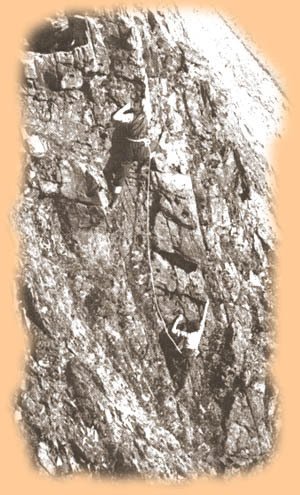 Simul climbing in the 1890s in England. Before climbers learned to belay. |
|
|
My favorite is "surprise" simul climbing where you aren't planning to simul climb but end up simuling because you run out of rope and can't find reliable gear for an anchor. When the rope goes tight, start climbing! Works best with trusted partners. This is definitely more common on granitic climbs. |
|
|
Eric Craig wrote: I think that the points you're trying to make are getting muddled up by terminology. The distinction you're suggesting isn't mentioned in Freedom of the Hills, Cosley-Houston, or TMGM. Use of the term "simul climbing" to describe moving together in alpine terrain is commonplace: https://youtu.be/xBWm_fBnqQo?si=nCI6GLer5Z8UpMVQ ("It could mean long 3rd or 4th class ridges") https://publications.americanalpineclub.org/articles/12200601400 ("Steve led as we simul-climbed up easy ice toward the ridge") https://americanalpineclub.org/news/2020/4/8/7emfrby0qk8mew5spzimu4ckm7deb6 (Article specifically on 4th class terrain, uses "simul climbing" terminology) Whether this usage is "correct" or not I cannot say, but it’s definitely common; arguing otherwise seems quixotic. |
|
|
The usage is not correct. |
|
|
NateCwrote: I’ve used pcp-protected simuling a lot on terrain I wouldn’t solo, but can comfortably run out 10-50’ between placements. (Ie steeper, more sustained 5th class rather than low-angle alpining) I think it can be a valuable time saving tool for competent parties and also is just generally more fun. It’s as close to solo-ing as I’m comfortable with and has a lot of the fluidity of free soloing with a fraction of the risk. I would challenge the perception that big alpine routes are unrealistic without simul climbing. A lot of ‘big’ alpine routes get guided all the time with basically zero simul climbing. (Excepting short roping, which is fairly different) |
|
|
Max Tepferwrote: If I'm comfortable going 20-50' between pieces, I'm generally comfortable soloing. Risk tolerances are hard to describe, but I think we are generally talking about a similar comfort level. I'm not certain I agree with you, but it's going to boil down to what constitutes a "big" alpine route which is where you, I and several others are going to have divergent opinions. Generally speaking, I wouldn't consider it a "big alpine route" if it has become pedestrian enough to be guided. Maybe throw an example out so I can relate to what you're saying? My impression of the word is usually a multiday technical route that isn't regularly repeated, requires a signifcant amount of experience in alpinism, and covers several mediums (rock routes significantly ease things to a point that while there are some exceptions the vast majority aren't "big alpine routes.") These routes usually require significant physical and mental commitment, and simul climbing of some sort (I'm sick of the semantics game that's being played above) is employed to improve efficiency and ensure that things are done inside a weather window. |
|
|
NateCwrote: Yeah, I spend enough time effectively soloing and sometimes soloing that I prefer to not do it recreationally. Especially in 5the 5.9 to 5.11- zone which is usually the grade I’m talking about simuling.
Definitely. By the below definition, there probably aren’t that many big alpine routes getting guided. Fitz Roy and the Moose’s Tooth both come to mind as bigger objectives that are somewhat frequently guided and might fit your definition? (except for the regular repeats part) Saying they’re not ‘big’ alpine objectives begs the question what’s bigger, but to your point, there’s a lot of subjectivity there. Lessar, still ‘big’ routes are the grand traverse, evo, Beckey chouinard, torment-forbidden, north ridge of forbidden, peak 113600, et al, but they don’t quite fit your parameters.
|
|
|
Max Tepferwrote: Fitz, and Moose's are definitely exceptions in what I was getting at and a good point for you to make. Moose's tooth is commonly done in a day by many parties though. Both are still big routes and proud ascents, though I'll admit that the frequency Ham and Eggs is getting guided is certainly diminishing its status in my mind. That's a different conversation though. I think a route that has been, and is still, guided that is inarguably big is the West Rib of Denali. My understanding though is that many of these ascents still involve simul-climbing to some extent. |
|
|
Max Tepferwrote: I meant to respond to this in my last reply. I think we are actually really saying the same thing now though. You likely can comfortably solo in those grade, but choose to simul climb in order to have some element of risk mitigation an still present on a big route. Am I correct? If I'm correct in that assumption, we are saying the same thing with our simul climbing preferences and criteria. I "could" solo the terrain but choose to keep the rope in play and moving in order to mitigate some risk. |


