
 Continue with onX Maps
 Sign in with Facebook






Pure Trad Multi-Pitch Rock Climbing - How Cold is Too Cold?



|
gunkie Xwrote: Not what you asked but- As a fellow Gunkie I switch over to single pitch when it gets down into the 40s and below. I wouldn’t do that at the gunks in the normal season but there’s no one there anyway. It’s not ideal but it extends the season and it’s better than the gym. There are enough anchors there these days that you have plenty of single pitch options. |
|
|
Kevin Rwrote: Thanks! Great video! |
|
|
gunkie Xwrote: I sort of fit in this cohort. I left the gunks a few weeks ago when the weather was temperamental. As a west coaster, I sweat too much if it’s sunny and 60 with the humidity, both to have security on polished rock and retain skin. Everyone was psyched it was 75 still, but even going up shockleys in the sun felt like death and 5.10 out of the question. I would have loved 50 and sunny daily. I found on the 50, cloudy, and windy days, a large jacket helpful. I’ve never found hand warmers sufficient to keep me warm. It’s probably not worth bringing the heavy jacket on multipitch unless you like climbing in it, so it’s probably worth focusing on climbing fast, linking pitches, and efficient transitions. If it was breezy at the base of the Trapps, the top was gusty and cold without shelter (a reason to stick to base pitches). |
|
|
Like others said, keep your core warmer than desired and your hands and feet will stay warmer. This works for ice climbing and skiing too. Functionally, this means I dress for the weather and then just add a vest into my layering system. You may have to trade off being sweatier than desired for warm hands. Also keep your belay gloves inside your jacket so they're warmed up before you put them on. |
|
|
It takes just a few trips to JTree at 45 degrees, with 50 mph gusts, and one short climb, after which the weather chases you back into the car, to learn you must be honest with yourself when you check the weather forecast. I think mostly sunny, 50 degrees, and 25 mph gusts is a minimum cut-off for JTree. |
|
|
Climbed in a T-shirt in below freezing temps at North Table Mountain near Golden, Colorado. Sunny winter day with no wind, south facing black basalt, so like a solar panel. Single pitch, though, so I guess it doesn’t count for much. |
|
|
I usually stick to single pitch when temps are questionable. Easier to bail when it gets unexpectedly cloudy, windy etc. That said, in the right conditions 25°F can be quite comfortable |
|
|
The Dawn Wall was freed in January then in late November. Nighttime temps in the 20s are typical. I don’t know how cold it got when Tommy/Kevin and then Ondra climbed it, but it can get very cold, even during the day. The early sun and southern exposure had to help, but a lot of the climbing by Tommy and Kevin were done at night. I was in the Valley last November and it only got up to about 35 during the day. But that was a cold spell. |
|
|
Lots of good advice here. My quibbles would be: 1) I know crack gloves are lame, but I find them to be significantly warmer than tape. 2) didn’t we all learn as kids that you lose 150% of your heat through your head? That’s why a beanie makes shirtless bouldering possible at any temperature, right? For real though, don’t skimp on the hat; consider a full balaclava for the fleshy flappy bits, helmets can take hat layers underneath. 3) November 50F is a lot colder than April 50F. Adaptation happens, but not if you leave the thermostat at 72F at home all the time. |
|
|
This post about wrist gaiters was in the context of gloves, but I've made pairs of them lower-profile to facilitate free climbing, and they work well. 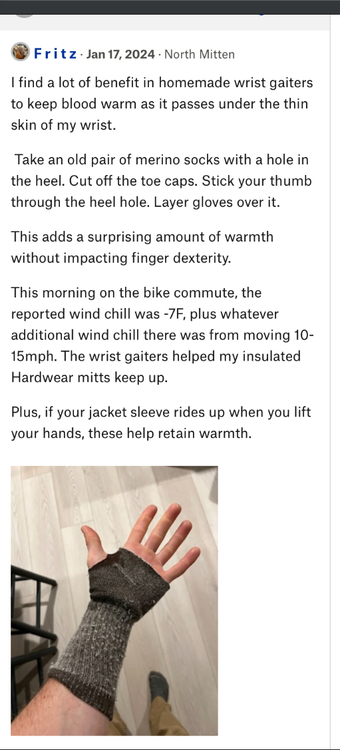 |
|
|
Sep Mwrote: If you lose 150% of your heat through your head won't you die? |
|
|
F r i t zwrote: This is genius. |
|
|
I realized how critical wearing a beanie is when climbing in temps below 50°F, never realized how much heat I lose through my head. Im am bald as hell so heat escapes my head fast. I found a thin but warm skull cap to keep on under my helmet and it helps. Im going to go this weekend and mess around with my balaclava that I normally wear in the winter months on my motorcycle under my helmet. hoping it should make a nice difference too. |
|
|
- hoods not hats - hoods are warmer because they keep your neck warm. - always wear socks under climbing shoes in the winter months, who knows you might convert to full time use! - temps matter less than wind chill and humidity. As already mentioned here in Colorado 20 degrees and sunny can almost feel hot on certain aspects on windless dry days. - no belaying followers on multi- pitch. Fix and follow everything. Consider hauling a small pack for a belay coat and maybe some coffee. - bring a stove to the crag. You can heat up rocks and put them in your chalk bag. You can heat your hands if you get desperate. Make fresh coffee, heat up soup for lunch. - link as many pitches as possible. Leader stays warm climbing, follower stays warm with puffy and wind pants pulled over harness. Consider bringing approach shoes for the follower to wear while belaying. Transitions take time and everyone gets cold. If you have a 2 pitch route you can do in a single pitch, fix the rope and rap to the ground. Follower fix and follows with a second rope to rap. - thin gorilla grip gloves let you climb easy rock with gloves on. - look for mixed lines with face holds vs crack climbs. That’s all I have. Stay warm! |
|
|
I like bouldering in the bitter cold, amazing friction, and your body works through the chill pretty fast.. I feel like multi-pitching below 30 is just mean to your belayer, and their toes. |
|
|
For the Gunks, I think the key thing in the winter is shifting your schedule to climb AM until the sun crosses the cliff (assuming you're climbing at the usual cliffs that lose sun at around 2-3pm). The Nears especially gets really strong sun so it's definitely possible to comfortably climb in the 20s or 30s on full sun days. |
|
|
F r i t zwrote: Curious, what were you up to? |
|
|
Andrew Gilbertwrote: Yer definitely gonna die. |
|
|
M Dwrote: I had been working year-round at an outdoor education camp above Lake City. By the start of the winter season, I had been sleeping outside for nine months and really wanted to get one year in a row. There was a truck topper on the ground in the camp junkyard, so I put a lot of closed-cell foam pads and several zero-degree bags in it. It was pretty cozy! I was doing a lot of biking, ice climbing and backcountry skiing, so adaptation was high. 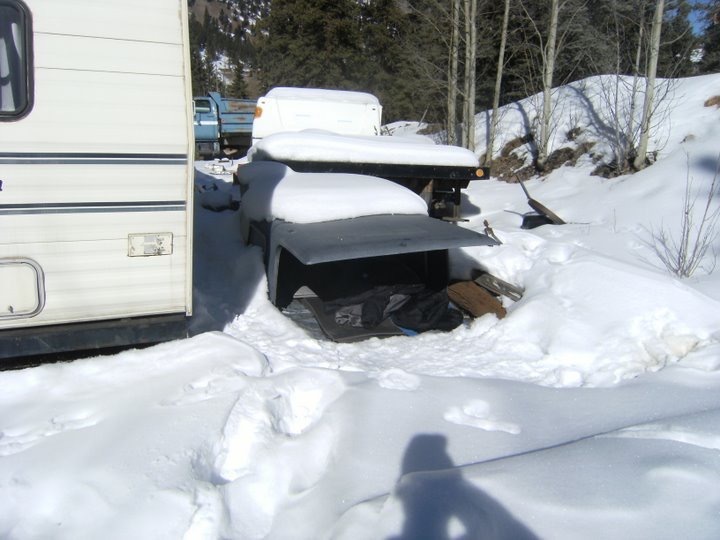 |
|
|
when it gets real winter its just more fun and a lot more logical to do this..     rather than this...  |


