Continue with onX Maps
 Sign in with Facebook






New Edelrid Belay Device the " Pinch"


|
|
The thing that most piques my curiosity about the pinch is that Edelrid supports its use for fixed point lead belay. The conventional wisdom around ABD devices for fixed point use has been that they provide too hard of a catch in a high factor fall scenario and that too much force is transmitted to the anchor. I'm not sure what to read into Edelrid approving the pinch for this use case—do they purport that it allows a bit more slippage than a grigri? I doubt it. So maybe they're saying that the hard catch/force transmission just doesn't matter that much and it would therefore follow that a Gri actually would be just fine for FPLB? That feels plausible. It seems to me that DAV has kind of led the way on development of FPLB, so maybe it makes sense that Germany-based Edelrid would be the ones to move this way. |

|
Gri gri's slip around 3-6kn depending on the rope used in pull tests with no hand on the break. |
|
|
Mr Rogerswrote: The forces in fact could be high, depending on whether it was direct, i.e. factor 2, or less, as is most commonly the case with protection above, that holds. That the rope can slip below the breaking/damage point of the rope within the device is reassuring, to a degree, and there is really nothing recommending belaying from the harness, over a direct anchor belay. The amount of dynamic belay imparted by lifting the belayer a few feet is inconsequential, and as long as the anchors are "bombproof," constraining the forces to the device and anchor is a better solution, than introducing random forces onto the belayer, that might cause loss of control, injury from impacting the wall, etc. |
|
|
ELAwrote: Agreed. |
|
|
Got mine today and won’t be able to test for LRS til later in the week but first impressions- when affixed directly to belay loop for LRS, you can thread a quick link through to secure from catastrophic opening without having to have a big locker on there (this would be assuming you are keeping it on you for a long multi). Second method, just put the locker on the top also threaded through belay loop; you can just put your fifi on there if aid soloing. I think the slippage is definitely going to make me lean towards grigri+ with a steel biner tho. My harness has a very narrow belay loop and it is way easier to open accidentally than I anticipated without threading something through to secure it. I honestly feel like it’s only a matter of time before someone belays off their harness without threading something through and we are here reading about it. I am able to remove it one handed if you press into the button and pull in the right direction on the lip it creates. Another low probability failure risk I can see: when the device is set up for LRS (aka inverted), the bite of rope that passes behind the camming device is exposed and on top- if it somehow catches on a fall (unlikely imo) it will pull all the way through the device without any breaking mechanism. It’s pretty snug in there but it’s definitely a risk the grigri does not have. Also noting, it kinda sucks you can’t use chunkier gym size ropes on it. Definitely a specialist device. |
|
|
Slim Pickenswrote: At 1:50 in this video they say you can use it like this, but it will result in “very high impact forces”. |
|
|
Kevin DeWeese wrote: So I'm more positive about clipping directly to the belay loop. Even with a Rhino locker on my GriGri, I occasionally get it cross loaded. After a few times, I figured out how to attach it smoothly. When feeding for a clip, I've used a technique with the GriGri where I hover my thumb over the brake lever, without hooking my index finger under the lip. This works better with the Pinch, as it's more stable. Regarding the problem of the device being completely removed from the harness while removing the rope, isn't this the case with the GriGri as well? It's quite possible that I'm not skeptical enough to ensure my own safety, but I don't quite see how one would open the device inadvertently. The button is flush with the frame, it takes a real, and particular, push to get the thing open, and there is a small tab that catches the belay loop while in the normal working position. To open it, you have to turn the device sideways for the tab to clear the belay loop. Someone above mentioned having a skinny loop; we'll see when I use it with my outside harness. So far, I like it. But I guess that could also be post-rationalization due to actually buying one at full retail. |
|
|
Victor Kwrote: Keep me updated on the skinny belay loop. My harness has a dyneema belay loop that is skinny and I've been curious about this. |

|
So since I'm not hearing anything are we assuming its just like every other trash copy. |
|
|
Kevin DeWeese wrote: What don’t you like about the pinch for belaying from above? Is it the extra weight of the device compared to a grigri or something else? |
|
|
Cam Brownwrote: It should be just as good as the grigri for multi pitch. The manual discusses top belay of the anchor. |
|
|
Kevin DeWeese wrote: Care to explain? |
|
|
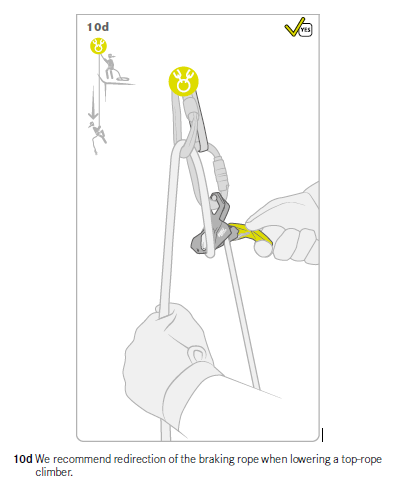
Kevin DeWeese wrote: Perhaps image 10.d in the user manual will help. |
|
|
Kevin DeWeese wrote: If you are insisting on going hand free while belaying this will likely provide enough friction to prevent the rope from back feeding through the device. BTW the grigri manual also forbids letting go of the brake hand while belaying. |
|
|
Pat, Manuals say lots of things. many are there to cover their ass so common use can be called misuse for obvious reasons. Example is using a GG for LRS. but pertaining to back feeding and a redirected brake strand…. Seems like an awkward way to belay back feed or not. And for clarity, I believe you’re assuming the redirect would offer enough friction to mitigate back feed. |
|
|
climber patwrote: It feels like you’re trying to talk him into liking something he doesn’t, which, why? |
|
|
Slim Pickenswrote: I don't care if he likes or uses the device but he is incorrectly saying it is unsuitable for multipitch climbing which is clearly wrong. I have played with the pinch in my room but not on a cliff yet. Both the pinch and the grigri will allow rope to flow if hung from an anchor and the direction of pull is straight down and the feed line is straight up. The pinch flows a little easier but not a whole lot with my 8.9mm rope. The bend from picture 10.a is likely to provide enough friction prevent back-feed but will definitely lock the device up the follower falls. Hopefully Kevin noticed the back-feeding issue after pulling the slack and loading the device rather than while belaying and taking his hand off the belay strand. If he was belaying, I would be scared to climb with Kevin. All these grigri-like devices have a range of direction of pull where they will not lock up. This range is the root cause of the grigri high clip failure mode or the upside down fall failure mode while LRS. The grigri has a range similar to the pinch where there is not enough friction to lock up the device in a fall. This range of not locking is the root cause of grigri/pinch/other similar devices high clip failure or upside down fall failure. In my little experiment the grigri 2 is very similar to the pinch in the range and friction. The pinch seems to have less friction that the grigri 2 but locks up quicker. The grigri+ seems to have a little more friction than the grigri 2 and locks up faster than the pinch especially with the switch in top-rope mode. All three devices exhibit the problem of letting the rope slide through the device if the pull and the feed is just right. The LRS community seems to be preferring the grigri+ over all the other devices because you can set the spring tension to allow easier locking of the rope. The LRS community knows about the back feed problem and current best practice is to do some sort of back feed mitigation every 5ish meters. I think the grigri+ is a better device for LRS and probably overall unless you really have a problem short-roping your partner. Those, including me, using a grigri for LRS manage this range of not locking to optimize the lockup failure modes with easy rope feed and backup the system with knots. Unlike LRS best practices, there is no knot protecting the follower for a similar failure with either the grigri or the pinch if you go hands free top rope belaying. |
|
|
Man. Really answered a lot of what no one was asking and came to some conclusions based off no evidence. |
|
|
Finally got my hands on one. Someone had it at the crag yesterday. Gotta say, 100% not a fan. I literally see no advantage over a GriGri. When looking at pictures, it looks like it has a lip to lock your finger in when paying out slack; however, that is far too small to use effectively. The direct attachment seems gimmicky at best and doesn't offer much, if any, real advantage. However, I could see it being useful when belaying from above. Anyways, just my $0.02, which is worth exactly that—hard pass. |
|
|
So I've been using the Pinch in the gym for about a month. Now that I've habituated myself to it, I have few comments. First of all, if you already have judged that it's a hard pass for you, fine. But if you are interested, the single best reason to switch from the GriGri is the ability to clip directly to the belay loop (BTW, it's fine with the small gauge loop, like on my Blue Ice harness). I feel a distinct improvement in control of the device for feeding rope to the climber when clipping. Previously, I've used both a DMM Rhino, and a Petzl Freino as belay biners to prevent cross loading. Even with those devices, I'd occasionally get the lock ring hooked to the belay loop. I know, I should do better. But, the Pinch really does support more control of the device by using the belay loop to resist rotation. It seems like I've been much less likely to short rope my partner, because my hands find the device more rapidly for the big feed. Also, it has some ridges in the glide path of the rope, which adds some friction when lowering, which is nice. Lastly, after some time with it, it's a bit faster to rig and de-rig. Overall, it works better for me than the GriGri. |