
 Continue with onX Maps
 Sign in with Facebook






iOS 18, Inreach killer?


|
|
Looks like the new update is out and you can now send 2 way messages via satellite on the iPhone 14 and up. |

|
I haven't had to use it yet and hopefully never will, but I've noticed the satellite icon on my iphone 14 when I'm in the backcountry before. The inReach allows you to text back and forth with people, track yourself and share position, and allows you to pull weather reports - all of which can be pretty helpful. However, I loathe paying Garmin every month when I don't need the service more than 1 or max 2 weekends a month so I fully intend to give up the other features and just rely on my phone as an emergency call(text) device should I ever need it. |
|
|
Cosmic Hotdog wrote: I guess you can now text back and forth with the iOS 18 update. I’ll try it out tomorrow. I don’t use the Inreach for anything but that. If it works I plan on abusing it: like texting my wife to call in a pizza on my hike out |

|
Ive been on the ios 18 beta for a while now with my 14 Pro, I think it’s great, though I will still bring my inreach. I like the idea of a device that has only a few purposes, and I can just keep my inreach off until I need it. But I’m glad more people will get access to that kind of technology in their pocket. |
|
|
Cosmic Hotdog wrote: Following this thread. This caught my eye...."It's free for two years after the activation of an iPhone 14 or later (all models)..." |
|
|
RJNakata wrote: I did some quick googling, I don't see what the cost will be once it's no longer free. But you raise a good point. Of course this will turn into an extra cost. https://www.apple.com/newsroom/2023/11/apple-extends-emergency-sos-via-satellite-for-an-additional-free-year/ |
|
|
For those who venture to more remote areas, I believe Apple is using the globstar network which isn’t really global. It works well in the lower 48 and most of Alaska but north of Fairbanks or west of Dutch harbor or so, Africa and even Hawaii aren’t covered. I used to use a SPOT device which worked on the same network and found the coverage to be a lot less than they claimed. Basically if u were anywhere close to the edges of the stated network it simply doesn’t work. The inreach actually works globally. |
|
|
Worth reading the August 22nd post here: |
|
|
Greg Barnes wrote: Here's the text: (I believe free-form texting is currently available - correct me if not)... "Grant County Search and Rescue:We've had a few missions lately where people are using the newer iPhone feature for sending SOS messages via satellite. Here are some observations about the emerging technology from a SAR standpoint:* At the moment, only pre-defined messages are available. Free-form texting should be rolling out soon, per Apple. Please note that the pre-defined messages may not provide enough information for searchers to be immediately activated. We have pre-defined rules that classify search urgency as high (immediate), medium, or low (which will be a delayed response).. * The best thing to do is to make sure your medical contact in the Health app is completely filled out with emergency contact(s) and phone number(s). That way, when you activate the SOS texting feature, that emergency contact and phone number will also be sent to the emergency center, and searchers can then call your emergency contact for more information. This will get assistance to the person requesting help a lot faster and more efficiently.. ** Hopefully it goes without saying that your emergency contact(s) should not be out in the backcountry with you with no cell service.... * Unlike InReaches, Spots, or similar devices, you have to actively point your phone to the satellites to communicate. This means after you've sent your SOS message, after some amount of time (10-30 minutes) you should point your phone at the satellites to see if there is a return message from the dispatch center. Without doing so, you may miss any return text messages. Please note that at this time, searchers have no way to communicate directly with you, and any info is relayed through the emergency dispatch center. Also, it may not be possible at all for the dispatch center to reply.. * While GCSAR is excited about this emerging technology, we want to remind everyone that it is brand new. There is a learning curve and when you are relying on it to possibly save your life, be absolutely sure you know how to use it before you need it.. * At this point, we encourage those of you that have other established services (such as InReaches or similar devices) with proven track records to continue using them. At the moment, these devices are vastly superior to the emerging iPhone technology.. * Always...alway...carry the essentials when going into the backcountry, even just for a few hours! We also strongly suggest carrying a physical map and compass, and not just rely on your phone for mapping. With all of the new technology, phone batteries are used more and more. A map and compass never fails a battery test!. * Along with the essentials, always let your emergency contact(s) know your plan. Countless searches have been resolved much faster after a vital piece of information was provided by an emergency contact.. Take a few precautions and enjoy the backcountry safely! |
|
|
I would absolutely not ditch an in reach yet. 'Ditch' implies you own it already so it's not like youre about to spend $400 and service is $10 a month. iPhones die, break, short circuit, etc, especially in extreme weather which may be present if you need SAR. Seconding above comments, this technology is brand new. It absolutely might work fine, but it might not. If you are just going cragging somewhere close to the car or with no/spotty service, sure your iPhone is probably fine. For actual backcountry travel, I do not see ditching my in reach anytime soon. It will take a lot of successful rescue stories, committing to always having a charging block (now heavier then bringing your in reach), and probably an otter box before I would go iPhone only. Major detail- the having to point your phone at the satellite to receive messages is a major red flag for me. The ease of working on a patient and just listening to your in reach ping is worlds easier than having to actively check for a message and not providing care every few minutes. I think the iPhone should be viewed as an awesome backup we have, not as an alternative, at least for now. Garmin also provides from my research the best price and simplest to claim on rescue insurance (read the fine print on AAC if you haven't, way not as good as most climbers think). This is another reason to stick with Garmin for me. |
|
|
Tried it out today on my drive home in a fairly wide open valley. Could not get it to connect and drained my battery a ton. Got my answer I guess |
|
|
Rainy Day wrote: whoa. not expected, but not surprised. |
|
|
Sent a text via satellite no problem today in about 10 seconds. Was up against a crag, maybe 80’ from the wall with the clear view of the sky. Wrote the message, hit send, it showed me in the UI where to point the phone. Once I did that I sent in seconds, no battery issues. 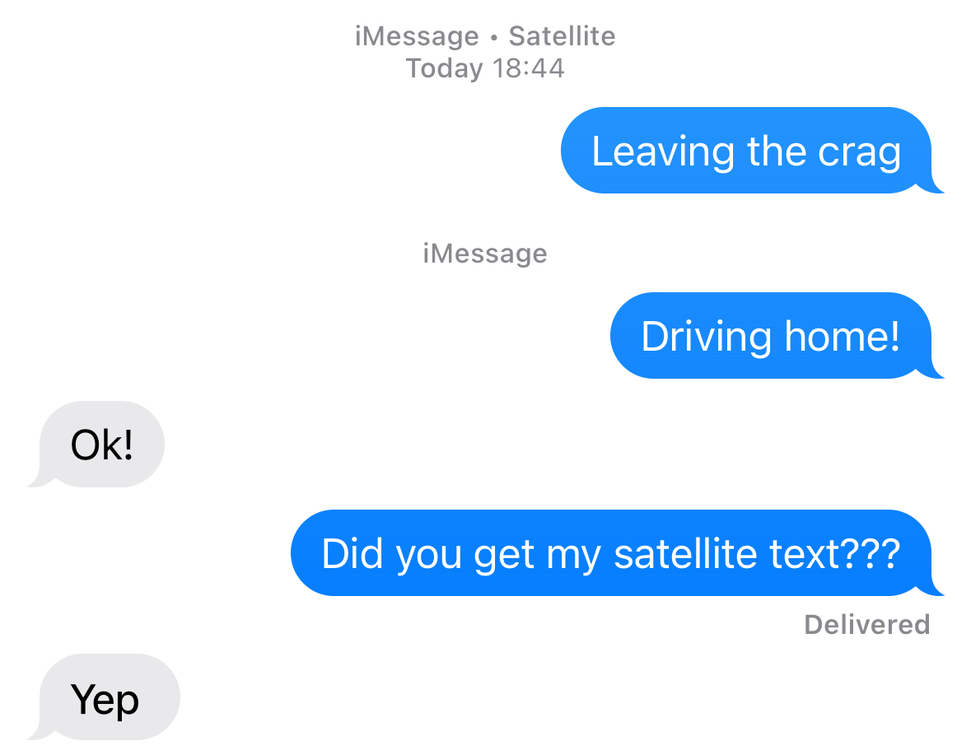 Seems like this would be hard to do while driving which may be why the previous poster had no luck sending a message. |
|
|
Does it come in GREEN? |
|
|
Live Perched wrote: That would be a sin |
|
|
Cory N wrote: Unfortunately I did get out of the car. And believe me when I say that I was very much hoping for it to go well and also not have to exit the vehicle. Based on this study there’s a 50 per cent chance of iit working |
|
|
My bad M L, I made an assumption based on what you said. Looking forward to hearing more reports. I was pleasantly surprised about it sending so fast because I had read your experience before trying and had very low expectations. Btw, I still had my inreach with me |
|
|
Pat Marrinan wrote: All valid points but one correction - even the cheapest Garmin plan now becomes $39.99 to activate (every single time you restart service, no free suspending) + $14.99 It's clearly still the superior tool but this is a money grab by Garmin |
|
|
Cosmic Hotdog wrote: Money grab and/or attempt to maintain market share. You're seeing this across entire satellite communications industry as Starlink, OneWeb and whatever Amazon's LEO system is called disrupt the GEO systems and legacy LEO (i.e. iridium). That being said my inReach ain't going anywhere any time soon. I've used iphone sat messaging a couple times, not sure it's ready for life/limb/eyesight level shit yet |
|
|
I understand the hesitancy of apples new messenger but at the same time I have had absolutely horrible experience with inreach on the beaches of Kodiak -can’t get more open terrain than an ocean…to the point I just stopped trying Likewise I’ve used all trails on my iPhone in mystery canyon and many other deep canyons with surprising accuracy. Wouldn’t the satellite capabilities be similar with all trails and the iPhone messenger ? |
|
|
akafaultline wrote: No. There's a big difference between receiving a relatively high powered signal from a sat (GPS) and sending a signal up to a sat from a small device with limited power and major compromises made to antenna design (Iridium). |


