
 Continue with onX Maps
 Sign in with Facebook






Trad Anchors: Which Direction Should Pieces Be Oriented in and Why?
|
|
Hi! I'm pretty new to trad climbing, and have a question about trad anchors that I haven't been able to find an answer to elsewhere. I'm hoping that someone on here could answer it. Sorry in advance for the long question, I wanted to lay out my whole chain of reasoning in case I misunderstood something somewhere! I know that you're supposed to place protection so that it is oriented in the direction that the piece would be pulled in the event of a fall (e.g., if you're climbing in a straight vertical line, pieces should be oriented more-or-less downwards). Suppose that you're doing a multi-pitch with your partner, Garfield. You've led the first pitch and Garfield will follow up directly beneath your trad anchor (i.e., not from the side). The pieces you use to build your anchor should be oriented downwards because that's the direction that the pieces will be pulled in if Garfield falls as he follows. Imagine that Garfield climbs up with no problems, you switch, and Garfield leads the second pitch. If Garfield falls as he leads, you will be pulled upwards, which will pull upwards the downward-oriented pieces that you used to make the anchor. This could cause the pieces to rip out, sending both you and poor Garfield to an early grave. Am I right in thinking that there's a bit of a dilemma here about which direction to orient anchor pieces in? If yes, what's the best solution to this dilemma? I'm curious because whenever I've seen others' anchors, all the pieces are always oriented downwards. Is it best practice to: (1) Orient all the pieces used to build the anchor downwards, because if Garfield falls when he's following the first pitch, all the force goes directly on to the anchors (assuming you're belaying in guide mode). But if Garfield falls when he's leading the second pitch, you'll absorb some of the force from the fall because your belay device is attached to your harness? (I'm not sure about this, because the force generated will be larger if Garfield falls from above the last piece he placed when he's leading the second pitch...); and/or: (2) Make sure that the lowest piece used to build the anchor is a cam (and not a nut) that will stay put if it's yanked upwards (i.e., it's not placed in an upwards flaring crack) because this is the piece that will take the biggest hit if Garfield falls when he's leading the second pitch. By implication, should you never build an anchor entirely from nuts (unless it's the anchor for the final pitch and you're walking off)? and/or: (3) Make sure that at least one of your anchor pieces is oriented downwards (so it doesn't rotate if Garfield falls when he's following the first pitch) and at least one of your anchor pieces is oriented upwards (so it doesn't rotate if Garfield falls when he's leading the second pitch); and/or (4) Something else? Sorry if this is a silly question, I want to understand what the best practice is and why. Thanks for your help! J |
|
|
The worst possible fall that your anchor must withstand is a factor 2 fall straight down which happens on a multipitch when the leader falls before placing their first piece. So the majority of your anchor strength should be downward to handle a factor 2 fall. In those circumstances, either the anchor holds or the team falls to their death. Second, the anchor must be able to absorb an upward pull if the leader falls after placing a piece. If your belay device is clipped to your harness belay loop, the force of the upward pull will be much like catching a lead fall standing on the ground for a single-pitch sport route. It doesn't take much counterweight tied to your harness to prevent you from being lifted up. So your anchor doesn't need to be nearly as strong in the upward direction as it does for downward pull. Also consider, that if you are being pulled up, then the top piece of pro that is totally independent of your anchor is holding the force of the fall. So in a sense, your anchor is a backup to the top piece of protection that caught the fall, and all the pieces between the top piece and your anchor are also backups. Given the above, most folks are happy with a single (bomber!) piece of a multipiece anchor that is oriented to resist upward pull. This could be a multidirectional cam placed in a horizontal, or it could be a piece placed specifically for upward pull that is held in place by tension from a piece oriented for downward pull. If you belay the leader with your belay device clipped directly to the anchor instead of your harness belay loop, then your anchor should be constructed with more attention to upward pull. |
|
|
Thanks so much, that's really helpful! |
|
|
I think (2) is the most common case. That is, a cam doesn't need to be in a horizontal to be considered multi-directional. But, if the crack is vertical, it needs to be deep enough for the cam to rotate freely, and the crack's sides need to be parallel and flat enough to avoid unpredictable effects from rotation. |
|
|
I simply want to salute you for asking questions. Many simply learn how to do something one way from a "mentor" and then that is how they do it from then on--and they never learn the WHY of what they are doing. As you climb with different folks, a great way to learn is to ask them WHY they do a certain thing in a certain way. A responsible climber should be able to explain the reasons... a sketchy climber shrugs the shoulders and says, "I dunno... I´ve always done it that way." Relatedly, you will find that any two experienced climbers will often differ greatly in how they do something and both will have reasonably good answers to the WHY question. That´s because there are often many safe ways of doing the same thing depending on circumstances, climber experience, etc. You will just have to gather evidence and expert opinion, then decide what works best for you. |

|
I love this thread. Great questions, great (helpful and informative) replies, great encouragement to ask questions like this. The community is awesome. |
|
|
Crotch Robbinswrote: Does this mean that when I'm building my anchor, I should mainly focus on where the factor two fall could happen instead of the direction that the follower is coming from? Returning to the Garfield example, suppose that this time Garfield is following the first pitch and approaching from the left, but the second pitch that Garfield will lead is more to the right. Should I have pieces that are oriented in both directions, but perhaps the more bomber pieces oriented to the right? |
|
|
J Ewrote: J E, the real answer to this is that it depends. It's important to focus on what direction the force will come from, that's true. In the scenario you describe, I would probably orient in the direction of pull for the follower, but not completely. If the end of the pitch is a traverse, I'd likely allow for that somewhat, with the understanding that on top rope the follower falling won't produce nearly the amount of force that the leader would from climbing above the anchor (to start the next pitch) and then falling onto the anchor before the leader gets their first piece on the next pitch in. What I mean is, if I'm leading the current pitch and I know it ends with a traverse, I'll likely put as bomber a piece I can to protect the end of the traverse and then slightly orient the anchor toward that last piece, realizing that the last piece on the pitch I just led is going to take the brunt of the force if my follower falls. That way, I can slighly readjust the anchor if I need to, because protecting the leader when they start the next pitch and when the anchor will see much higher forces > a top rope fall with lower forces. There are other methods one can employ also. For example, I've often plugged "augmented" pieces that are strong enough to hold a TR fall that aren't part of the anchor, but will allow me to arrest a TR fall from the follower in the direction of pull should the follower fall, so that I don't have to readjust the anchor for direction of pull for the next pitch if that direction of pull happens to be wildly different than the previous pitch. These little tips and tricks are what you learn over time, and from climbing on different terrain. One bit of advice I got early on that has paid off very well (seeing as how I have taken plenty of falls on multipitch terrain and I've never been injured and I'm still here to talk about it) is to never push your mechanical skill and your physical skill simultaneously. Try to get in lots of mileage on things that you're fairly confident that you won't fall on while you're working all these methods and logistical considerations out. Once you're smooth and can configure anchors in a variety of different terrains and know the "why" of what you're doing, then start pushing grades. Happy climbing, and stay safe. |
|
|
For vertical nut placement, it usually protects against downward pull. Although you definitely can place oppose nuts as multi directionals. For Horizontal nut placement, it should be multi directional if you place it correctly. For cams on vertical placement, you need to ensure it can be pulled upward/downward. For trad anchor, it should protect against downward/upward pull. Another thing that you can minimize the force if the leader climbs above the anchor before placing first piece and fall, this can be a factor of 2 fall which generates a lot of force. The leader should always clip in the rope into one of stronger pieces or anchor. Therefore, when the leader falls, it's just the leader force and not with belayer force. |
|
|
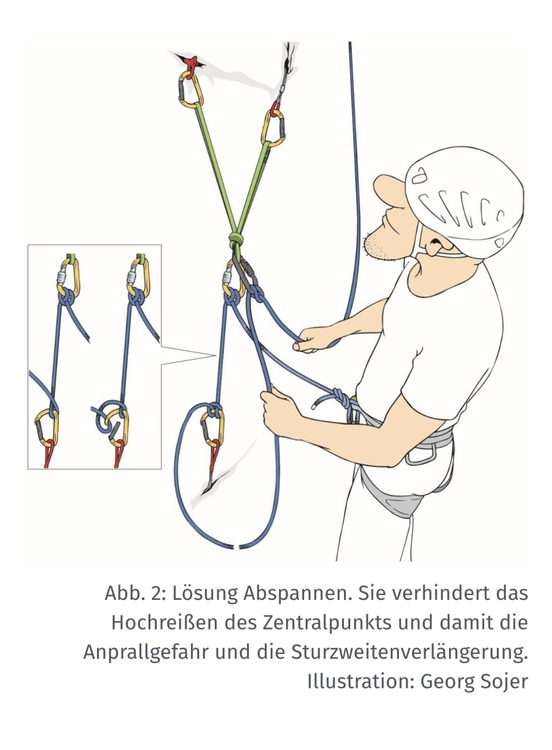
J E, an easy way to rig your anchor for an upward pull is to take the backside rope of the clove hitch at the master point and clove this to a nut or cam below the MP rigged for an upward pull. If you really want the belayer to stay put (like if you are belaying below a roof) take the backside of the clove on the upward pull piece and clove that to your belay loop. |

|
This is my strategy: I Build the anchor for the downward pull of the second, and don’t worry about the next pitch. If you’ve done a long pitch, you’re often limited in the gear that remains on your rack and you have to make the best out of what you have. The only task at hand is protecting for the downward, low force typically, pull of the second taking a fall with no slack out. |
|
|
Short answer: In direction of anticipated loading. |
|
|
A picture of what Ken Tubbs described from the DAV. In the alps there‘s still a lot of belaying the leader from the masterpoint.
 |
|
|
B Uwrote: So that leader magically comes to a rest without any opposing force from the belayer? Ummm. Maybe you are thinking of the banshee belay. |
|
|
Cosmic Hotdogwrote: Don’t get used to it. |
|
|
Tony Danzawrote: yup, with you. it's a rarity to the point where i had to comment on it |


