Continue with onX Maps
 Sign in with Facebook






Petzl Ice Tool Failures (Current Generation Quark, Nomic, and Ergonomic)


|
|
Rexford Nesakwatchwrote: 1. Some of the current picks have holes that will fit on ice clippers, and the newest gen (all future production) tools and picks will have an option for easily clipping at the back of the head. There is also currently a wrap that also serves as a washer for the bolts and nuts that you can get that also serves for clipping your tool. 2. Currently, no. But carrying a spare piton hammer is probably more functional in my opinion for any legitimate hammering. But I do understand this concern having been used to tools with a hammer myself. |

|
Artem Vee wrote: People keep calling it a new design… it was released in 2018. It’s been on the market for 6 years. That’s part of where my insistence that the number of breakages is small comes from. Not to derail your point or nitpick. Just clarifying to keep the perspective on the tools intact. |
|
|
Is Petzl releasing a new Nomic-it is rather long in the tooth…. |
|
|
Pat Marrinanwrote: I bent an X dream shaft. That was my bad tbh and it didn’t break, just got a bit wonked to one side. Camp replaced it, this was 2018. I got spooked by it and I wasn’t in love with the tools for my climbing anymore but I have confidence in X dreams not to break. Also it was for sure my fault. |
|
|
Petzl NA wrote: Petzl NA ? How young are you? Everyone today needs to hide behind some form of internet identification without using their true name! Secondly, embarrassing you could not identify a metal core in the handle from the photo’s. Generically I stated metal because the composition could be an alloy. This forum should be left alone, available at this point only to invite more listings of failures and followed by responses from Petzl. David K Rioux |
|
|
Artem Vee wrote: All these failures listed are with current generation Nomics and Ergonomics. Design and manufacturing would include current Quarks as well. Even if no failure s are being reported as of yet. |
|
|
JJwrote: I agree with your posts. But material is not just the only criteria. Engineering can certainly make different materials viable in axes. Selection of alloy and design of the components. Also different materials contribute to different characteristics. Bike frames constructed with different materials will have different tube thickness and diameters. Bicycles are easier to point out some differences. Climbers are seeking lighter tools and different functions characteristics every few years and expectations keep expanding. Make tool as light as possible while meeting certain functional characteristics and dependability might be present in the majority of numbers with few unexpected failures. The failures are without doubt higher than being reported in this thread. Also higher numbers than either climbers expected or for that matter higher than manufacturers expected as well. |
|
|
David Riouxwrote: I didn't take Petzl NA's post to be anything but conjuncture. Same as your speculation about quarks. That's the problem for all of us here, because like you, we would all like to hear from Petzl and get some numbers and some engineering/design feedback on the situation. A sister thread was started on UKCC. There was a post that might make sense to Petzl's, I have no idea if there is different/additional legal issues in the USA. But the lack of transparency is frustrating. The post is below; As ice tools are an item of class III PPE, there is a Notified Body (APAVE Exploitation France for the Nomic) who are responsible for monitoring the equipment through periodic testing and production control. Therefore Petzl are under a strict watchful eye and I don't think they would be shirking responsibility for their tools. They will be complying with whatever regulations they need to which probably prevent them communicating publicly outside of an official recall. The best way to get Petzl to notice is to submit a warranty application. This will be logged and the Notified body will be made aware. We can hope that Petzl will build their next generation to exceed the strength of the current ones, but if they pass all the standard tests and the failures happen at a low enough rate then they are doing their job according to the law. Threads like these and the one on MP can inform users and potential buyers, but I am sure they will not lead to action from Petzl. |
|
|
Melanie Sheawrote: Probably if you tried harder to break it you would have. How was it your fault, anyway? |
|
|
Steve Barbywrote: Any Petzl employee can’t post here regarding safety. I believe they’d be restricted from doing so. That said, I’ve a bit of experience in understanding KPI and process yields. Given the huge number of ice climbers and that Petzl is one of the product leaders in this sport, I’d be comfortable surmising that the number would be out of the million or so range? Let’s say you’ve 500,000 to 1M people using Nomics, multiply that by 2. That’s 1M to 2M tools. Take the number of failures we’ve seen and multiply by 4 and you obtain 20-30 complete failures. This is still much better than 3 Sigma. A design flaw would be considered below 3 sigma depending upon the application. Typically, 2 sigma is a good failure mode to investigate design issues, but for mountaineering 3 sigma? My first thought is not to solo with any tool, unless I absolutely had to. Secondly, it’s a dangerous sport. Lastly, Petzl has designed this tool reasonably well enough for me to trust them. Of course, I’d have a redundant safety system when using them. |
|
|
2.45 million ice climbers/mountaineers in the US alone! https://www.statista.com/statistics/763799/climbing-traditional-ice-mountaineering-participants-us/ |
|
|
slo tawrote: To be less snarky, the comments (by JJ and others) about how aluminum is a bad choice due to fatigue life are a bit ridiculous. The number of cycles we're talking about doesn't check out on the back of the envelope: 1 million cycles (the point beyond which steel and aluminum differ), if you assume 2 feet of progression per swing, is 2 million feet of ice climbing. At 50m per pitch, that's ~12,000 pitches, or 24 years of ice climbing at 500 pitches a year (which is a huge number). So the scale of usage we're talking about here doesn't match the graphs or the failure rates. And, lots of items with cyclic loading are made from aluminum: airplanes, bicycle frames and components, automotive suspension parts, wheels, etc. That's not to say this particular tool doesn't have a problem, it seems pretty clear to me that there is a design flaw which could result in catastrophic failure. Just saying it's not due to the choice of aluminum alone.
It can still be a design flaw if it's above 3 sigma. 3 sigma is ~99.9% (~1 in 1000), that's an unacceptable failure rate for lots of things (planes, cars, life support equipment, etc.). I think you're confusing standard manufacturing tolerance assumptions with failure rate of critical assemblies, which are very different things. 3 sigma is a totally unacceptable rate for complete failure of safety critical equipment (such as an ice tool).
How do you have a redundant safety system for an ice tool while leading ice, unless you grow another arm and climb with 3 hands and 3 tools (and always have 2 in the ice while swinging)? |
|
|
Kyle Tarrywrote:
Ropes and protection … |
|
|
Li Huwrote: A lead fall on ice has a very significant chance of serious life-altering injuries, so I don't think that ropes and protection offer full redundancy against tool failure. They are likely to keep you alive, but I think that the risk of a major lower leg injury is a significant risk in its own right. I acknowledge that this is subjective and others may be less risk adverse than myself. |
|
|
Artem Vee wrote: There is a post listed with a failure at the head. Still includes quarks. Yes, failure at the handles would not include the quarks. In writing my post I should not have included “All”. Error. It was late. |
|
|
Steve Barbywrote: I agree go through the warranty process is the best way of informing Petzl. Great post. I agree if Petzl is aware of everything listed in this forum or other forums, not just any representative will be able to respond. Time, information gathered, legal requirements, research and evaluation, etc manage there interaction with us. |
|
|
Kyle Tarrywrote: I 1000% agree with your observations, but want to include the idea that it could be manufacturing, not design. I’ve seen a lot of metallic parts with solid design undone through out of spec heat treatment, passivation, anodizing, etc. I’d actually lean more that way myself. |
|
|
Hedging my bets soling wtf off the deck today. One of each, they can't both break at the same time ;) 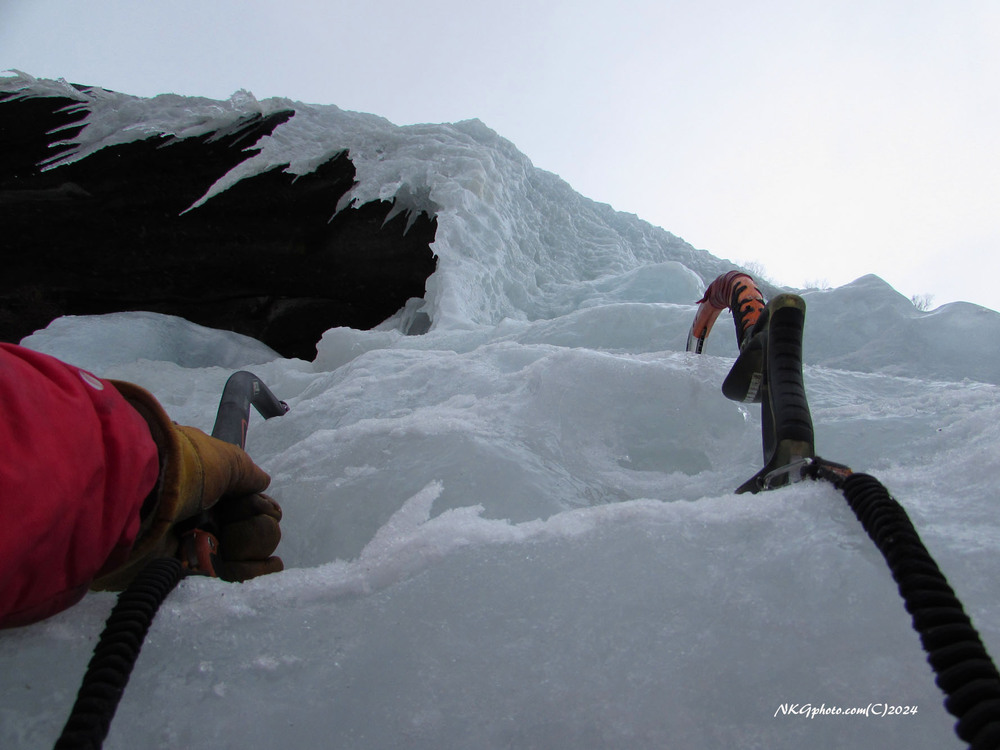 |

|
I just want to reiterate that the arguments of "the current failure rate is 'low', so this is not a big deal" are poor arguments to make for uninspectable fatigue cracks that lead to potentially catastrophic failures. No one outside of Petzl has any idea what the actual failure rate is. No matter how many examples we find on the internet, we cannot be confident that everyone who has broken an ice tool will share that information online. Whatever the current failure rate is, the fatigue failure rates are going to increase with time / use. These fatigue failures were probably non-existant within Petzl's prototype testing period. While it is understandable that Petzl could have missed this during R&D, their lack of response to these potentially catastrophic failures is not tolerable behavior, in my opinion. I can begrudingly tolerate the low-strength (1.5 kN) pommel design, wobbly heads, or even fatigue cracks that can be detected by die penetrant inspection. However, ice tool handles breaking off without warning or guidance from the manufacturer rises to the level gross negligence, in my opinion. The only reason why Petzl and other climbing equipment companies continue to get away with this kind of behavior is because consumers accept it and regulatory bodies do not respond by strengthening the regulations. Again, I want to reiterate that uninspectable fatigue cracks that can lead to serious inury or death are not tolerated in many other industries, and I see no reason why the mountaineering equipment industry should continue to tolerate this. Fatigue crack inspections are the common method for preventing potential catastrophic fatigue failures. These fatigue problems are not approached from the perspective of "acceptable failure rates", but rather a perspective of "when / how should fatigue cracks be detected / sized through inspection to prevent castastophic failures from occuring". |
|
|
This reminds me a lot of the fervor over Thompson bike parts some years ago. There was a string of catastrophic stem failures (including mine, no injuries thankfully) and the internet arguments just about mirrored those here. Most blamed incorrect torque spec/use, some said “no part will last forever” and suggested use beyond end of wear life. Others pointed out the lack of grain structure and induced stress risers from machining billet rather than forging. No one had data, only annecdotes and pictures on the internet of broken gear. There was also the contingent of Thompson defenders as they do seem like Good People. Funny thing is… I’m personally convinced machined bicycle stems are not acceptable, but Thompson still sells the same exact designs 15 years later, so really nothing has changed. I don’t expect anything here to either… |