
 Continue with onX Maps
 Sign in with Facebook






Gymclimber mag - Auto Belay related lawsuit



|
As an attorney ( though not one involved in such suits), I agree that one shouldn’t rely too much on a plaintiff’s press release, especially one as ‘carefully’ worded as this one. I also agree that there is considerable pressure on all parties to settle instead of taking a case to trial, so it is wrong to read too much into the fact that there was a settlement in this case—-though it was quite a substantial one, in attempting to determine what really happened in this situation. I do assume, though, that the summary of plaintiff’s injuries is generally accurate—and that they were substantial. I also feel that the judge’s determination that there was a cover-up by C3 and it’s original counsel ( backed by a substantial fine) is significant and very troubling. It is really unfortunate in such circumstances that the reality of litigation will likely prevent, or at least seriously impede, a full and objective determination of what actually happened here. The bottom line though, is that this decision may very well have significant negative impacts on climbing gyms ( with possible roll-over effects on certain privately-owned outdoor areas as well) in terms of higher insurance costs or, potentially, the inability to obtain any insurance—which would, in turn, lead to increased fees for visitors and members or even possible gym closures. Personally I don’t trust or like any auto-belay systems and rarely use them—and when I do, I try to stick to routes on which I am unlikely to fall and routinely down climb instead of lower. |
|
|
Alan Rubinwrote: Same, although I love that split second of free fall after letting go of the wall, but before the auto belay engages, where life flashes before your eyes, but then the machine catches you and you live to climb another 5.7 auto belay route. |
|
|
https://www.reddit.com/r/climbing/comments/16kdukf/vertical_world_response/ 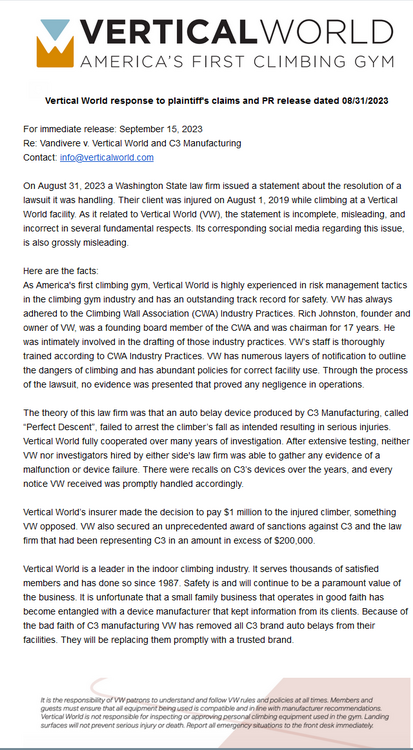 |
|
|
The VW press release, posted above, if accurate, just adds to the uncertainty ( to put it mildly )as to what actually occurred in this situation. It is worth emphasizing one part of the release: “After extensive testing neither VW nor investigators hired by both side’s law firms was able to find any evidence of a malfunction or device failure.” It is note-worthy, very likely as a result of language in the settlement agreement that there is no mention of the extent, if any, that potential ‘pilot error’ contributed to this situation ( as it has in the other auto-belay accidents that I am aware of). It is not surprising that the insurer decided to settle, given the nature of the injuries sustained by the plaintiff and the impact those injuries would likely have on typical jurors. But, as I mentioned in my previous post, this just increases my concern as to the long term effect of this litigation upon climbing—and not only the climbing gym industry. |
|
|
bruce lellawrote: sorry i am literally years late to respond. the plaintiff's attorney emailed me and was asking a bunch of questions. i told him to pound sand. |
|
|
Has this issue been decided? What is a final verdict of esteemed MP experts? |
|
|
|
|
|
Just A Climberwrote: From day one when I read the story, I have always suspected that the climber did not clip in properly. While it could happen with any biner, I've seen it happen more easily with those triaction locking carabiners (popular in gyms) -- people are too used to believing that the biner is locked once they let their hand go. 99% of the time they do. Occasionally, the biner gate gets caught and remains in unlocked position. In the regular gym rope climbing setting, only the belayer has a chance to make this mistake (with their belay device biner) since the climber always ties in (not clips in), and the belayer usually catches this rare mistake because the belay action automatically makes them look down from time to time. In the auto belay setting, it's the climber who might make this mistake, but they are so focused on climbing that it's hard for them to catch that error. The scenario is pretty clear to me. In the latest Runout podcast episode, the gym owner confirmed that when they found the fallen climber, the intact biner was at the top. No, it's not unclipped by staff trying to help him as some have speculated. A good listen on how the incident led to the settlement. The saga is not over yet. |
|
|
That was a terrific Runout episode, maybe my favorite to date. I thought Rich did a good job explaining the lawsuit, at least to someone like me who doesn’t have a law background. You could really feel the contempt in his voice talking about Vandivere, the guy who brought the suit. Our legal system is F’ed. |
|
|
Cronwrote: The US legal system practically killed affordable personal airplanes back there. |
|
|
Just A Climberwrote: The issue you raise about the triaction locking carabiner makes me nervous. I have noticed this with the carabiners (usually older ones) on the auto belays at one of the gyms in my area. As an adult, I always double-check and never let my kid climb on an auto belay without checking the carabiner. However, the gym is full of unsupervised kids climbing on the auto belays. It wouldn't be a bad idea for gyms to assess how they approach supervising the use of the auto belay systems, at least with children. |
|
|
Deirdrewrote: In the auto belay setting, the solution is simple -- two locking biners with opposing gates. I know it would annoy me if I had access to auto belay and have to deal with two locking biners, but leaving room for some careless users to make gross mistakes will only result in higher cost for all gym users. Vertical World's insurance premium went up 300% because of this incident. Lawsuits like this will not make climbing gyms go away; they will just cost more for all to use. |
|
|
I think that's an issue with all carabiners, no? The nose can sometimes catch on the belay loop and not fully engage the locking mechanism. As JAC mentioned it is more that the auto is more of a "clip in and go" movement as opposed to one with a buddy check, etc. Seems prudent to do a gate lock check regardless — clicky clicky no die! (thanks MP ) |
|
|
It seems like autobelay makers could easily enough add a sensor to the clip in point and a stop/go light as an added safety check that the carabiner is closed and locked. I remember something similar in the autobelay system at Vertical Endeavors in St Paul back in the day. My impression of the trublue and perfect descent autobelays is that they are an accident and lawsuit waiting to happen. |
|
|
Dude is a Barney shoulda never got on the auto belay and people like him who take advantage of legal loopholes lead to artificially increasing prices (via insurance rates which are passed to consumer) of everyone who actually enjoys climbing and it’s not fair to the business owners to pay for the dudes screw up |
|
|
If anybody is curious how this panned out for Seattle climbing gyms: - Edgeworks owns several rope climbing gyms in the greater Seattle area, but they got scared, removed all autobelays and have not brought them back. - Currently Vertical World still has several auto belays in each of their 2 gyms (Seattle and Mukilteo), all from TruBlue which use a different internal design than Perfect Descent did. Sounds like VW has their employees do a function test every day on all of them. I admire that they didn't roll over on this after the lawsuit. - They added a 2nd triple action carabiner on a short sling that's girth hitched to a hole in the main carabiner's spine, apparently designed for exactly this purpose. The main carabiner is tight and the backup is dangling loose while climbing. It's one more step to connect but doesn't annoy me while climbing. - There are giant red mats / signs at the bottom that block the starting holds until you are clipped in, and then they have multiple yellow signs on the wall that you climb by reminding you to clip in. - VW takes them down and sends them off for service frequently, so there will be missing autobelays for weeks or months sometimes. But I'm just happy to have any autobelays at all, especially for doing laps on the cracks. From TruBlue product page, this is how all are setup now: 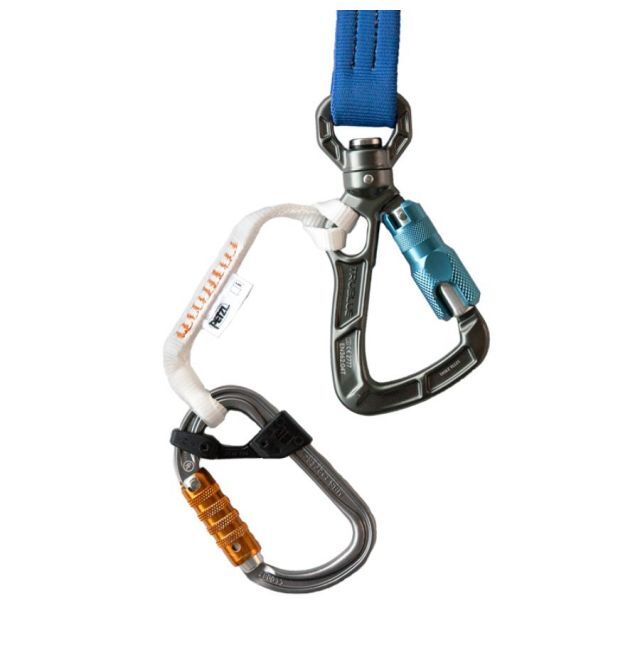 Old pic before they added the 2nd carabiner but the mats are the same. Red square is like 4-5ft tall: 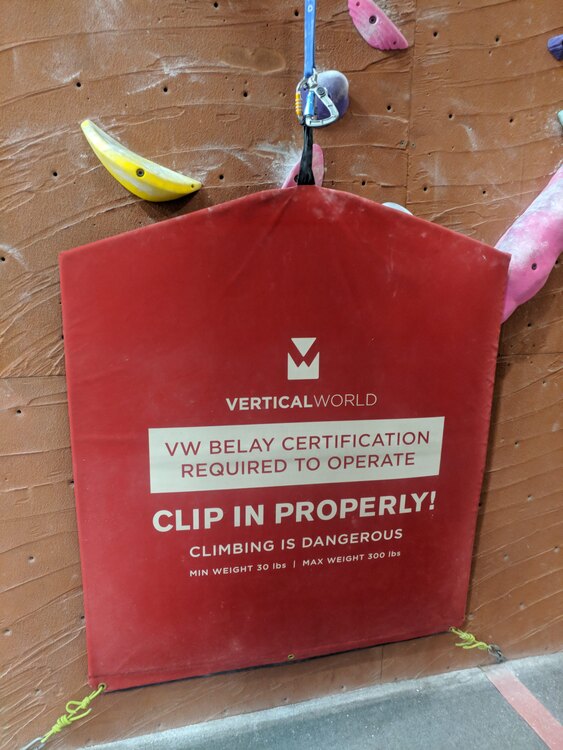 |
|
|
Former trial attorney here. This case didn’t settle because of the facts about the accident or the autobelays — it settled because of litigation misconduct by C3 and their lawyers. In litigation, both sides have to turn over all their evidence. If they hide or withhold anything, the judge can sanction them. Usually that just means paying a fine. But if the misconduct is bad enough, the judge can pretty much do whatever they think is fair. In this case, the penalties were serious enough that C3 had to dump their entire legal team, and that the new lawyers told them to settle for $5M. When that happens, the smaller defendants almost always pay out their full insurance limits. Going to trial is just too risky once a major party has already settled — especially since the jury isn’t allowed to know why. Bottom line: this was a BS case that should have gone nowhere. It only went somewhere because C3 essentially chose to lose. |
|
|
Devan Beewrote: I am going to add - RunOut #112 had Rich Johnston, the president and owner of Vertical World in Seattle, as guest, this lawsuit was definitely mentioned. |
|
|
GeHowrote: I agree with your premise but the woman was given third degree burns by coffee that was legally to hot to be served, and all she originally sued for was medical bills for illegally hot coffee that gave her third degree burns when she couldn’t afford medical bills bc she was retired. |
|
|
Nels Rogerswrote: The restaurant had also been notified about it several times. ...and about defective lids that didn't stay on. The real story is a lot more than the sound bite that people sent around. (it always is) |


