Continue with onX Maps
 Sign in with Facebook






Slinging trees while leading - How small is too small?


|
|
I'm a novice to trad climbing, and got myself on a route the other day where to only decent protection I was finding were some scattered pine tree saplings. I attribute this, at least in part, to my inexperience with finding good placements. I'll be working on that, but it did make me wonder if any of the little trees would have actually held had I taken a fall. Most were a few inches in diameter, like wrist size or a bit more. What do the more experienced climbers, or tree experts (arborists?) think? How small is too small? What is the threshold where you wouldn't bother slinging the tree? I've heard for anchors you want something thigh size or larger, but I assume anchors demand a higher standard. |
|
|
generally I’ve heard the rule of thumb is the thickness of a human thigh. These obviously vary in size. If there’s no other protection available you take what you can get. Though I don’t envy the sapling called upon to catch a big whipper before it’s had a chance to grow up :,) |
|
|
"Five and alive" is what I was taught. 5" diameter at the base and in good health is a general rule. |
|
|
I will definitely sling things way less than 5 inches or the thickness of a thigh for lead protection if nothing else is available. I however take some consideration to not ending up in a situation where I fall with something not well attached to the rock, where I would end up hanging from the rope together with a large ripped out tree attached to the rope. |

|
|

|
As noted, it depends. Sometimes one has to take what one gets. Regardless of slinging a tree, brush, chikenhead, or placing a marginal piece of gear gives one just enough of a mental break to relax so to figure out what comes next. |
|
|
It depends. What's the alternative? What's the probability of falling, fall-factor, distance between placements, etc. How well rooted? How exposed to the wind and elements has the tree been? Dead or alive? How long dead? Can you move the trunk and root system? Is there pitch or sap? Are you slinging at the very base or up the trunk? |
|
|
Not what you asked but- if you let us know what route you were on there’s probably someone on here that can give feedback on protecting that route. |
|
|
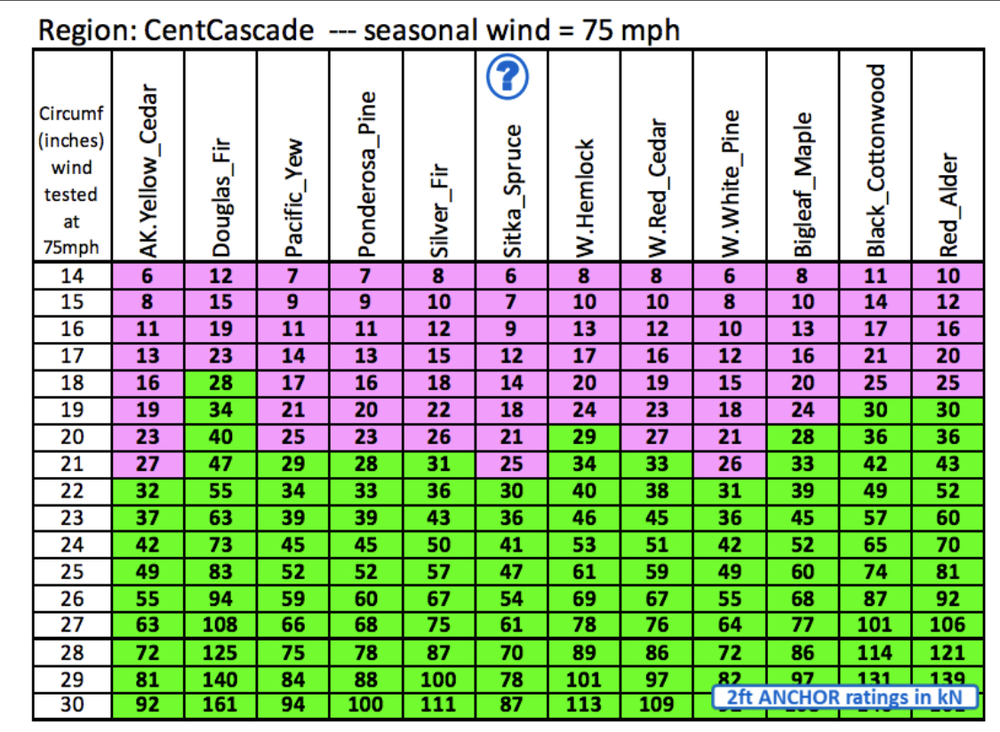
Zach Kwrote: This was a great study - brilliant to figure out how to measure the strength of lots of trees without heavy equipment. Note that the left column is circumference - not diameter. The trees in the first row are about 4.5" diameter and broke a 6kN. Obviously, this is for well-rooted trees. |
|
|
Jay Andersonwrote: I wouldn’t put too much stock in that study. If it’s “well rooted” a 4.5” diameter tree can sustain WAY more than 6 kN That study is more saying that at min, even a crappy rooted tree of that diameter can sustain 6 kN…(by still being there, it’s proven itself) even so, it all depends on the rock and soil quality of the specific tree at your specific time and place. Forget the table, clip any tree or bush (as low to base as possible) the size of your wrist or larger that you can’t obviously pull out by hand, and move on to the next best placement. |
|
|
The average whipper, even large ones rarely exceed 5kn, though I'm sure exceptions do exist. If you're run out, what are you gonna do, NOT sling it? Sling it, hope to stay on, and that's about as good as it gets. You can either protect marginally in R or X (or even PG) territory, or not protect. One clearly seems more prudent than the other in that circumstance. |
|
|
Take whatever, sling it at the base and pay attention to how well rooted it is. Just like any pro ideally it should be bombproof but sometimes you have to take what you can get and then place as soon as possible after. Sometimes I place a mediocre cam to protect a small low force slip and I treat small trees/roots the same way. Rhodos can be pretty strong and cluster of them can be decent (usually near the top, in low angle terrain anyway so the falls won't be as severe). That said, just like seeing some small cams blow, I've seem folks end up with a small tree dangling from the rope after falling on them. On the plus side, once the foliage has been ripped out, you likely can excavate a placement if it was living in a crack... Mainly just use common sense - a sapling isn't going to handle a serious winger where you are in free fall but it might slow you to a stop if you slide past it while still accelerating. There is no real hard rule about this stuff, there are too many variables and plants are too variable in their toughness. Note that I've seen small trees that are up to thigh thick only loosely attached at the roots that are mobile when you pull on them (ie the whole base lifts out of the dirt) and some roots an inch thick I had no hope of break short of using a tool. Tug and test it as best you can. |
|
|
Just make sure to also weigh into your decision to sling or not the possibility of sending down a bunch of dirt, rocks, or a whole tree down onto your head and your belayer's head in the event it doesn't hold. |
|
|
I've hung on a tree sapling before to place a bolt |
|
|
Mark Pilatewrote: Once, while cleaning a route, I found this birch tree the size of my forearm. It was stood, with green leaves and all, on a 1 meter by 10 meter ledge in a 10 centimetre deep turf. I grabbed the birch with both my hands and used the strength of my legs, and I pulled with all my might. To my surprise, I was able to peel the tree and the entire turf off the ledge! It turned out, that the ledge was completely flat and smooth. That taught me a lesson about how well rooted a tree needs to be if you want to use it as an anchor. |
|
|
Stefan Jacobsenwrote: Exactly. The wood itself is strong enough for the majority of your needs once it gets over an inch or two in diameter. The final strength is all about the placement. Just like a cam. It’s not the piece itself that breaks, it’s how it’s placed. That birch of yours had its lobes tipped out |
|
|
Right on guys, thank you for all the info. Sounds like the small trees have the potential to be stronger than I thought, but there are a lot of secondary considerations. I'll keep slinging em when that's what's available, and start giving them a look/shake before trusting them too much. Climb on, the route was called Carters Solo, in Newlin creek, CO. It didn't seem like it had seen much traffic. |
|
|
Sean Andelwrote: It depends on the type of tree but I just avoid slinging trees because it stresses them. |
|
|
I would like to think about aid climbing those types of placements that can support boddy weight. In my (not great ) experience If I was very run out Id be likely to sling body weight and regroup but probably wouldn't trust these skinny trees. But just to reiterate a lot of things can be good enough and trust your judgement. |
|
|
If it's green clip it |
|
|
In Alaska we would rap off of frozen wrist sized alders. Bomber (yes I died while doing this) |