
 Continue with onX Maps
 Sign in with Facebook






Seneca Rocks Accident 8/5


|
|
Double ropes have the disadvantage of being more prone to cutting on sharp edges due to being thinner and more prone to abrasion by nature of their higher elasticity, increasing risk for some situations. Doubles probably would have prevented this tragedy, but I don't think they are a panacea. |


|
This is a horrible, rare accident, and I am so sad at the loss of what sounds like a wonderful young man. My sincerest condolences to his friends and family, who are grieving him terribly right now. The attempt at analysis is always valuable, but the reality is that with all climbing, and especially gear-protected routes, we make a hundred decisions that have possible branching consequences, every time we leave the ground. Added to our decisions, circumstances and happenstance we could not have predicted, change the outcome on any particular day. In reading the analysis, I saw a number of branch points that would have led to a different outcome. This outcome sounds like it was the result of the decision to keep going up, after several uncertain attempts, but compounded by freakishly bad luck. In a thousand other attempts, they might have decided to bail, he might have gone right instead of left, he might not have fallen/jumped, he might have down climbed, he might have found better gear, the rope might not have been in the groove, the belayer might not have taken in slack, the fall line might have been inches different and the fall a clean one. There is nothing about reading this that is going to cause me to do anything differently. People who have climbed at this location (Nick) have already stated that they like 1/2 rope technique for this place. Maybe that is the only take-away that is productive. Rest in peace dear climber. |
|
|
This sounds like a unique event, but single ropes do get cut. It’s rare, but it happens repeatedly for a range of reasons and almost always results in a death. The most common reason is a swinging fall that drags the tensioned rope over an edge. It even happens to people seconding, although I’ve never heard of this resulting in a completely cut rope, and subsequent fatality. The rope is the most critical and non redundant part of the system. Because this happens enough to be “real”, virtually always results in a fatal accident, and is the last thing that I want flashing through my mind when I’m trying to summon the courage to risk a fall, I’ve been using two skinny ropes on a lot of trad climbs and I’ve been pushing my partners to do it even more.
Obviously all of this is personal opinion, but I think it’s fair to say that a single rope is a little more convenient and two ropes are a little more safe. But when the one rope system fails, it’s usually horrible. Very sorry for all involved in this horrible event. |
|
|
Ross Exler wrote: Yes, but there are situations where having just one rope in a double system cut can still end very badly (blocky or lower grade climbs with lots of ledges). It seems to me the benefits of doubles over single are to some extent dependent on the terrain. |
|
|
Ross Exler wrote: But two 8mm ropes have a lot more cross sectional area than a 9.5mm rope. Would it be safer to just use one 11mm rope for a similar (?) weight and cross-section? I'm not sure that having two separate strands is actually safer since they can abrade independently and are running over largely the same rock features when clipped together |
|
|
I’m not at all a scientist or engineer , so can’t say for sure, but it is my understanding that it is still more likely for a single rope to be cut than doubles, especially if alternatively clipped. My friend who’s rope was cut in Scotland was using a single 11. |
|
|
Mathew M. Pretty sure that there has never been a documented case where both ropes in a half rope system were severed, additionally bintd most of my ropes had 11 fall rating and now its the minimum 5 fall rating and how skinny can we go... ... the brand, model, diameter and fall rating of this rope should be discussed. |
|
|
Simple j malarkey was the route. Right after the first pull going into the third pitch. The rope was definitely taught against a sharp edge and the tension created by the fall was enough to go through the rope. I’d say the rope was 9.5-.7 ish. He tried to down climb to his second piece but it didn’t seem like he was comfortable doing so based on what we witnessed. He was frozen in that awkward looking corner for about 20 minutes before deciding to take the drop. |
|
|
Thomas Edwards wrote: Thank you for adding clarity. I'm sorry you and your team witnessed it. Feel free to reach out if you need anything. |
|
|
I’m not sure if it’s in bad taste but if it helps people be safe and prevents future accidents hit me up. |
|
|
10.5 was the old school standard, not 9.5 - 10.5. Under 10mm is only a modern skinny rope. Very sad accident. |
|
|
And old school double/half ropes were 9mm. |
|
|
When I bought my first rope in 84 it was an 11mm.. talk about weight training.... |
|
|
Can we please move general discussion of one vs two ropes out of this thread? The conversation is useful and interesting but seems out of place here. I made a new thread in the general forum: mountainproject.com/forum/t… |
|
|
Eunny Jang wrote: Halfs vs twins vs single is a worthy topic, but it has had its fair share of coverage. I think the most alarming take away from this discussion is the risk of rope pinching during lead falls, and the potential for rope damage, and F2 falls. I’m traveling and I don’t have access to my gear, but I’m interested in trying to re-create this phenomenon. I feel like people should be aware of it. It calls for added awareness on the part of the leader, and it would seem, unfortunately, that the belayer is essentially helpless to mitigate this risk. Edit: Nick as I was thinking about this, it dawned on me, is it possible that the fibers were deposited on the carabiner when the exploded belay strand was pulled through it after the fall? |
|
|
one of the actual witnesses says the rope cut on a sharp edge ... |
|
|
Nick Goldsmith wrote: The most simple explanation is usually the correct one. In general, people don’t want to believe that such a simple thing could possibly kill somebody, but the truth is climbing on any route at any grade is one simple mistake away from death. |
|
|
https://www.youtube.com/watch?v=Mksafk9ASwM Ryan from hownot2 has a synopsis on the speculations surrounding how this accident could have unfolded. He's open to ideas on how to recreate this accident. It's great to have people in our community do this! Do I understand correctly that the carabiner that took the whip has not been inspected? Are there plans to inspect this piece of gear? Sharp edges or burrs on the carabiner seem to be an important ingredient to the failure mode of the fall. |
|
|
That youtube video is interesting. I don't understand how a rope can be pinched under a carabiner prior to the force of the fall coming to bear. In other words, "the rope was pinched" makes no sense because the weight of the carabiner alone cannot pinch the rope (while the climber is in the process of falling, aka right beforehand). Obviously once the forces come to bear (instantaneously) there is pressure, but the carabiner had nothing to do with it in the moments before the force factors became manifested. |
|
|
I picture it much like the rope on rope pinch of a guide mode belay, with an unfortunate groove in the rock that allows the climber rope to pinch down on the belayer rope, slab above, vert or overhanging below. I drew pic in paint of sorta what I picture, but paint is very limiting so I didn't go too deep into angles of the rope strands. 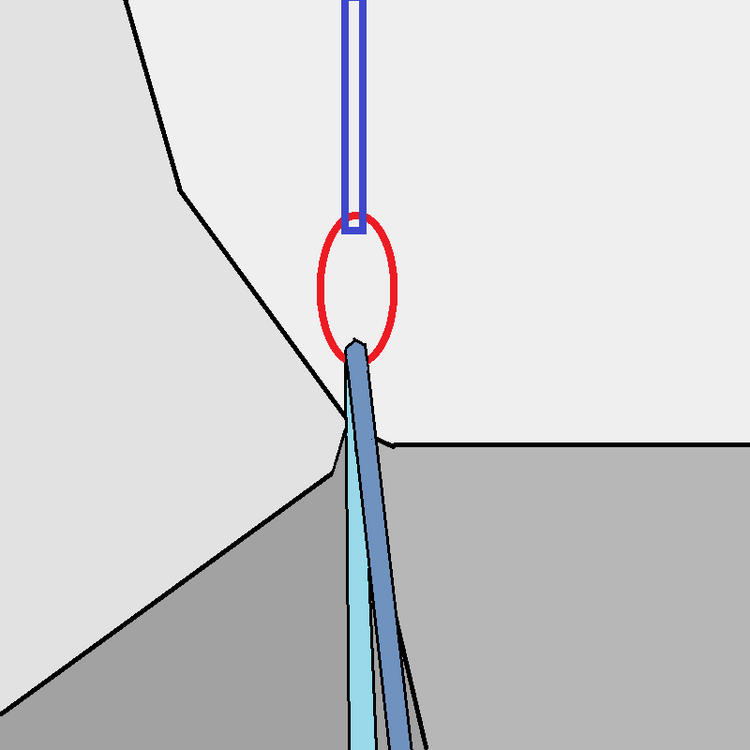 If you want more of a sense of the pinch, the light blue side should exit the pinch and more abruptly turn a bit more to the left. |


