Continue with onX Maps
 Sign in with Facebook






To cordellette, or not to cordallette, that is the question


|
|
If the next lead is to be swung then I often go RURP belay style and just clove hitch a series of pieces (generally better pieces than a RURP). |
|
|
In practice, the only times I use the rope: |


|
I like using the rope and carry a 240cm dyneema sling for times that I'm going to block lead instead of swing leads. But do whatever you want. |
|
|
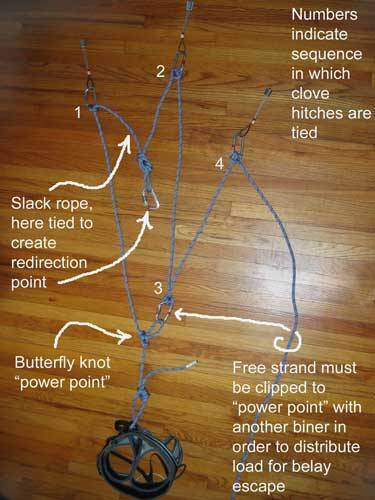
I use the rope about half the time and a 240cm Dyneema sling about half the time. When I use the rope, I pretty much use what RGold posted (some years ago, actually). If it's a two bolt anchor, I often rig it as RGold posted but use points 1 & 2 only. I don't find any of those methods to be complicated. |
|
|
one of my favorite things about swinging leads is I can build any kind of anchor I want. which is hopefully just two bolts or 2-3 bomber cams, each clove hitched w the rope. |
|
|
Op: If you google Andy Kirkpatrick and cordelette, you’ll find an old article from him called “is the cordelette dead”. Has answers to a lot of the questions you asked. |
|
|
I was thinking of citing that article, which I read when it first came out in 2008. But in discussions like this, I try not to argue by deferring to some authority but rather give the reasons for what I'm claiming.. But now that PP has brought it up, here's the link: https://www.andy-kirkpatrick.com/articles/view/back_on_the_ropes. Among other things, he says, "No matter how you look at it, an old school rope belay is by far the best, offering flexibility, strength, limited components and a much greater ability to absorb impact forces." |
|
|
'Whether 'tis nobler in the mind to suffer. The 240cm slings and arrows of outrageous fortune.' Its all horses for courses, I don't think there is a perfect method to use in all situations. I'll use the ropes (usually climb on halfs) or a 240 (or even 480) sling especially if 'taking someone up something' and doing all the leading. Even if using a sling or slings to equalise some pieces I still like to get some rope in the system if I can for a bit of stretchy stretchyness. Using halfs is often very quick if you have 2 really solid placments just tie in 1 rope on each. Never used a cordalette, not due to 'disgust' but because they are less common in the UK and I don't have one, but I'd happily use one. End of the day if it works for you and is safe then do your thing. |
|
|
Neil Bwrote: So I may have vaped to help me fall asleep and accidentally gotten high as balls, but this comment is an absolute banger from start to finish. A+++ would read again |
|
|
rgoldwrote: r gold, can you explain the reason for “free strand must be clipped to pp to escape belay” And overall this appears to be harder to escape than if one is clipped to a power point with a pas. Any tips? |
|
|
I think Andy's article has done a good job of re-asserting the benefits of rope anchors, while somewhat minimizing the cordelette, or better yet, the open, or Rabbit-runner style of cordelette. Point one: If I get the direction of pull on my Cordelette slightly wrong, I can still tweak it by tying a clove to my piece, just as with a rope anchor. Point two: Tying and untying in order to lead in blocks is a deal-breaker for me. Too much risk involved. There may be a few circumstances where untying is necessary, such as severe rope twist. In this case you can clove the follower in to the backside of the leaders clove, untie the follower, and remove twist. Point three: Under no circumstance does the sliding X create equalization. Edit: Per Eric Marx use of an Quad; you can clove up to four pieces without having to start adding extra slings. |
|
|
Going to get some hate for this, but I carry a pre-rigged cordalette quad over the shoulder and use two piece anchors. If it needs three, I'll clip two of the pieces to one side of the quad. If the belay needs extending I'll either clove in and hip belay or belay far away with a regular atc guide on the anchor. It's incredibly easy to pull rope through a device from 25 feet away. This system only requires a simple rope flip if you're not swinging leads, and very easy transition if climbing through. Hasn't ever failed me on 10s of thousands of feet of multipitch climbing up to 5.12 and it's just about the fastest possible system besides short roping. I'm not sure why quads are so hated and why anchor building is always overcomplicated. Glen: I dont use an equalette. |
|
|
Greg Rwrote: In some self-rescue scenarios, an intermediate step is to transfer the load to a line coming out of the backside of the anchor. If that is the case, that strand as pictured is only directly loading the right-hand piece. Clipping it back to the power point means the backside strand loads all the pieces. Of course, you could do this every time when setting up the belay. But given that the vast majority of climbers will get through an entire career without having to escape a belay, it seems more than reasonable to defer this simple step until it is needed, which is probably never. As far as getting the belayer free and out of the system, the all-rope anchor is no different---so no harder and no more complicated to escape---than a cordelette/sling system, because none of the required actions have anything to do with how the powerpoint is joined to the anchors. The belayer might have to get off the power point (and re-attach with a tether), and the loaded line has to be secured to the power point with a Munter mule. The steps are the same no matter how the power point is rigged to the anchor points. The complication with all-rope anchors arises when the rescue protocol requires having the other end of the rope. For example, the belayer wants to do a counterweight rappel to reach an injured second (no more than half a rope length) below. In this case, slings or a cordelette (carried in reserve for other purposes) will have to be installed on the anchor to serve as a pulley point for the counterweight rappel. If a cordelette had been used to begin with, this step wouldn't have been necessary. To quote Andy Kirkpatrick one more time, "This technique also made it harder to carry out a self-rescue, but most climbers would agree that the chances of this are so rare, that the greater belay strength and flexibility is worth the extra work if such an event occurred (again this is more guide territory)." |
|
|
Thou shall learn the rope for all the things. Thou shall learn the codellete for all the things. Simply learning one or the other is for fools and folly. Then just use the rope. |
|
|
I will often take a 20 foot cordalette up multi pitch for building my own equalized anchors. But I use the rope and slings when it's faster. I also carry it for rescues. 15 years ago we were rapping off Son's of Yesterday to the highest anchor of Serenity. It was a diagonal double rope rappel, but our first person to rap was suffering mild heat exhaustion and went straight down, missing the anchors, which were off right. She ended up 60 meters down, hanging in free air, on the rope end knots. She tried to prusik up, but her ultra light weight slings wouldn't work, they knotted up. And yes, she had forgot to practice that. She had heard it worked as well as regular prusiks. My other partner and I realized we needed to z-pulley lift her up the cliff...but we had no rope, since she was using them both in her botched rappel. How do you do a z-pulley lift without rope? There was no cell service back then, no one around at 6PM and it was over a hundred degrees...and we were long out of water. But, we each had a short cordalette. We tied those together to get enough rope for a z-pulley lift. It still didn't work...too much drag from the double ropes going over the roofs. I short roped with slings to the edge and brute force lifted our stranded friend while my other friend pulled on the z-pulley, gaining a couple inches each pull. Hopefully you'll never have the need for a long cordalette...but I did. |
|
|
You stated you are a new trad climber. So, I recommend carrying the cordellete. While a cordellete is absolutely not necessary there is a fair bit of additional knowledge you will need if you choose to not use it. I used to carry a cordellete on climbs but as my knowledge and wealth of experience grew I decided to stop carrying it. Hope it doesn't sound like I talking down to you or anything; just trying to give you advice I would give a friend! |
|
|
I feel like I may have been one of the persons to provoke this thread, since I recently made a snarky comment about cordelletes in another thread. To clarify, it's not the cordelette that I personally reject (disgust or hate is far too strong a word), it's the cordelette Koolaid attitude that some evangelicals espouse. The people who seem most enamored of the cordelette are some (not all by far) guides, people who learned to build anchors from guides, and people who learned to build anchors from books and the internet. Clearly from comments in this thread I have learned that accomplished and experienced people outside that set of cordelette users have also evaluated it and also decided it's the best system for them. I applaud those all of those people for using their experience and brains and making their own choices. People should do what they want, whatever seems best practice and safe for them. I don't use one because none of the multiple people who mentored me when I started climbing in 1980 used one. I was taught to build anchors with rope and sling. Since I started climbing, I've adopted plenty of climbing technology advancements - ultralight gear, skinny ropes, ABDs for belaying etc. I just have never been convinced of the benefits or advantages of the cordelette. I think even today, out of my dozens of very experienced climbing partners, only one of them uses one. I actually bought a Trango Equalizer, which is kind of a sewn cordelette light, to try it out, and I use it occasionally, if I'm in the mood to carry it. It's OK. But I never feel the lack of it when I don't carry it, which is most of the time. I asked myself if this was just me, being out of touch with some mainstream thought, so this morning I sent off a couple of emails about cordelette use to a few climbing friends who are extremely accomplished, "known" climbers. All said something to the effect - never used one, don't see the point. Add to those opinions, R Gold, who knows more than almost anyone I know about the science of climbing, Andy K, and someone like Will Gadd, who also has rejected the cordelette, and I feel like I have enough info from people I respect not to adopt something that seems a waste of weight and space to me. To me. Your opinion may differ. I think this is the last comment I'll ever make about this topic for the rest of my life. |
|
|
Somewhat niche, but IMO rope anchors are unbeatable at crags with ledge belays where anchors are going to end up at ground level (Devils Lake, crags in the UK, Gunks?). Faffing around with a cordalette to try to get your masterpoint to hang off the edge with a decent stance, equalization, etc is a PITA. For a rope anchor you top out, clove some decent pieces together, sit down and belay off your rope loop. It's way slicker and more fun, and I'm even a total idiot when it comes to knots. Rgold's method is undoubtedly effective (and he definitely has more experience more than most of us) and there's also a million other variations if you want something different. Rope anchors are especially worth it just so I don't have to rerack cordolettes constantly. Webolettes or 240cm slings seem like a decent alternative though if you're not sold on rope anchors for whatever reason. |
|
|
ryan climbs sometimes wrote: With the majority of people that I climb with it isn't realistic or feasible that we can swing leads the whole way up a multi. I might have to take the wide 3s or OW pitch, I sho ain't taking the fingers or 5.8R face pitch, etc., etc.. Unless we're romping up something well below both of our limits which isn't what happens most of the time for me anyway, there's just no way we're swinging leads the whole way. To what degree we do or don't swing leads changes, but pretty invariably if I'm doing a climb I'm actually excited about it means I'm either gonna be leading some consecutive pitches or following some. From what I gather this is a pretty common experience for a lot of other climbers, also. |
|
|
All threads have a way of drifting, and often in productive ways. In this case, looking back, I'd note that the question posed by the OP is, "When Trad climbing a multi pitch route without a cordellette, how do you build redundant equalized anchors without using up all your runners?" I'm curious about alternative answers to the OP's original question. If by choice or circumstance you have to rig an anchor with the rope only, how do you handle the various possible configurations that might be required?" |