
 Continue with onX Maps
 Sign in with Facebook






Advice on how to clip half ropes in roofs & traverses
|
|
In the scenarios below, how would you clip half ropes to minimize rope drag? Assume you can place gear anywhere along the climbs. Obviously you would extend pieces around the corners and avoid placing them directly in the corner, but where would you use rope 1 and where switch to rope 2?
 Point A = ledge for stance 1, Point D = ledge for stance 2 Szenario 2: vertical, than traverse 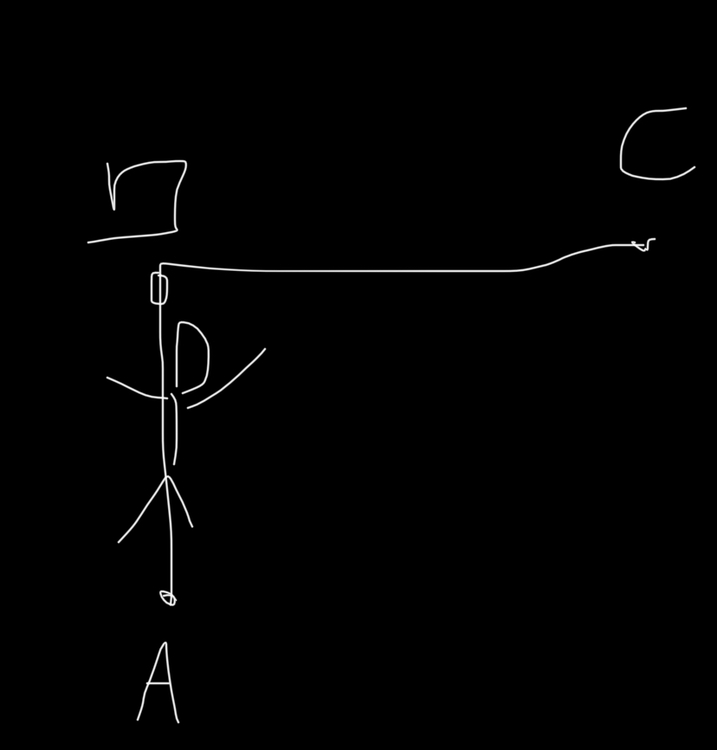 Point A = stance 1, Point C = stance 2 I often found similar scenarios when climbing on Table Mountain in Cape Town and was never certain what the best way to go was… hope the drawings are understandable. |
|
|
Assuming no aid, place pro where both you and the follower are happy to have it. |
|
|
Scenario 1: As with a single the problem is ropes dragging the lip, just try to extend runners placed around point B as you would with a single. Scenario 2: Usually for a traverse I use one rope for higher runners and one for lower runners, ideally use the rope attached to the highest runner in the A to B vertical section as the top running rope for the traverse, if all the runners are at the same level just alternate. Sometimes if you are then moving back over the traverse bit to belay you can only clip one rope for the traverse so the other will be above the second to protect them better on it. Hope that makes some sense. |


|
king paradox wrote: Bot post - reported. |
|
|
David Menkenwrote: In situation one. I'd want a longer runner in the corner B. However, a long runner might not keep you off the ground while you got for runner C. Hence you might want to use a single rope clipped short on runner B and then ditch that rope when you get on the vertical (make sure they're single rated). Or you could place a short runner on B with a long runner sitting doing nothing. Then climb to place runner on C and climb back to swap B's runner over to the long runner - doesn't matter so much which ropes are used if you do this |
|
|
First off, Tim Parkin mentioned in a parenthetical "(make sure they're single rated)." One member of a set of doubles is rated to take falls alone. A double rope is simply not rated to take *as many* UIAA falls as a single rope. It wouldn't be correct to imply that we weren't supposed to take falls on just one half rope (same as just one double rope). Might be worth looking up definitions and use cases of twins vs. doubles (halves) vs. singles. Let me take a stab at Scenario 2. This is a classic application for doubles. Clip rope #1 at A, traverse a bit, clip #1 again with a mid-length runner, traverse a bit more, clip #1 again with a long runner, then start clipping rope #2 as you complete the traverse and ascend. The result is that each rope runs nearly straight, with rope #1 on the left, and rope #2 on the right. Scenario 1 does not have such a straightforward answer, because it depends on measurements. If B is far above A (like 20m for example), then you would want to begin by clipping both ropes into the first piece or maybe even the first two pieces (using a separate krab for each rope). Then when you get close to B, you use a runner and clip only rope #1. When you reach B, you use a long runner and clip the same rope again. As you move across the vertical section, you start by clipping the same rope once again, and again you use a runner. Then you switch to rope #2, with a long runner, and stick with rope #2 until you reach the end of the roof. There you clip both ropes (one krab for each rope). The end result is that you'll have rope drag on rope #1 but no rope drag on rope #2. On the other hand, if B is not very high above A, you can't use a runner at point B. So you clip rope #1 without runners on the way up to B, at B, and as you do the roof. When you hit the end of the roof, you clip both ropes (each with its own krab), and off you go. Same end result: rope drag on rope #1, but not on #2. It bears mentioning that scenario #1 is not a good scenario for doubles if you can't use runners at B and close to B. In that situation, you have just as much rope drag as you would when climbing with a single. So in the case where B is not very high, it could also be argued that there is no way to reduce drag and you should just clip both ropes (separate krabs) or use a single. Does that sound right? |
|
|
Moby Climberwrote: But the concern with a single half rope rather than triple rated is cut resistance, do people climb with a single half rope? I know it's used in alpine but they don't plan on falling, it's a very different scenario, a shorter rope too. |
|
|
Devin Haneswrote: Hey Devin, Half (aka double) ropes are definitely okay to fall on. It is true that they have less cut resistance than single ropes, but it is not true that you aren't supposed to fall on one of them. Most are rated to take 3 UIAA falls, if I remember correctly. You would not go to the crag with only one half rope for that reason, and because of the lower cut resistance, but that should not be construed as implying that you aren't supposed to fall on one of them. The whole point of half ropes is to have redundancy and reduce drag by clipping only one at a time. The purpose of twin ropes is to provide redundancy in case of a cut, and twin ropes are alway clipped together. With half ropes, typically you clip one rope when you're over on the left, and you clip the other rope when you're over on the right, and when you fall, all the fall energy goes onto one rope because you only clipped one at the last place you put in gear. So, if you are going straight up a crack and don't need a 60+ m rappel, then a single will be best. If you are going up a seriously zig-zagging route, then doubles will be best. If you need 60+ m rappels, then you must use either (1) doubles, (2) twins, or (3) a single with a tagline. Just to be clear, I definitely agree that it is not recommended to climb on a single half rope. But that is not the same as falling on a single half rope. Falling one a single half rope is part of the intended purpose of half ropes. It is anticipated that the majority of the time, when you fall, the highest piece of gear will have only one of the doubles clipped to it. Let me know if that doesn't make sense or if I've messed up in any way. (I usually do. :o) Moby |
|
|
Moby Climberwrote: Hey Moby, Oh I think we might just be reading Tim's statement differently, I read what he said as to ditch the first rope as in to just continue climbing with only one because of the drag from the overhang, I don't really pick up him saying you can't fall on one which is why I brought up what I did. Something that's funny to me now that this is brought up though is how small some single ropes are now, I see edelrid shows how they test cut resistance but it has me curious, even though I personally won't climb on small singles, I wonder if a rope only rated for halves is any less cut resistant than a small single. I know that's what they used to say about halves but it might not be too true anymore. Devin |
|
|
I don't think there is any generic strategy for ceilings. If the terrain presents horizontally-spaced protection opportunities, then choosing how the ropes run over the ceiling with the least friction is on a case-by-case basis. Typically, there will be some pro just under the ceiling or part way out the ceiling, and even if it is on long slings the rope through those pieces, strand A, will make a sharp bend around the ceiling lip, causing a certain amount of unavoidable friction. If there is any general strategy, I think it would be to keep the other rope, strand B, free of protection points high under the ceiling so that the angle strand B makes going around the lip is as big as possible. Once above the lip, I'd tend to clip strand B once or twice before engaging strand A to reduce pinning strand A around the lip. And if clipping strand A above the ceiling requires zig-zags that will compound the friction, then perhaps best not to clip strand A at all after the lip. Moreover, if the lip is sharp, I might not clip the strand A at all after the ceiling and finish the lead only clipping strand B. The reason for this is an unlikely but not impossible scenario in which the rope, pinned by a leader fall both above and below the sharp lip, is severed by the lip. This happened with a single rope on High Exposure in the Gunks some years back and the leader fell 120 feet to the ground and miraculously survived. Note that double ropes, regardless of their purportedly reduced cut resistance, are safer in this scenario when clipped appropriately. But perhaps I should add that I use 8.5mm half ropes, not any of the modern super-skinny ones that seem more suited to cordelettes than lead ropes. If the entire pitch traverses, then I don't think there's any generic strategy. If some placements are high and some are low, then strive for parallel strands, a high strand and a low strand. There is a sort of generic strategy for traverses which end with a vertical ascent, which is to do whatever until about halfway across the traverse and thereafter just clip one strand, hereafter called strand B, with strand A the one no longer being clipped. Strand B is thus available for protection at the start of the vertical section. Again depending on the lay of the land and the difficulty of the climbing, the leader delays clipping strand A as long as is practical. In some cases, the leader can traverse off the vertical moves and back over the traverse and place something high for strand A. The goal is to leave the second with a pendulum fall rather than a leader fall while at the same time giving the leader protection at the start of the vertical moves. There is no way to arrange this double advantage with a single rope. The traverse and ceiling strategies are two of several instances of half ropes providing advantages that are not strictly related to reduced friction in the system. |
|
|
Devin Haneswrote: My reading was 'untie from the first rope' so you're only on a single. I know half ropes are rated for falls on their own but I would prefer a single rated rope if I'm about to ditch one half of my system. It's odd that we consider half ropes OK for falling on singly, but suggest the use of a one half rope on its own, without the other dangling there uselessly, and there's some uncertainty about it. |
|
|
David Menkenwrote: Depends on the details, just make the straightest line possible with your ropes and visualize what’s coming ahead to make a plan. |
|
|
Tradibanwrote: If you're using half ropes, a complicated route will inevitably not have straight lines, otherwise there would be no point using half ropes. p.s. The best straight line is always had by putting no gear in! |
|
|
Tim Parkinwrote: Huh? Straight lines still applies with half ropes, that’s the point of using them, it’s easier to make your ropes go straighter. |
|
|
Tradibanwrote: I wish we had nice easy straight routes in the UK but this sort of thing is fairly normal 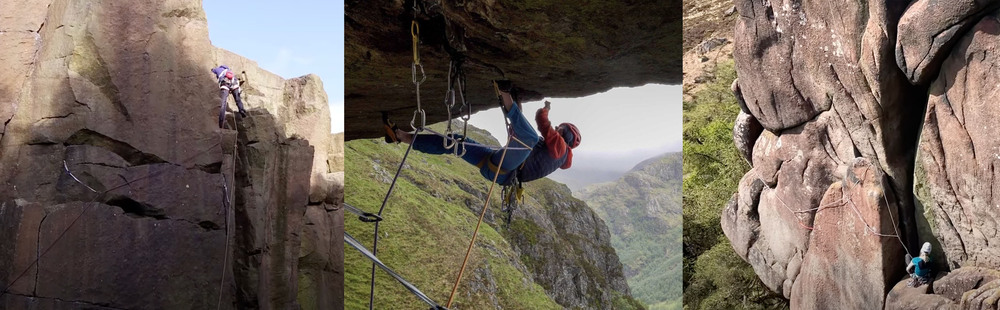 |
|
|
Tim Parkinwrote: Straight ropes on crooked routes mate, thast what half ropes make. |
|
|
Tradibanwrote: We are arguing around nuances I think.. |
|
|
I remember a (British) video where the climber did this: 1. Clip rope 1 to a long runner at point B and climb on. |


