Mountain Project Logo

New Alpinism

Long Ranger · · Boulder, CO · Joined Jan 2014 · Points: 669

Hmm, if you're doing 15-25 hour week loads, it would seem to me a quick dog walk would be a rounding error - or even carefully tracking your warmup/cooldown.

Or like, would you track time at Cosco milling about? There's a line to be drawn to help with the problem of over-tracking and signal/noise, I'm thinking.

I get that people do what with their fitbits and all, but if you're reading TFTNA, I'm also guessing you're going to be in a bit better physical shape that counting "steps" is a little ridiculous.

Nick Drake · · Kent, WA · Joined Jan 2015 · Points: 651
Long Ranger wrote: Hmm, if you're doing 15-25 hour week loads, it would seem to me a quick dog walk would be a rounding error - or even carefully tracking your warmup/cooldown.

Or like, would you track time at Cosco milling about? There's a line to be drawn to help with the problem of over-tracking and signal/noise, I'm thinking.

I get that people do what with their fitbits and all, but if you're reading TFTNA, I'm also guessing you're going to be in a bit better physical shape that counting "steps" is a little ridiculous.

Think you're reading between my post and tsherry and missing the point. The point is to log the fact that you did something that was 20 minutes or more that just lightly elevated your heart rate because active recovery sessions can actually make a huge difference in how much fatigue you carry into the next session. You don't log how tight your shoe laces were or how many cars fido tried to chase, just put a check mark in for active recovery, that's it.

If I was milling about a Cosco facility I would log it, because they are a logistics company and that would likely mean I was a longshoreman doing hard physical work.
If I was milling about a COSTCO warehouse I wouldn't count it because I'd just be eating free samples and getting fat. 

Long Ranger · · Boulder, CO · Joined Jan 2014 · Points: 669

I... ...I almost may be on the more advanced side of coin when it comes to endurance fitness, so I wouldn't count something like walking the dog as anything. Maybe if I rode my bike to Costco, then rode back without trying to set a course record - to me: that's active recovery. Or if I legit jogged for 20 minutes - that would be a lightly elevated heart rate.

TFTNA does list a "gentle walk" as a recovery workout, "if you are really tired or feeling a little sick" ala doing something is better than doing nothing. I might add that as a note in my training journal for sure, like: "feeling sick, walked the dog, felt a little better come dinner", but that's a pretty organic observation that I don't know is going to 1:1 translate to better performance.

Eh, if the tool works for you, cool. I don't do enough structured workouts to utilize spreadsheets, so it's sometimes interesting to see just what types of stuff people track.

Tim Sherry · · Portland, OR · Joined Sep 2013 · Points: 551

Nick, Long, thanks for the replies. Yeah the dog walks are generally 30-60 min at a brisk pace, but with plenty of pee breaks. Usually long enough to elevate my heartrate a bit. Certainly more than browsing Costco. The walks are built into my routine as a dog-dad, so hasn't been something I've been writing down.

Also, yes, counting steps is silly. 

Bernardo Fanti · · Denver, CO · Joined May 2014 · Points: 0

BUMP!

Great thread. I got the book when it first came out, love the concepts and have incorporated some elements in my own training over the years. Time to refocus as I start jonesing for bigger mountaineering objectives.

My lack of "focus" generally comes from my greater focus on pure strength (power lifting, olympic lifting) and on bursty mountain biking fitness. In trying to find a balance, I have recently found and researched concepts around Pavel Tsatsouline's "Alactic + Aerobic" kettlebell work. Is anyone familiar with Pavel's work and has experimented with mixing kettlebell work with TFTNA's Zone 1 training? Would love to hear anecdotes. Either way, I plan on mixing the two and will provide some plans & updates in here.

Reading:
https://breakingmuscle.com/fitness/the-hybrid-power-conditioning-program  (among others)

FosterK · · Edmonton, AB · Joined Nov 2012 · Points: 67
Bernardo Fanti wrote: BUMP!

Great thread. I got the book when it first came out, love the concepts and have incorporated some elements in my own training over the years. Time to refocus as I start jonesing for bigger mountaineering objectives.

My lack of "focus" generally comes from my greater focus on pure strength (power lifting, olympic lifting) and on bursty mountain biking fitness. In trying to find a balance, I have recently found and researched concepts around Pavel Tsatsouline's "Alactic + Aerobic" kettlebell work. Is anyone familiar with Pavel's work and has experimented with mixing kettlebell work with TFTNA's Zone 1 training? Would love to hear anecdotes. Either way, I plan on mixing the two and will provide some plans & updates in here.

Reading:
https://breakingmuscle.com/fitness/the-hybrid-power-conditioning-program  (among others)

So other than familiarity, why would you want to pursue this amalgamation? As someone who came from a similar background, the TftNA has plenty of strength work in it if you want to keep up that side of things.

Bernardo Fanti · · Denver, CO · Joined May 2014 · Points: 0
FosterK wrote:

So other than familiarity, why would you want to pursue this amalgamation? As someone who came from a similar background, the TftNA has plenty of strength work in it if you want to keep up that side of things.

Good question.

The short is that I still mountain bike a lot and am looking at a hybrid system that enables me to purse growth in both goals. That might be naive and impossible especially with time constraints, so I'm not 100% set on wanting to pursue the amalgamation. But it seems to amalgamate well, based on the physiology as I understand it. The Kettlebell work is very time efficient, the alactic nature further helps with mitochondrial development, and builds even more explosive full-body strength. It's simple and repetitive and even easier to follow.

Buster Jesik · · Estes Park, CO · Joined Jul 2006 · Points: 546

Welcome, new comers to the faith of Alpinism and veteran practitioners!

Yes, you have stumbled upon the holy texts from the profit House! For those uninitiated, Behold the "old testament - https://www.amazon.com/Extreme-Alpinism-Climbing-Light-High/dp/0898866545

And the "new testament" - https://www.amazon.com/s?k=training+for+the+new+alpinism&i=stripbooks&crid=2RYTHTBML01RU&sprefix=training+for+the+new+%2Cstripbooks%2C171&ref=nb_sb_ss_i_1_21

May your summit days be splitter and your 3rd world travel disease free!

FosterK · · Edmonton, AB · Joined Nov 2012 · Points: 67
Bernardo Fanti wrote:

Good question.

The short is that I still mountain bike a lot and am looking at a hybrid system that enables me to purse growth in both goals. That might be naive and impossible especially with time constraints, so I'm not 100% set on wanting to pursue the amalgamation. But it seems to amalgamate well, based on the physiology as I understand it. The Kettlebell work is very time efficient, the alactic nature further helps with mitochondrial development, and builds even more explosive full-body strength. It's simple and repetitive and even easier to follow.

You will probably find it more useful to split by season, instead of trying to train for both at the same time, especially including significant volume of kettlebell training - which would have very little applicability to the alpinism (explosive power is not necessary). I am not sure why you would also need explosive power for mountain biking.

Fill your boots and tell us how it goes.

Mike Gillam · · Ohio · Joined Jan 2010 · Points: 5
Bernardo Fanti wrote: BUMP!

Great thread. I got the book when it first came out, love the concepts and have incorporated some elements in my own training over the years. Time to refocus as I start jonesing for bigger mountaineering objectives.

My lack of "focus" generally comes from my greater focus on pure strength (power lifting, olympic lifting) and on bursty mountain biking fitness. In trying to find a balance, I have recently found and researched concepts around Pavel Tsatsouline's "Alactic + Aerobic" kettlebell work. Is anyone familiar with Pavel's work and has experimented with mixing kettlebell work with TFTNA's Zone 1 training? Would love to hear anecdotes. Either way, I plan on mixing the two and will provide some plans & updates in here.

Reading:
https://breakingmuscle.com/fitness/the-hybrid-power-conditioning-program  (among others)

If  you are looking at Simple & SInister, it is a minimum program that is designed to work (daily) or less if you are involved in other activities. using S & S using the alactic/aerobic method can easily be combined with mountain biking, hiking, kayaking, etc... While KB will not develop the strength that barbell work does, 2 simple exercises like the swing and tgu, gives you full body strength/mobility work and swings gives you power/posterior development, as well as basic conditioning work. I think this would work well as a general strength program while you are mountain biking, once your training switches to more climbing focused, I would move away from S & S and focus more on more specific weight work. Take a look at StrongFirst, devoted to barbell and kettlebell lifting and conditioning. Many disciples of Pavel on the site.

Patrick Shyvers · · Fort Collins, CO · Joined Jul 2013 · Points: 10
Bernardo Fanti wrote: bursty mountain biking fitness.

You can't do everything all at once, and bikes will never have high specificity to hiking. But, I have discovered that a low cadence climb on a steep steady grade feels a lot like Muscular Endurance if you keep your heartrate down and do the work with muscle tension.

Jesse Vanek · · Western MA · Joined Feb 2017 · Points: 0

Hey all, psyched to find this post. I bought TftNA a while back, but didn't really get into it until recently because I had other stuff going on. Ready to dive in now, and working on week one of the transition phase....

Is there any reason why I should go for flat road runs when I have easy access to hilly trails to run on? I lose the convenience of easily calculating time per mile gains as a measure of improvement, but I'm thinking I can just figure out a couple of benchmark trail runs to serve the same purpose. Anything I'm missing?

FosterK · · Edmonton, AB · Joined Nov 2012 · Points: 67

No need to go on flat runs, or even necessarily having benchmark trail routes - you should be measuring progress by increasing aerobic capacity, not speed, initially. Do the AeT and AnT tests every 8 weeks (or before and after a training cycle) - this will more directly provide feedback on capacity.

The speed, and speed-work, will come eventually. 

Jesse Vanek · · Western MA · Joined Feb 2017 · Points: 0
FosterK wrote: No need to go on flat runs, or even necessarily having benchmark trail routes - you should be measuring progress by increasing aerobic capacity, not speed, initially. Do the AeT and AnT tests every 8 weeks (or before and after a training cycle) - this will more directly provide feedback on capacity.

The speed, and speed-work, will come eventually. 

Makes sense, thanks! 

Patrick Shyvers · · Fort Collins, CO · Joined Jul 2013 · Points: 10

The main good things about flat runs are:

  • The load is steady, so it's easy to maintain the same intensity.
  • If you don't have a lot of capacity already, you may not be able to run uphill within your target intensity.
Jonny d · · Unknown Hometown · Joined Jan 2011 · Points: 40
Patrick Shyvers wrote: The main good things about flat runs are:

  • The load is steady, so it's easy to maintain the same intensity.
  • If you don't have a lot of capacity already, you may not be able to run uphill within your target intensity.

Exactly.  All I have is hills to run, so I'm constantly switching between running and walking to stay at my target intensity.

FosterK · · Edmonton, AB · Joined Nov 2012 · Points: 67
Patrick Shyvers wrote: The main good things about flat runs are:

  • The load is steady, so it's easy to maintain the same intensity.
  • If you don't have a lot of capacity already, you may not be able to run uphill within your target intensity.

The corresponding negative is that specific gait and loading for uphill/downhill running or walking is not trained, and so no specific adaption occurs. Whether this is more or less important of a factor depends on your specific goals, but generally I bias towards the specific terrain (even if it means walking at the target intensity).

Gunks Jesse · · Shawangunk Township, NY · Joined May 2014 · Points: 111

I’ve been using the basic principles of heart rate zones from the new alpinism for several years.  Keeping below my AeT allows me to run distance for the first time in my life!  This year I finally got the log book and have built a plan to get into way better shape.  I started a few weeks ago, but I was using the uphill athlete heart rate zones with the new alpinism training log.  I switched to all new alpinism and set the uphill athlete book aside for now.


has anyone else noticed the difference in the heart rate zones?  Am I seeing it right: new alpinism zone 1 is wide open, from just barely working out (110 bpm for me) all the way up to the AeT (150 for me)?  Then the rest of the zones are fairly tight through max.  Maybe 10 to 15 bpm range.


Whereas uphill athlete uses a more standard zone definitions.  Any advantages to using uphill athlete besides being able to talk to your friends who don’t use new alpinism?

Long Ranger · · Boulder, CO · Joined Jan 2014 · Points: 669

Scott is doing a zoom book club starting this month for Uphill Athlete: 
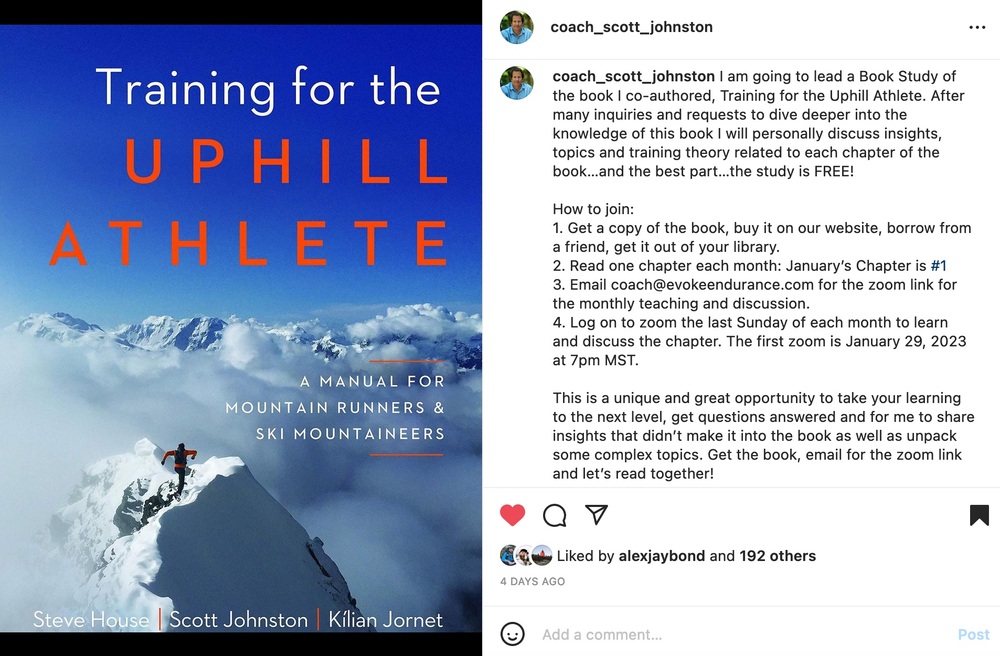
I am going to lead a Book Study of the book I co-authored, Training for the Uphill Athlete. After many inquiries and requests to dive deeper into the knowledge of this book I will personally discuss insights, topics and training theory related to each chapter of the book…and the best part…the study is FREE!

How to join:
1. Get a copy of the book, buy it on our website, borrow from a friend, get it out of your library.
2. Read one chapter each month: January’s Chapter is #1
3. Email coach@evokeendurance.com for the zoom link for the monthly teaching and discussion.
4. Log on to zoom the last Sunday of each month to learn and discuss the chapter. The first zoom is January 29, 2023 at 7pm MST.

This is a unique and great opportunity to take your learning to the next level, get questions answered and for me to share insights that didn’t make it into the book as well as unpack some complex topics. Get the book, email for the zoom link and let’s read together!

I've just started Uphill Athlete, so I don't know an answer to the HR Zone q, but asking Scott directly may work. Uphill Athlete also has a forum that could help with specifics like this. 

Lone Pine · · Unknown Hometown · Joined May 2014 · Points: 0
Long Rangerwrote:

Scott is doing a zoom book club starting this month for Uphill Athlete: 

I've just started Uphill Athlete, so I don't know an answer to the HR Zone q, but asking Scott directly may work. Uphill Athlete also has a forum that could help with specifics like this. 

For what is worth, I believe Scott and Steve no longer work together. Scott left to form a new training company calle Evoke endurance

Guideline #1: Don't be a jerk.

Mountaineering
Post a Reply to "New Alpinism"

Log In to Reply
Welcome

Join the Community! It's FREE

Already have an account? Login to close this notice.


