
 Continue with onX Maps
 Sign in with Facebook






Fatal accident at Tahquitz today



|
A horrible outcome that's all the more tragic for how preventable it was. This is the stuff of my nightmares, and reinforces the lesson to always back up tat for the first person to rap - those extra 30 seconds are worth it. philip bonewrote: I intentionally bounce as hard as I can when rapping first. |
|
|
Big Redwrote: Yeah, agree. The exact purpose of doing this is to weight test it. First person should bounce hard on that thing and make sure it's secure as long as they are properly backed up |
|
|
I bounce test anchors with a quickdraw off my harness and then rappel as smoothly as possible..... |
|
|
I don't think hard bounce testing is a necessary, or even prudent thing to do on a questionable anchor. Bouncing with a quick draw on a sketchy sling around a tree would exert a lot of force on the tree. If the tree were backed up that might be okay, but if not that kind of load could rip a small tree out of the rock. And as we see from this very sad incident, not backing up the primary anchor is something that happens. Ideally, back up the primary anchor (which would have been the tree in this case) but don't equalize the backup with the primary anchor. The weight should only be on the primary anchor. Send the heavier partner down first after giving things a check and maybe a little bounce, and have the second rappeller closely inspect that primary anchor while the first is rappelling. Then if everything looks good, remove the backup and the second rappels. |
|
|
I would not do that on a small tree but its my standard routine for v threads and if I think a tat anchor needs beefing up i will beef it up and then bounce to set the knots. If an anchor is so bad i dont think it will withstand a static bounce test then we are in deep doo doo and digging into the bag of alpine tricks.... |
|
|
Nick, I look at almost every anchor that I use that is not a set of bolts as questionable. I wouldn't hard bounce test any of them. I have to admit that I have rapped off of tat, without checking the knot in the tat.(that usually ends up out of sight). This accident has reminded me to inspect the entire sling each time, and not just what is readily visible. |
|
|
Bill Lawrywrote: Sorry Bill, you and I are usually on the same page, and to clarify, you could be right. I am merely saying there is a gap in the info from the report and from the evidence given so far, the odds and more plausible analysis don’t align with your take — I may definitely be guilty of overthinking this, but some are underthinking and erroneously thinking it. ultimately it may be splitting hairs as we all agree the anchor was definitely inadequate and not a suitable “anchor” So, we all agree that the rope can “snag” in a fall. No disagreement with any of your statements, just in how they comport with the evidence presented so far in this case. Here are my points
Set up an example like the equipment in the report pics and come up with a more plausible scenario. But it has to fit the actual details of the evidence and findings and not be left to the general idea that “ropes can be damaged in a fall” You have to work through the actual mechanisms of the how, where and why. |
|
|
if you don't hard bounce test it then its just as much of a mystery as stepping into your aiders on a beak.... obviously if the back up is not bombproof i am not bounce testing... tradi just likes to argue. My ass, I will test the effin thing before I remove the back up. You do you. quite often I am by myself so there is no guinie pig to send first. If I am with Isa the I am the guinie pig and I would rather have a 3 inch heart attack at the stance than mid rappel. |
|
|
Nick Goldsmithwrote: A “hard” bounce test could weaken the fibers and prime them to break on the next hard bounce. Just back up the anchor and leave it behind. Bounce testing in aid is a different logic. |
|
|
Big Redwrote: If you're in doubt about the strength of the tat, just back it up or replace it. I don't see why bounce testing should ever be necessary. If there's a lot of raps, bring a lot of webbing. |
|
|
Tradibanwrote: |
|
|
Tradibanwrote: I can see the train of logic you're trying to follow, but I doubt the assertion that it would weaken the anchor, that defies the laws of physics. If the anchor material was being abraded by testing I could see this being true, but not purely due to loading it. It is the exact same logic as testing an aide piece, providing some proof that it held at a higher force than the one you intend to use it for. If materials magically failed at lower loads than they were tested at, there would be no point in proof testing climbing gear. Bounce testing an anchor as long as you have a sufficient backup should be totally fine. Regardless, I don't disagree that you should just bring material to backup or replace worn that. It would be interesting to see experiments with cycling load testing on old material to confirm or deny though |
|
|
Clint Cumminswrote: Sadly, I think you are right, my old friend. We have to get this message across to people over and over again: no matter what you need to leave to make a safe rappel anchor, it's worth the few dollars. I was thinking previously that this tragic accident was an "act of God" due solely to rock breakage. To now have it revealed that it could have been due to them using bad tat just breaks my heart. When ever I do any multipitch route I have a locking carabiner clipped to the back of my harness with about 15-20 feet of 5mm cord (and a steel rap ring and a CT mini-ascender). I find myself replacing or backing up suspect anchors 2-3 times a year. I always have a package in my gear box. This entire package of 5mm cord, 30 feet, weighs 6.5 oz. Rated 5 kN or 1120 lbs of force. $10.60 for the package. If you feel the need for something beefier, 6 or 7mm not too much heavier. 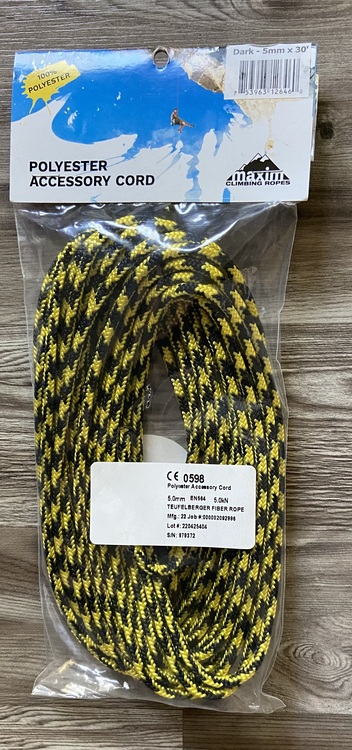 Rest in peace. Please be safe out there people. |
|
|
There have been a lot of mp discussions about the best way to build multi pitch anchors. This tragedy is great argument for having at least one cordelette in your kit. This story reinforces why webbing makes such poor rap anchors. With constant exposure to the sun, cord last many years longer as the core strength is preserved. I would suggest 6mm at a minimum. With the reduction in strength at the knot , 5mm comes in at about 3kn which is marginal for when a “surprise” increases the anticipated static load. |
|
|
All pretty difficult to take in :'( On the other side of the valley, my friend and I set up to rap down to LeDent Pinnacle and uncovered a loop of cord around a tree that had been completely chewed through. It looked brand new. We only noticed it by rotating the cord fully round before weighting it. On an alpine climb this summer, I watched a fixed anchor consisting of two rusty nuts fail while my partner rapped. The load came onto a backup pair of cams I rigged. Maybe it is a bit morbid to say so, but death is always on the line when you're out climbing. It's easy to forget when you're having the time of your life with good friends! |
|
|
Mark Pilatewrote: I hear ya, Mark. No problem. I'd still climb with you. :) tl;dr? Just an idea about how the observed damage occurred. In prior posts, I haven't fully put together the sequence matched to the evidence that I have in mind. I'll do that now; see below. But this is Not a "this is what happened." I only mean it as a reasonable explanation based on the evidence - possibly not the only reasonable explanation. There are these initial conditions, probably accepted by most:
Here's the reasonable explanation for the resulting evidence after the fall: A) The tossed rap rope strands land in a clump somewhere below, coming to rest on one or more rock features. It happens all the time - perhaps this time at the 3 ½ x 3 x 1 ½ ft rock in its' position before the rock fell to the bottom. B) Gavin starts to rappel - or I guess slips, or I guess Chelsea slips, or neither slips - and the old sling parts under his and/or her weight. At that point, Gavin's rap device is on the rope around where the "significant sheath damage" was reported in the RMRU report (photo D). C) Chelsea falls clear and Gavin falls twice the distance from x) his pre-fall position to y) the pre-accident position of the 3 ½ x 3 x 1 ½ ft rock - essentially a huge fall akin to a fall factor 2. D) One or both strands comes tight between Gavin and the 3 ½ x 3 x 1 ½ ft rock but without damaging the sheath up at the rock afforded by the tangle just tightening until temporarily secure. The key rock edge(s) and such only need to be less severe than when pulling a rope kinked at the ATC. I suspect this is where we part ways, Mark. (no pun intended) E) Given the likely involved velocity / resulting forces, there is no way for the rope (whether one or two strands) to feed fast enough through the ATC before the sheath parts. I think it unlikely Gavin is still locked off at this point; even if he is, it does not matter since the precipitously increasing rope load is directly applied to any brake hand grip. F) Since nothing happens instantaneously, rap device then continues (down) towards the two biners that were once attached to the old sling. This accounts for RMRU's "some sheath damage to the area around the ATC" which is an area a few feet away from where maximum force was applied at the "significant sheath damage". G) Rock (~2000 pounds) finishes rolling free of original place and all comes down. |
|
|
I’ve aid climbed enough to know that something I’ve bounce tested can still pop (which is not much) Why bounce test? Are you unable to visually inspect? If I can’t see the anchor and sling and rotate it enough to see the pinched section I operate under the assumption that it may not be solid and should be treated as a leg of a redundant system. |
|
|
What is the consensus for the “best” choice when faced with the situation that these climbers faced? Ie, 1 or more pitch from the top, lack of shelter, and heavy rain/hail. Rappel as they decided? Hunker down and hope the storm passes quickly (as it appeared to do)? Quickly climb through the final pitch(s) and hope to find shelter on top? In retrospect the answer was probably to wait it out as the storm passed quickly, but I’m curious as to what others would do. |
|
|
Backstepwrote: This is always going to be circumstantial. How exposed you are, in what shape are you in, environmental conditions (thinking of hypothermia mostly), how safe is rappel, etc. Sometimes it'll be to bail, something hunker down, and probably that half the time, restropective is going to be supporting whatever you didn't do. |
|
|
Being a tiny bit familiar with the area, I’d hunker down unless hypothermia was a real concern. You don’t want to rush rappelling but you don’t want to rap with frozen hands either. Edit: also depends how high up. A rap or two, no problem. But maybe you’re mid lead and it’s gonna take a while just to hunker down. |


