
 Continue with onX Maps
 Sign in with Facebook






Fatal accident at Tahquitz today


|
|
Ian Lauer wrote: All good points. |
|
|
Ian Lauer wrote: This. The heavier person takes all the extra weight and raps first, second strips the anchor, only necessary to strip the anchor if you have many raps ahead and may run out of gear to leave behind. |
|
|
When I was young and broke I bailed on a route and tried to pull my draws as I downclimbed. I fell and broke my ankle. Was not worth the $15. My parents promised to always reimburse me for any gear I left on the wall. I was already heartbroken, but to think $2 of webbing or an alpine draw could have saved their lives is just really really hard. Chelsea, you will climb with me always.  |

|
Eric Holden wrote: Excellent wrap up. Thank you for the service. Follow up question: I was told at some point early on in my climbing journey that webbing is essentially never made in white so never trust light colored nylon. Is this a ridiculous generality? I've certainly seen white static line, but I'm not sure I have every seen white webbing or cordalette material, so it sticks with me to be cautious if I do. |

|
Absolutely heartbreaking to read that report knowing it was a situation that should never have happened. The cost of gas alone to go climbing is more than any sling or cordalette on your harness. If you are going down, build anchors just as solid as the ones you build going up. Absolutely no excuse not to. I was thinking that the accident could have been attributed to so many things, but failed tat.. really sad. |
|
|
Paul L wrote: There is plenty of white webbing. Its generally spectra or dynema that I know of, or at least that's what I have, but that doesn't rule out nylon. It can be made in just about any color. Example, gearx.com/petzl-pur-anneau-…;gclid=Cj0KCQjw1vSZBhDuARIsAKZlijTs47MajLEQqvKVxJjsu_eXrHZtdL2B9HCiFTuhsfLnkA5rULZz5cIaAmUJEALw_wcB |
|
|
Paul L wrote: Depends. Mostly not, and a good rule of thumb to not trust it, but there is a lot of government issue white stuff. I have a smoke jumper buddy who has tons of the white stuff that has been used as Leaver material. Might see plenty out west though not as common as std colors. I always said people are gonna think that is super bleached tat. Best to just think it is and back it up no matter the color. Personally I always place black or olive. Check at the knot or hidden areas and if mostly faded cut it away and replace. $5 bucks of webbing or cord in the bottom of a pack is cheap insurance and peace of mind. Main point is, you’re not donating it to the community, you’re donating it to yourself ! Edit: I’m referring to nylon webbing above |
|
|
Ian Lauer wrote: Sorry, I wasn't clear in my thought process in that I was referring to nylon webbing in particular. I do own white dynema/spectra slings myself. |
|
|
Paul L wrote: I have seen white tubular nylon sold in bulk. Never in a sewn sling that I remember |
|
|
Re: reliance on single point tat anchors This is not a new lesson by any stretch, but the impacts will be felt by so many, for so long. |
|
|
Franck Vee wrote: True, but I believe very few people bring tied webbing up climbs these days. Usually all their slings are sewn. The quick development of the storm could be a factor in this. If it had been more threatening when they left the car, maybe they might have brought tied slings to potentially leave. So instead I agree with others that the primary action they missed was not girth hitching some slings together to back up the fixed sling while the heavier person rapped first. Or really even earlier - when they first clipped in to this anchor. I assume they had a couple of sewn slings that would be long enough to do this. Given that they were already leaving 2 biners, they were making safe decisions and were OK with leaving some gear. If they did not have the slings to make such a backup, then it would seem to be time to make a different anchor, like nuts or even a cam or two. I haven't done this climb, so I don't know if such a gear anchor would work near this spot. It might be that they thought they already tested the sling because they were both hanging from it. But rapping is a bit higher load. It is the "single point of failure" mode that you would think experienced people like them would see. But as the report said, maybe the wetness of the sling masked its old and brittle nature. Some anchor components, like the tree itself in this case, can sometimes be considered strong enough to be very low probability of failure. |
|
|
I’m saddened, and sorry. I feel for all of those involved. |
|
|
This is the second time relatively recently I've heard about rappel tat breaking. RIP Chelsea and Gavin. My protocol is to always back up in-situ stuff for the first person down---always. And if there is only one sling, I'll double up with some of my gear. Sewn Dyneema slings can be cut apart and knotted with a triple fisherman's knot. The knotted sling will hold ~18 kN static load and will withstand a FF 1 drop impact, but will break at the knot in a FF 2 drop. Still, this is plenty strong enough for rappel loads. Here are some Dyneema sling breaking results from tests by DMM. 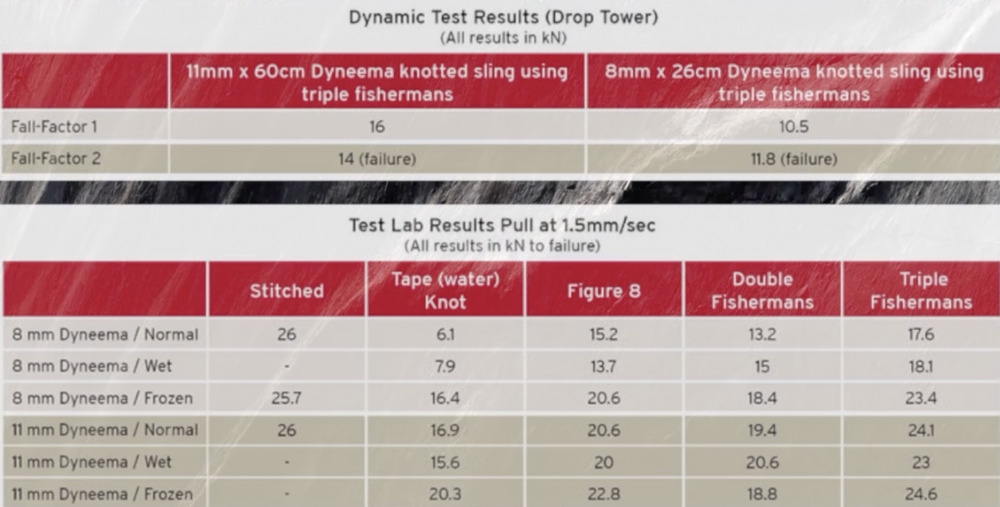 One takeaway is you can cut up your Dyneema slings, tie triple fisherman's knots, and fashion something good enough to rap on. (You do have to have a knife!) If you climb with, say, six alpine draws, you've got enough Dyneema to get down a few pitches. A feature of this tragedy is that the webbing wasn't all that weak. The three loops tested were breaking at 675+ lbf. Just getting on rappel will produce a momentary peak load of double body weight, but triple body weight is more than we would expect. I can think of two possible issues. One is that the rope didn't have any kind of rap ring on it, which is why the party added carabiners. But that means that the other rappels on it (we have no idea how many there were) were done with the rope threaded around the sling. When a threaded rope is pulled, the heat and friction can partially melt and so weaken the sling, booby-trapping it for subsequent parties. So the sling might have broken at a weak point, as testing the rest of the material didn't detect as much weakness as we'd expect. Takeaway: a sling without rap rings is more likely to be fatally weakened at some point than its general condition might suggest. A second possibility is that in the wet conditions, the first person might have slipped and taken a little fall, raising the load enough to break the sling even though it would have withstood a smooth rappel. Only a backup could have saved that situation. |
|
|
Clint Cummins wrote: Several issues with this post. While I tend to agree with your assertion, I wholeheartedly disagree with your conclusions. There simply is no real good excuse for this.
When heading into the bush, the alpine or even “alpine light” base any gear or operational decisions on assuming it will storm and you will be exiting in the dark. Then you’ll only be pleasantly surprised
Good to do regardless, but not in lieu of the above
Not sure if we know the biners were theirs. Odds are good, but unconfirmed. The gear pics in the report are not necessarily the victims. The rope is different (from actual rope pics) and the harness is same in both pics. It may be a “recreation” for example only.
That sheath damage is almost certainly not from the fall. That was damage caused by a sudden shock load against and along the rope axis. It is not clear from the report, but inferred from the pics, description, and experience that the sheath damage occurred on both strands upon a sudden shock load at Gavin’s belay device. This shock load could very well have been precipitated by rockfall - either underfoot (more likely) or to Gavin himself. The results being essentially then a simultaneous total anchor failure and two bodies plummeting with a rock. Again, not 100% clear from the report, but as the rope was doubled fro the rappel, if the rope has only 2 total damaged sheath sections near the belay device, it is easy for one side to be displaced above or below during a long fall. If there are in fact 4 total damaged rope sections (2 locations on the doubled rope) then need another explanation. TL:DR. Bottom line —the sheath damage tells a story we haven’t finished yet |
|
|
Sheath damage: It could have occurred during the fall if the rope snagged on something. In a sense, the rope has some tendency to sweep the wall. Perhaps it caught on and dislodged the rock that appears to have fallen with them. About the breaking strength of that old webbing: We just know that it broke for Chelsea and Gavin at something less than 2.54 kN / 570 lbs applied in the same way as the test. In the field, a sling closely tied around a tree multiplies the weight of a rappelling climber through the angle at the rope’s attachment at the sling. In short, the effective bearing weight of the old sling could have been and apparently was much lower than 570 lbs. |
|
|
When backing up suspect anchors leave a little slack to test them. The lighter 2nd person can remove cams etc. if the original stuff seems sound. Don't bounce around too much. Yes bring knotted webbing to trad areas. Very sad, I'm so sorry. Many of us have got away with it in simmilar situations. |
|
|
Bill Lawry wrote: Totally agree, however less plausible if only observed/noted damage was 2 similar sheath separations as shown in pic D. If rope snagged on way down (either by the free bight, or via biners) there would be telltale evidence. If the sheath separation is clean like in the pic, and at the locations stated, with no core damage at all, this is most likely due to the belay/rappel device. And if done during the fall, there should be evidence of a “snagging” event It’s just not clear solely from the info given in the report. |
|
|
The sheath damage below Gavin’s device is plausible evidence of a snagging event. And I’m having a hard time imagining something other than a snagging event that led to that sheath-but-seemingly-not-core damage. Still, this wouldn’t be the first time my imagination has failed me. Edit: Thrown ropes often tangle below. And the first to rappel often has to clear the tangles on the way down. And it appears that Gavin’s rappel had only just started. The terrain in the picture below the rap tree looks like it could be the source of a snag of tangled ropes during the fall. |
|
|
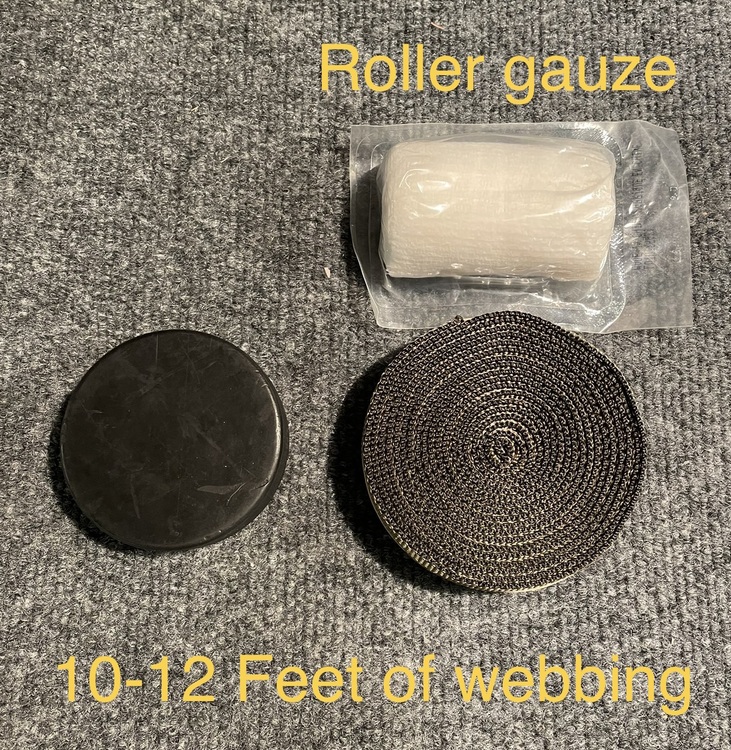
Some things not yet mentioned: 1) In this case, this context - just wrap your rope directly around the tree. This was obviously not a regular rap anchor. A little bit of bark lost will grow back and the pull will be slightly more difficult, but generally not an issue. 2) The webbing near the tear appears to have been worn by ropes being pulled directly over the webbing - causing some burning, deformation and weakening. If you ever come accross a rap station without rings or biners, you need to assume this has happened and the webbing left behind is extremely suspect, if not worthless - no matter what the age. Just like the little cut notch in a plastic food package that allows you to tear it open - the same goes for webbing. Consider the mechanism of Skinner’s belay loop failing. Lastly - don’t be that asshole that burns the webbing at a rap anchor and don’t remove biners from them either. 3) Shortening your rope might be the cheapest and safest way to get anchor material. You brought a rope, right? Always have a pen knife as well. |
|
|
Paul L wrote: Nylon webbing does come in white, and in widths commonly used in slings, like 9/16". 3/4", and 1" tubular. Lots of tieoff webbing is "white", also known as "natural". |


