Mountain Project Logo

What tells you a rope should be retired?

phylp phylp · · Upland · Joined May 2015 · Points: 1,142
Matthew Jaggerswrote:

??? Please explain.


sorry I wasn’t ignoring you. I’m 9 times zones away from home right now, so not posting on US daytimes. 

Russell Springer · · Rexburg, ID · Joined Aug 2022 · Points: 5

Thank you very much guys! i just bought my first set of gear and its all fresh other than my shoes, chalk bag, and the tape on my hands! New 70 meter rope, 12 quickdraws, helmet, harness, belay device and soon some slings! I cant wait to start climbing more, learning, and getting out of this god forsaken flat land! :')

phylp phylp · · Upland · Joined May 2015 · Points: 1,142

Hi Russell, there was one more thing about ropes and soft goods like slings and harnesses.  It is advised not to store them in places where they can be exposed to certain chemical vapors.  And be careful of tossing your stuff on driveways and garage floors that might have stuff that dripped from a car engine. (You can find more info in various threads and online sources).   Inside the house is the best option.  Have fun, be safe.

Russell Springer · · Rexburg, ID · Joined Aug 2022 · Points: 5

thanks everyone for all the tips! yall are awesome! I now have everything I need to climb sport routes, and its all new!

thanks phylp, thats really good to know!

ya'll stay safe!

Ethan H · · Tucson, AZ · Joined Apr 2019 · Points: 34
Daniel Joderwrote:

Just to be clear… your rope will be rated to a certain number of UIAA “falls”, which are extremely harsh drop tests in reality (as Aaron K pointed out.) So, if your rope is rated to 7 falls, this doesn’t mean you retire it after you have taken 7 falls on it. A rope will last through hundreds of short, low FF falls.

Also, just me personally, but I retire or cut a rope shorter well before I start seeing the white core show through.

No one has yet mentioned the pinch test… has the rope become so soft that you can double it over flat with your fingers? This often appears first on the ends after lots of use. That’s when I’ll cut an equal amount off the ends (and re-label the rope so I remember it’s true length).

Good point, the UIAA fall test does not actually translate to real world fall capacity for the lifetime of a rope. The rope is rested for only five minutes between tests, so there is going to be some accumulation of stretch and subsequent loss of energy absorption capacity that would not happen to the rope you fall on once a week (because it has time to relax). I think of the fall test as a measurement of how well a rope recovers its ability to absorb energy between falls, but that might be an oversimplification.

Matthew Jaggers · · Red River Gorge · Joined Sep 2017 · Points: 695
Ethan Hwrote:

Good point, the UIAA fall test does not actually translate to real world fall capacity for the lifetime of a rope. The rope is rested for only five minutes between tests, so there is going to be some accumulation of stretch and subsequent loss of energy absorption capacity that would not happen to the rope you fall on once a week (because it has time to relax). I think of the fall test as a measurement of how well a rope recovers its ability to absorb energy between falls, but that might be an oversimplification.

Once a week!? Lol

dave custer · · Unknown Hometown · Joined Nov 2010 · Points: 3,078

For inquiring minds who want to know how many non-UIAA falls a rope can sustain, this article develops a nice model:

https://journals.sagepub.com/doi/10.1177/1754337118813408

The article is probably behind a paywall, so you may need to find a local librarian or university student.

Jordan Rogers · · Bellevue, WA · Joined Aug 2019 · Points: 138
dave custerwrote:

For inquiring minds who want to know how many non-UIAA falls a rope can sustain, this article develops a nice model:

https://journals.sagepub.com/doi/10.1177/1754337118813408

The article is probably behind a paywall, so you may need to find a local librarian or university student.

Can you just summarize the model for those of us without convenient access? 

Russell Springer · · Rexburg, ID · Joined Aug 2022 · Points: 5
Jordan Rogerswrote:

Can you just summarize the model for those of us without convenient access? 

that would be great if you could

Austin Donisan · · San Mateo, CA · Joined May 2014 · Points: 723

https://sci-hub.se/10.1177/1754337118813408

I'm not capable of summarizing all of it, but some useful bits I think I understood:

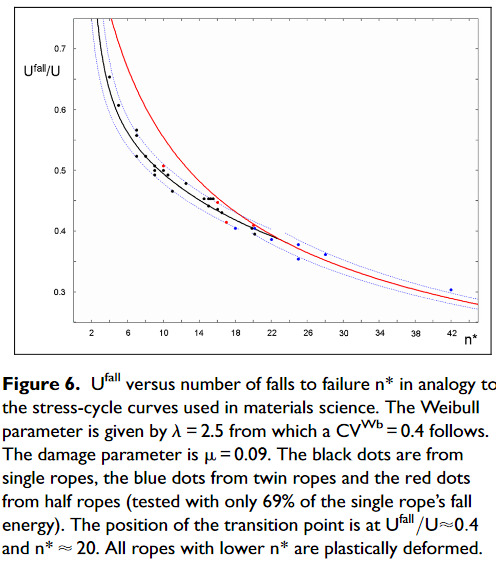
  • Falls with total energy greater than 40% of the rope's energy capacity plastically deform the entirety of the rope, otherwise it's just local damage (the section running over the anchor).
  • This plastic deformation reduces the ropes springyness/capacity up to 30% (mostly in the first few falls, then leveling out). This makes future falls harsher, accelerating the wear process.
  • The UIAA test fall is above this 40% value for almost all ropes. Because of the accelerating wear effects from the plastic deformation, ropes with smaller fall ratings are affected more. I think the corollary is that a rope rated to 12 falls in not 2x more durable than one rated for 6 if you only care about "normal" falls.

In this diagram the red line assumes only localized wear, and the black line includes plastic deformation.
Guideline #1: Don't be a jerk.

Climbing Gear Discussion
Post a Reply to "What tells you a rope should be retired?"

Log In to Reply
Welcome

Join the Community! It's FREE

Already have an account? Login to close this notice.


