
 Continue with onX Maps
 Sign in with Facebook






Hydrogen Embrittlement of Rock Anchors


|
|
I've finally posted Part 5 of my series on the corrosive sea cliffs of Cabo da Roca. It took me a full year longer than I intended because of a climbing accident I sustained part way through the process. I am confident of the chain of causality that runs as follows. High environmental sulphate -> sulphate reducing bacteria -> hydrogen embrittlement. I am equally confident that work-hardened 304 with martensite composition greater than 10% is especially susceptible to this attack. It's a job for another day to extrapolate to the corrosion phenomena we see at Railay and Long Dong. Similarly, the task of material specification for such cliffs will be something for the future. |
|
|
Nice report! Scrap the hardware but leave the holes: 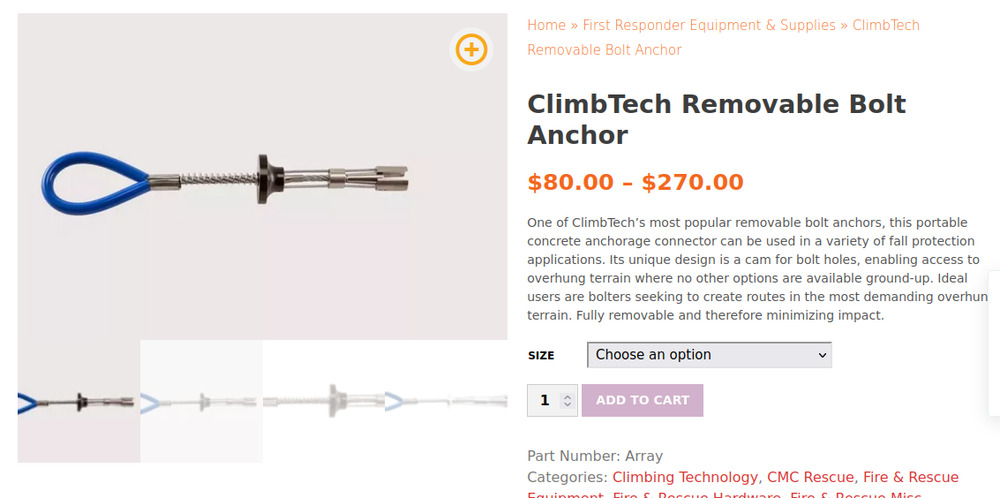 |
|
|
Daniel H Bryantwrote: You must have some good eyes to be able to climb, and see the holes for RBs along the way. I think it would be harder to onsight the gear than the climb itself. |

|
Corwrote: Yes. And this is only one of dozens of problems with RBs, which is why RB-routes are practically non-existent. Put-up an RB-route and you guarantee it'll never be repeated, so what's the point? Removable bolts have been suggested as an alternative to bolts for 25 years and have never been practical, safe or affordable, just to name a few drawbacks. And since Ti bolts are readily available, there's not a single good reason to use RBs, besides an outdated and impractical sense of ethics. People who still suggest them are plainly ignorant. |
|
|
Good stuff Dave, I'll admit I probably followed 40% but my last metallurgy course was 40 years ago! My question is how to reduce the transformation and/or the hydrogen incursion? I know from experience and some crude experimentation that if I reduce the speed I cold work at the transformation from austenite is reduced but how do I work out what is acceptable, to form the bolts I have to induce a certain amount of dislocation no matter what. Then it's preventing anything getting into the material. Things like bolt-ins have such poor finishing in the threads nothing suprises me but with formed bolts I try to remove any possibility of anything actually entering the substrate. We strip all the ferrite off the surface first then close the chrome by barrel treatment and under a microscope we see a closed layer of oxide. The question is is this a barrier? The options of changing to 316LN or a higher nickel content are uneconomic as is post-production heat treatment! |
|
|
Corwrote: You ain't kidding! I drilled a route with 12mm holes and forgot about it, a buddy came along and bolted it six months later. I couldn't believe I'd missed the line so climbed it and found all my old holes after careful searching. |
|
|
Corwrote: Just spraypaint the hole flourescent orange so you can see them better. May as well paint all the holds too so you don't get off-route. |
|
|
John Byrneswrote: Maybe we could use silver spray paint to mark the bolt holes? They could still be seen like a bolt of course, but then people wouldn’t have to rely on an unknown developer for their safety. |
|
|
Jim Tittwrote: I've started down the long road of looking into the 304 vs 316 question by shifting my focus from stuff that has obviously failed, to stuff that hasn't. I'm particularly interested in cases that might prove an exception to my current theory that cold-worked martensite is the villain of the piece. My guess is that we will see the actual nickel content being the deciding factor, in that a one percent difference in Ni can shift the martensite transition temperature by tens of degrees either side of room temperature. And, as you say, that is before we figure in the rate of cold-working. |
|
|
Tradibanwrote: Marking the holes has been suggested for decades too -- tongue-in-cheek of course. I thought Tradiban would be more original. But obviously, finding the holes is only one drawback out of dozens. And you still have the "unknown developer" problem even with just the holes. |
|
|
David Reevewrote: I think it was observed in Thailand in '96 or '97. Cayman Brac had it's first failure in '98, which was the first time a broken bolt was ever formally analyzed by a metallurgist, who wrongly concluded it was SCC. |
|
|
John Byrneswrote: No tongue anywhere, I swear! Not phat paint spots, maybe 1in dots. You can inspect a hole and the RBs do have some range to them. So what's the problem? |
|
|
I hope those that are suggesting ClimTec RBs know they are very different than cams to place/remove. When they are not virgin RBs the wires spread and sometimes take 2 hands to place... Removal often requires a long pokey object and needs force to be removed.
|
|
|
John Byrneswrote: In Krabi (Phra Nang) we were seeing random failures only a few years after routes were put up, '88 on. At first we just attributed it to normal wear and tear on sport routes. Little did we know - all developers were pretty naive and went about our ways since we were supplying the anchors ourselves. Dave - excellent stuff. You make a scientist proud of your diligence and exploration of the facts. |
|
|
Tradibanwrote: Are you trolling me, Tradiban? One inch dots? Bloody nonsense. You gonna count the number of holes from the ground with 1" dots? Got some paint that doesn't fade in the sun or flake off? "Inspect a hole"? That's moronic. Maybe on a slab but how about when it's foot and a half above you on an overhanging face? You gonna crank up and put your eyeball up there? Stick a wire in to see if the hole is cylindrical? How about when it's just over a bulge and totally invisible? How are you gonna tell it's not pear-shaped under the surface, or the rock isn't fractured, or the hole hasn't filled in with run-off, or some asshole put a stone in it? How about you take a bunch of leader-falls at the crux and then try to get the RB out of the hole in limestone or soft sandstone (assuming it doesn't fracture the rock)? Now you have an immediate corrosion problem. How the fuck are you gonna lower-off without permanent anchors at the top? Et cetera, et cetera. There are so many problems with "RB-routes" it'd be almost impossible to list them all. So, Tradiban, if you actually had a brain you'd know it's not "the problem?" singular. It's problems, Plural, with a big fucking capital P. |
|
|
John Byrneswrote: Yes, the holes would be marked with “special” paint and then you could “feel” the placement, just like with a cam. |
|
|
Tradibanwrote: Great, Tradiban, go fer it! Let us know how it turns out. And you can rent out the12 RBs someone will need to climb it. That is, if you spend the money to buy them (~$850 + tax and shipping), and if anyone at all ever decides to climb it. |
|
|
Tradibanwrote: okie dokey, maybe it is time to stop. his eyes are bugging out and the veins in his neck are tweaking. i think he might be having a stroke. |
|
|
slimwrote: Slim, your attitude and actions are why MP is almost worthless as a source of credible information. What do I mean? I mean that bullshit, such as Tradiban's and many others, is allowed to stand but when someone corrects/contradicts the bullshit, you support the bullshitter as you did above. If you think my eyes are bugging out and the veins in my neck are tweaking, then you're as full of it as Tradiban. The Fixed Hardware forum is the one forum where bullshit should never be allowed to stand unchallenged. Ever. Trolls should have their posts removed, and people like David Reeve should be rewarded and respected. Mr. Reeve has made an extremely important contribution to Metallurgy and to the sport of climbing. What contribution have YOU made, Slim? And why don't you, Slim, climb an RB route with Tradiban belaying, since you support his ideas? About 20' up I bet your eyes will bug out and your neck veins will tweak. That is, if you have the courage to even try. Which I'm sure you do not. |
|
|
I’ve definitely seen stuck RB’s that were only used for the bolting of the route. I imagine all those holes would be permanently clogged with stuck, then frayed, then broken RB’s in pretty short order. It really isn’t a solution, even if price isn’t a concern. What would work is a corrosion resistant object installed on the cliff that allows the climber to easily an securely attach a removable piece of gear he’s carrying to it. Maybe the super geniuses here can work on that. |
|
|
John Byrneswrote: I don’t think “slim” is supporting my ideas per se, but I do think he supports thinking outside the box, as I do. Many great ideas start their existence dismissed. The fellow above this post and his corrosion resistant device may be on to something, eh? |


