
 Continue with onX Maps
 Sign in with Facebook






Escape a belay?


|
|
I have several times switched from atc guide to munter for lowering but not sure that actually counts as anything other than practice. none of those situations was a real emergency.. |
|
|
Derek DeBruinwrote: I cannot follow this. I think you mean a 2:1 rigged "inside" between the strands but I don't know what the clove is for. Would you clarify? If using the free (brake) strand to apply load isn't it necessary to escape the plaquette and replace it with a pulley? |

|
Alec Baker wrote: I need a picture or illustration. |

|
Alec Baker wrote:
Sorry for the poor writing. Alec's interpretation is indeed correct. Here's a photo. 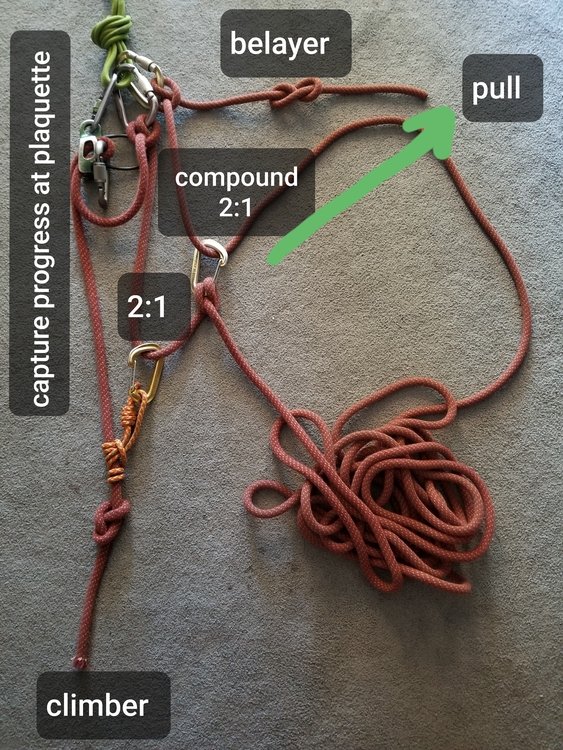 Webfootwrote: The plaquette can be used as the progress capture. The prussik applied to the load strand of the rope will take the load below the plaquette as the belayer starts to haul. This will generate slack between the prussik and the plaquette. While holding the load with one hand, the belayer can feed slack through the plaquette with the other. Then the haul is released, the prussik is slid down the rope, and the process repeated as needed. In this case the rope is serving as the zed cord referenced by Alec upthread. |
|
|
Do you have a trick for holding the tension one handed? |
|
|
mbkwrote: Forearm curls? Hangboarding? The combination of adrenaline and a compelling desire to save your partner's life (because why else would this be happening?)? Aside from just being strong, the most effective way I've done this is to leave a free HMS locker on the masterpoint somewhere, do the requisite squats needed to raise the load, then tie a munter directly on the free carabiner in the proper orientation, mule it, use two hands to milk the plaquette as much as possible, release the munter-mule, reset the haul, repeat. It's pretty sub-optimal all around. |
|
|
Derek DeBruinwrote: Calculating the actual MA for this I propose that if you have the stance it may be advantageous to re-rig for a standard 3:1 Z-drag, and pull on the downward-moving strand while driving up with the legs. If as the typical climber you have proportionately high pulling strength you may get nearly the same hauling force while making more progress on each lift. If you have one pulley to use in either system the force I calculate becomes even closer. |
|
|
If its a top belay situation, the climber is awake, able, and there is enough rope available... drop loop is the way to go. |
|
|
Desert Rock Sportswrote: Having pulled climbers through cruxes using 3:1 and drop loop, drop loop is remarkably easier |
|
|
Derek DeBruinwrote: That’s exactly what I imagined. |
|
|
Webfootwrote: With the standard 67% efficiency of rope over carabiners, the 4:1 compound setup is (2.8):1, but of course with the penalty that you have to pull up 4 feet of rope to raise the load one foot. . If the plaquette friction can be reduced to no worse than a carabiner following webfoot's suggestion, then you get (2.1):1 out of the system and three feet of rope to move the load one foot up. If the climber who has to be raised can't help with the process and weighs the standard 176 lbs, then the (2.8):1 system requires you to pull with 63 lbs and the (2.1):1 system requires you to pull with 84 lbs. I'm not sure that the amount of work done is a good estimate of the total effort involved, but both systems require the same amount of work.l Under these conditions, suppose you have to raise the load ten feet. The (2,8):1 system requires 40 feet of rope pulled for this. If you can manage a two-foot stroke (I doubt one can do better), then we got 20 strokes with 63 lbs. With the (2.1):1 system, its fifteen strokes with 84 lbs. I think I'd go for the twenty with 63 lbs, but others might be stronger. Other sources of friction in the system (rope zigging through carabiners) or in the environment (rope bending over edges) will reduce the effective mechanical advantage even more, making for higher pull numbers. And rigging the tractor system with dynamic climbing rope means that a certain amount of each stroke will have to be used just to stretch the rope enough to get enough tension for raising, thereby increasing the number of strokes required. All in all, the prospects are dismal on rock---unless the haul is very short and/or the climber being hauled can offer real assistance. I suspect that in many cases when people report successful hauls, they didn't actually have more than a 1:1 system---the rigging just provided a better direction for pulling. On glaciers, the possibility for very long strokes makes things more likely to be successful, but more and more people on glaciated terrain are carrying pullies and dedicated progress-capture devices to make their 3:1 set-ups more functional. |
|
|
rgoldwrote: For rope-on-carabiner efficiency 67% is highly optimistic. It is variable with load, rope, and carabiner cross section, and there is a difference between static and dynamic efficiency, but real-world tests I have seen place it much lower. I am happy to leave it there or debate this further with lots of references but I think 50% is a better starting value, understanding that even that value may not be attained. To analyze the modified 3:1 simple with the arms pulling on the down-running strand it is necessary to distinguish force applied with the legs from force applied with the arms. In the case of the compound 4:1 the force may be combined into one net value. I am assuming the upward pull is always done using the harness with the hands free to pull in opposition. The legs must first overcome bodyweight before applying surplus force to the rope, whereas the arms apply force directly and to a different point in the system. I can apply more force with my arms than I can net force with my legs but stronger individuals will have a greater surplus. . Let: FL = net force applied with the legs FA = force applied with the arms FC = combined net force from arms and legs (FL + FA) P1 = efficiency of first pulley P2 = efficiency of second pulley . I derive these haul force formulas counting tensions: 4:1 compound = FC (1 + P1) (1 + P2) 3:1 simple = FC (1 + P1) + FC P1 P2 3:1 modified = FC (1 + P1) + (FC P1 + FA) P2 . Compromising on equal values of 60 pounds force for FL and FA, and using 50% pulley efficiencies I calculate haul forces and actual MAs as: 4:1 compound = 270 lbs, 2.25:1 3:1 simple = 210 lbs, 1.75:1 3:1 modified = 240 lbs, 2.00:1 |
|
|
rgold do you disagree with or find errors in my analysis? |
|
|
Webfootwrote: I see where you got the ordinary 3:1. In the modified 3:1, I have (keeping expressions grouped by strand) FL + (FA + FLP1) + (FA + FLP1)P2 and I don't think this agrees with yours. I didn't look at the compound 4:1 |
|
|
rgoldwrote: Are you not neglecting the net upward force contributed by pulling down with the arms? Verbosely I have this. 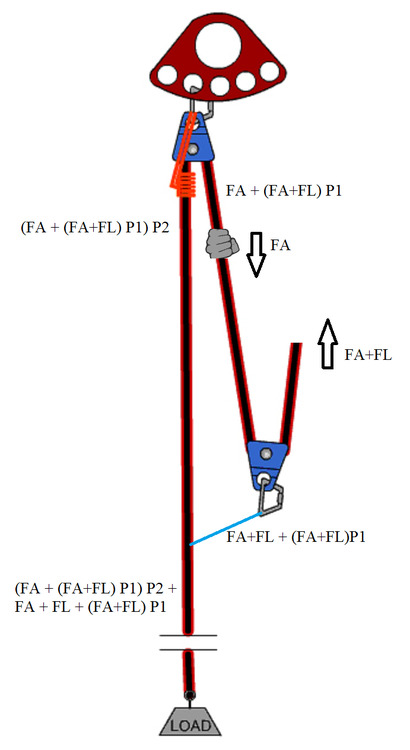 |
|
|
It's tricky and I'm not sure what's right---I've never thought about the effects of pulling on some other strand with a hand. I thought the force on the final upward pull strand should be FL, not FA+FL. That's the difference in our results. If the nature of the situation is that it behaves as if FA and FL are both pulling on the final the pull strand, then wouldn't the tension in the pull strand be just (FA+FL)P1, not FA + (FA+FL)P1? Or let's look at it another way. Suppose FL=0, no deep knee bend applied so zero tension in the final pull strand. Then you seem to be saying that the load FA applied as a downward pull on the middle strand migrates around the bottom pulley and creates an upward tension of FA on the final pull strand? Shouldn't that tension still be zero? |
|
|
rgoldwrote: I defined FL as the net force produced by the legs after overcoming body weight, so FL=0 would require a deep knee bend that just lifts the body without any surplus force to do other work. But suppose the legs are not used at all, just dangling in space. If the final pull strand is anchored to the harness, and the arms are strong enough to do a pull-up with added weight, whatever surplus force they produce will be transferred to the final pull strand. With my definitions this case would would be: FL = -bodyweight, FA = bodyweight + surplus.
Only surplus force (after lifting your own body weight) is transferred to the final pull strand, and not by migrating around the pulley but through body to the hip belt. Whatever surplus force can be produced in combination with the arms pulling the legs pushing will be passed to the final pull strand. The force FA is applied to the middle strand regardless of the first pulley; the top of that strand will have more tension than the bottom. If there is no surplus (you are unable to lift your own body) we have only a 1:1 redirect of whatever the arms can pull multiplied by the efficiency of the second pulley: haul force = FA P2. |
|
|
I feel like I'm cranking an extremely rusty cranium case, but... In doubt, I check balances of force and energy. Let me substitute in a pair of frictionless pulleys, so no energy is lost. The work done is now the weight(s) raised. With no hand assist, we raise the LOAD 1 unit and the body weight above the knees 3 units. If some third person does the hand assist, we have raised the body 3 units and the LOAD 1 unit. If the person owning the knees pulls down, we have the same result. The arm pull on the rope adds no work to the final state!!! I guess they just make it faster, and that extra work oscillates away in jiggles or something. But clearly the third person would be helpful, his energy has to go somewhere, and that reduces the work by the legs. So the work applied between the pulleys is Ax1 unit. And the work applied by the arms to the waist is 3A units, as long as the legs raise the body. That, of course means that with frictionless pulleys we can raise the 180 lb person with only 45 lbs of force by the arms and bodyweight by the knees.. I like where this is going - if I set up a 9:1, I may only have to do an unweighted squat and pull a pinky pinch on the rope coming out of the first pulley!! This mechanism is starting to look like a perpetual motion machine. It is requiring the arms to put out a fixed amount of force, but through greater and greater distances! And I think that with some practice, one could coordinate the arms and legs. But the mechanical advantage is different. The arm force is 1:1 to the load, while the knee force is 3:1. Doesn't this mean that the effective help is less?? While I pull down an inch of rope with 60lb, the knees are pushing up 3 inches., and my arms have to pull the waist up 3 inches. They are doing 4x the work than would be done by a third person pulling with the same force. But with the different speeds and differing strengths at different joint angles, I expect that a simple addition of the max arm force to max leg force is really over- optimistic. As a side comment representing the creaky knee subpopulation, my useful stroke no more than 9", so that is only 3" of raise, and a lot of resets. Next rainy day I'll definitely get in the garage and try something or other!! |
|
|
Latrowrote: I either don't understand or I disagree. A force on the middle strand applied over distance is work, and there is no more reason for it to be dissipated than any other work put into the system.
That's a great way to look at it. As long as the hips move up the differential motion causes the arms to sweep four times the lift stroke, so this system is 3:1 on the legs and 4:1 on the arms.
Any weight you can slow lift in a hip belt squat is force you can apply throughout the leg stroke. Likewise any weight (including your body below the elbows) you can lift in a slow non-kipping pull-up is force you can apply throughout the arm stroke. |
|
|
Re hauling. Just use the same technique most use on a big wall: a 2 to 1 using a separate thin cord or webbing. Works like a dream compared to the clutch being weighted. See https://people.bath.ac.uk/dac33/high/13SelfRescueSenarios2.htm#ahaulingsystemthat |


