
 Continue with onX Maps
 Sign in with Facebook






Rope for rebolting work?



|
For a 200m rope I tend to coil it into 3 sections. It's way easier to deal with than 1 or 2 coils. If you cut the rope it's worth thinking about where you are going to use it. It can be better to do a 60/140 split or something similar. How long are the pitches on your project? Will you be rapping? Is 100m better to rap with? |
|
|
Luke Stefurakwrote: Yeah, that sounds like a much better way. Is is hard to consolidate the separate coils? Pitches on most of the projects are 50m long, but there is another big project with 60m pitches I’d like to utilize this on as well. The math at this point is telling me to keep it whole and deal with cutting portions down after the inevitable core shot. Not going to be super helpful to cut it in half and destroy it’s usefulness for 60m pitch climbs. Cheers y’all, appreciate the comments. |
|
|
Since this thread continues to have legs, a few other points. Agreed that sheath damage is best avoided by anchoring the rope appropriately to avoid edge loading. But you can help your cause with the occasional edge protector. I find the Petzl ones with the clip mechanism to be least annoying to use. Relatedly, I've gone as skinny as 9mm for this sort of thing, and 10mm is much more psychologically inspiring and certainly more durable in general. Going thicker than that gets heavy for long approaches. You can use rope material to help mitigate abrasion/cutting, too. Polyester sheath is more abrasion resistant (such as Sterling HTP), and aramid sheaths even more so (some aramid strands are woven into the new Edelrid cut resistant ropes, but there are many options available for static lines with aramid sheath). Keeping the 200m as a single rope will allow you to maximize rope efficiency and minimize knot passing in inconvenient places. If you have separate lengths of rope (ex. a 60m and two 70m lines), you either a) have some amount of rope leftover when you reach the anchor, obvious ledge, etc., and tie this off short, then add the next rope. This keeps the lines free of knots to pass but costs you rope length. Or b) you continue with the leftover rope, joining it to the next one wherever you run out. This maximizes rope in service, but now you have knots to pass mid-pitch. A single long rope avoids that problem. |
|
|
Just as an update :) 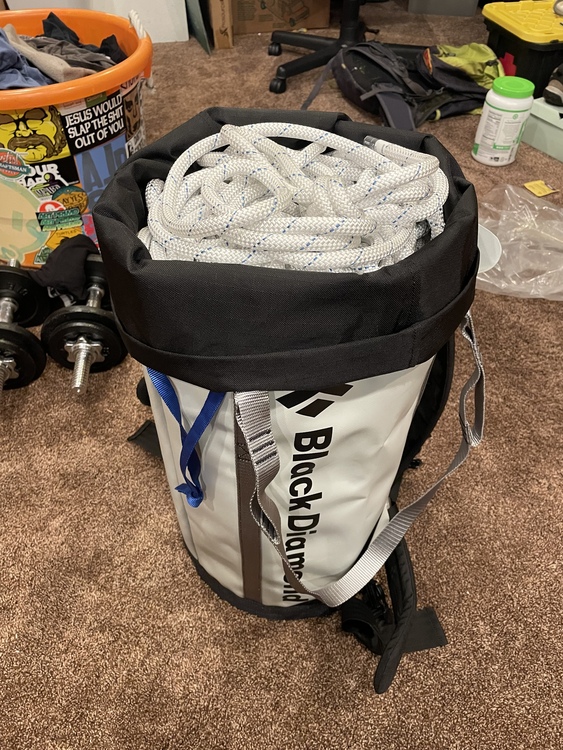 200m of 10.5 in a stubby. |
|
|
Not going to lie, that's some gear porn right there. |
|
|
Another vote for not cutting. The choices spelled out by Derek can be really annoying always having to think about. With the 200 you just go. Tying off wherever convenient. Marking yours up in a strategic way can be nice. I.e. with 70m, 60m, 35, etc sharpie marks for figuring out future pitch/rap lengths. And +1 for multiple coils. Though your bag looks nice. |
|
|
Thanks for all the info. I think I’ll go with something 10 to 10.5mm. Anything smaller I think wouldn’t hold up well for my application. And the extra cut resistance is nice. |
|
|
Salamanizer Skiwrote: I have a 10mm 200m you can borrow if you are doing a project in my area. It doesn't fit well in a stubby for what it's worth. |
|
|
Bobby Huttonwrote: I was tempted to ask you, but then decided that might be a faux pas lol. |


