Continue with onX Maps
 Sign in with Facebook






SS 304 vs 316 longevity


|
|
Elijah Swrote: This is not equivalent as a glue in can be 304, 316 9r titanium. However a well places titanium glue in is probably the most bomber bolt you can put in. But massive overkill in a lot of situations.
Does anyone actually use double wedge? 5 piece have a larger area of contact to the rock and thus hold better in softer rock. But they are real finicky for torque spec (especially on certain rock types) and if they turn into spinners can't really be fixed. For what I've heard, people tend to have success in sandstone especially the Red and here in WA, nothing but trouble on really hard index granite, hard (but brittle) metamorphosed andesite that puppy lovr, Shawn and I bolt in. I think we need to hear some more details about the crag. Rock type? Angles? Overall cohesion of the cliff? Dimensions? Tried any bolts in it yet? What type/how much vegetation does it have (this will help determine how much moisture it gets. like I DMed you the presence of a lake nearby will not affect the overall moisture if you're on the west side of the cascades) |
|
|
Hey Daniel, Thanks for your reply. The particular crag I’m bolting on is mostly vertical to slightly slab. Lots of vegetation in some areas, drier in others. At first I thought it was basalt columns by the looks of it but another local developer told me he believed it was andesite. I’m no geologist, I can’t really say. I have placed some Fixe 304 glue ins there. I picked up some of those 304 wedges you recommended and ordered some 316 wedges from Team Tough, when I get back up there I’m gonna bolt a route with the wedges. Also ordering some wave glue ins tomorrow and excited to try those out. I guess part of this process for me is attempting to get a better understanding of bolt selection and what qualifies an area for one bolt vs another. It seems like some of the lines could be fine with 304s where some would be better for 316s. Although I do like the idea of a bolt that essentially lasts forever I don’t anticipate using Titanium because we are not on the coast. So a 316 glue in would be the next best thing…? |
|
|
Elijah Swrote: None of it is that simple, you can turn a bit of 316 into garbage in manufacturing or 304 into something good. We aren't even sure there has been a case of genuine 316 ever failing, usually the investigations come out that either the material wasn't what was claimed or assumed or that somewhere along the line there was a process-induced change in the material And it isn't just sea-water that causes problems. There's also a "what lasts longer" problem that there are plenty of forged steel anchors been doing good service longer than any stainless bolt has (but they have other issues). I get asked regularly "how long do they last" and the answer is we don't know, the answer (and this is what the standard says as well) is the installer has to go by past experience of what was used earlier and turned out good/bad The material cost difference slowly dwindled over the decades as 316 became more widely used and only makes a 316 bolt 5% more expensive than 304 so I effectively stopped making 304 as demand fell. So as a manufacturer the answer is pretty simple as we don't sell anything but 316 anyway. I'm not sure any Euro manufacturer still makes 304 stuff anymore., certainly not mechanical bolts due to the construction codes. There have been numerous attempts to give a scientific basis to material choice and lifespan but even the standard reverts in the end to an experience criteria, if it works it's good, if it doesn't it isn't. The Space X school of development! Mechanical bolts must by design and installation be more susceptible to corrosion, in Europe nobody uses 5 piece anyway so we have no real experience wirh them, drilling a larger hole for a weaker bolt seems wierd to us. Saves us wondering about using washers though! The double-clip bolts have lower pull-out numbers than single clip and are designed to overcome a problem climbers don't have. |
|
|
Elijah Swrote: I think that is fine but I agree with Shawn that it is rock type dependent. I believe some fixe hangers are stamped with the 316 or 304. I know there isn't much developed around where you are at but I would go to Portland crags try to look at bolt hangers and see if they have a stamp then look up the date of the FA. I would generally look to the wetter routes for reference point. If you are west of the cascades I would go 316.
I personally don't worry too much about bolt strength, often there are spec sheets that tell you strength. 5 piece are stronger and if they don't become a spinner in the first year they will be problem free. However, I have yet to meet someone in Seattle who advocates for them since they tend to become spinners on install or if you don't place it perfectly flush you are screwed. Wedge bolts tend to be more forgiving. There is a developer here who has placed wedge bolts 15 degrees off the correct plane and people whip on the bolt all the time still. Edit: Jim and Daniels' responses are better than mine. |


|
Jim (and loads of other folks), I don't understand where you are getting this mis-information about 5-piece bolts. They are stronger in every measurement than even the best wedge bolts of equivalent size, often double (yes, double) the strength of wedge bolts. The bolt diameter of the core is the same (actually slightly larger) than a wedge bolt of the same diameter (since the threads cut into the diameter of a wedge bolt a lot more than people realize). They are far stronger in medium to lower quality rock, since the expansion sleeve can expand dramatically while a wedge bolt clip is very limited. They are definitely removable in the future, whereas wedge bolts are less likely to be removable. This is particularly true in the vast amounts of U.S. rock climbing in Wilderness where all power tools are prohibited. Yet even in power drill legal areas, in my experience, stainless wedge bolts that need to be replaced are likely to have the threads stretched and damaged such that the nut cannot be unscrewed at all, and a spinner tool is of no use. 5-piece are also "longer" than people realize - a 2.25" 5-piece bolt is about the same depth in the rock as a 3" wedge bolt. The reason is that the 5-piece is measured below the washer (a 2.25" is actually 2.6" long), and wedge bolts lose depth as they are tightened. This is very obvious when hand drilling granite, if you use a 2.25" wedge bolt your hole depth is much shorter than with a 2.25" 5-piece. If people are having trouble with 5-piece, the most common reason is one of technique - when pounding the bolt in, you tap it in until the hanger is just flush (or just less than flush) with the rock, you never hit the bolt once it's tapped fully in - that dramatically increases the chance of a spinner. 5-piece are not made in 316, probably because 316 is far more than 5% more expensive than 304 in the U.S. Jim, does anyone use the Hilti HSL-3 in Europe? Those are similar to 5-piece, and made in 12mm. Of course 12mm wedge bolts are going to be super strong and even if the HSL-3 is much stronger, it's kind of pointless when the carabiners would explode before any difference would be noticed... |
|
|
Elijah Swrote: Andesite or basalt, functionally the same thing if it's columnar (I am also no geologist.) Sounds like you got it handled. I would just keep an eye out for seepage (which will change as you clean it) because seep lines & stains are places you would want to use 316. I would probably use 316 glue ins as those are way harder to replace (if you're going to use glue ins). If the rock is solid, not flakey/a million death blocks barely attached then 316 wedges are the way to go. Here comes the (extra) unqualified part of the post: andesite and basalt being similar, wedges are perfectly strong because individual pieces of basalt are so hard. The only issue comes when there is no cohesive place to put the bolt. So unless it's pretty soft andesite, glue ins are VERY overkill. Don't let that stop you if you want to use them. |
|
|
Greg Barneswrote: The problem is a bolt like the HSL-3R for a 12mm hole is actually only an M8 bolt. I've tested the Fischer equivalent and the difference between that and an M12 wedge bolt is considerable, especially in the axial test when tested to EN 959, not ETA-02/0042 which is what the manufacturers data uses. They also require the hanger to be bored out to 14mm, their rules not mine And the Hilti ones cost a fortune! The cultural problem is Europe went from appalling rubbish straight to resin/cement bolts at a time when reasonable mechanical bolts were in their infancy and never really engage in bolt-ins that well, a lot of the rock quality didn't give good results so glue-in became the default bolt. |
|
|
Greg Barneswrote: Is there a good resource somewhere that includes all of the nuances of installing 5-piece bolts? |
|
|
My problem with the 5 piece is that stainless version was only available in 2.25" or 3.5" not 3" the longer 1/2 inch thick rigs always worked perfectly. the 3.5inch stainless 3/8 rigs never got seated all the way in that hole without haveing to hit too hard. ended up with a few spinners over time , Travis had simeler issues up in Smuggs. we both have had great luck with 3" stainless wedge bolts which is also what Sykes and his crew uses. . I also had a 2.25" 5 piece on a steeper spurt climb turn into a spinner after about a decade. I replaced it with a glue in. |
|
|
5 piece = more pieces to drop/lose |
|
|
Nick Goldsmithwrote: The 2.25" are as long as a 3" wedge bolt (as far as depth of the bolt under the rock), so not much need for the 3.5" size anyway. The 3.5" are not my favorite, the 2.25" are plenty long. If you feel that your rock quality is low enough that you'd want to place 3.5", then you should be using the 1/2x2.75" instead (or longer - or better yet glue-ins). The 3.5" are very rarely used by ASCA-supplied rebolters, the only place where they are frequently used is hand drilled medium/low quality rock (Pinnacles is the only place that comes to mind - all climbing there is in Wilderness). As mentioned before, the actual diameter of a 3/8" wedge bolt (measured between the "trough" of the threads) is just slightly less than 5/16", so the 5/16" bolt core of a 3/8" 5-piece is actually thicker than a 3/8" wedge bolt (even without counting the sleeve). Likewise with the length of the bolt, a 3" wedge bolt is typically about 2.25" under the rock (and even less if more threads are showing after tightening), so it's not really a 3" bolt. |
|
|
my red head 3830s are about 3 1/8th long and the way I typically place them in a nice tight hole I end up with about 3.5 in in the rock. trying to buy 5 pieces my default is 3" so naturally the closest thing to 3" in the 5 piece is 3.5. Like I said I had great luck with the 2.25in 5 piece but even then I had the ocasional spinner. I am super comfortable with the Red head 3830 and the Hilti quick bolt. placed hundreds of them and work just fine. |
|
|
Seems like a lot of mixed reviews on the 5 pieces… I’ll probably just avoid them for the time being and stick the the simple wedges. Bolt busters did an episode on the Dewalt Power studs… they seem pretty bomber. I picked up some in 304 SS, 3/8” x 3.75 |
|
|
Elijah Swrote: They're my go to. I highly recommend using a drill bit with 4 cutters on the tip, not the ones with just two. The holes end up much rounder and the power studs require way less pounding to get in. |
|
|
Greg Barneswrote: The core diameter of an M10 bolt is 0.321" to the Din Norm, a 5/16 bolt is 0.3125". The lengths for wedge bolts are a bit confusing so for simplicity just given as total length. In reality there are two systems. The first is where the embedded length stays the same and is given for the worst-case concrete (usully 5x diameter) and then the threaded portion varies in length for whatever is being fastened and the code number looks like 10-10/80 for an M10 bolt to install something 10mm thick or less and is 80mm total length or 10-140/210 for installing up to 140mm thick. The bolt is threaded nearly all the way down to allow it to be used for stand-off applications or use one nut to install to the required torque and then fit something like a box section which would otherwise be crushed. The alternative system is to keep the threaded portion shorter and allow the embedded part to be longer, this is to allow the correct depth in the concrete even though there may be a layer of rendering, tiles or similar over the actual structural concrete but these are rare nowadays. There's a third system which probably combines the worst features of a 5 piece and a wedge together! Basically a wedge bolt with the threaded part removed and a short internal thread to take a normal bolt. The only place I found them useful was bolting climbing wall holds onto concrete. |
|
|
This thread is 304 vs 316, not 5 piece vs glue in vs wedge dammit! I'm trying to get hyped. Can we get back to how glue ins are for sure good for 100+ years and definitely the tested and proven glue is good for all climates including those with heavy freeze/thaw periods and exfoliating granite? |
|
|
There's no guarantee that any climbing equipment lasts for any period of time. YGD. |
|
|
Kyle Elliottwrote: Geologic time is now. |
|
|
|
|
|
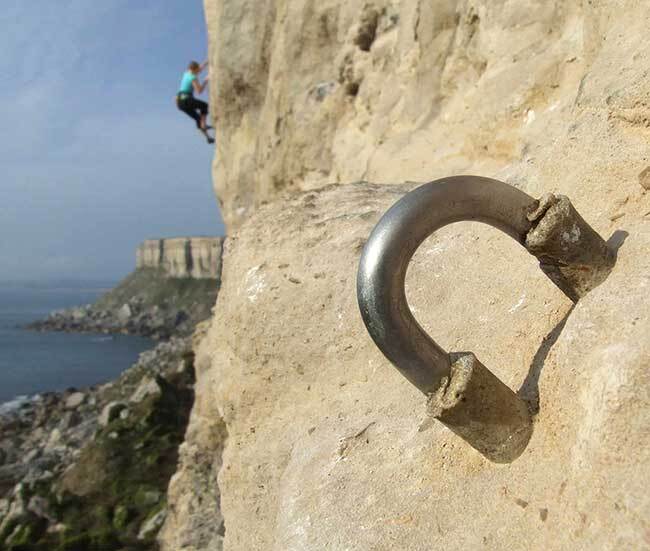
Wow! fantastic photo Tim, where is that? |