
 Continue with onX Maps
 Sign in with Facebook






SS 304 vs 316 longevity


|
Just out of pure curiosity, how long are the epoxies meant to last? RE-500? RE-100? Jim Titt, the epoxy that you sold when I was in Montenegro? (Which, by the way, I like working with way more than the Hilti stuff.) I remember hearing something like 100 years for a few of those, but I have never read anything official. |
|
|
The old Euro standard was 50 yrs but is moving up to 100, some companies have re-certified but I haven't looked at them for a long time. |
|
|
Jim Tittwrote: I doubt any of those epoxies have actually been tested for 100 years so how do they compute that number? Is it some sort of accelerated aging process similar to what's used for MTBF calculations for electronic components? |
|
|
I have mostly used 304 and ocasionally used stainless 10mm glue ins where i thought they were needed. I feel really good about all the work I have done and doubt it will need replaceing in my lifetime. I don't live anywhere near an ocean. |
|
|
Emil Briggswrote: The usual accelerated ageing, the details will be in the relevant EAD (European Assesment Document) which is in effect the standard to get the ETA (European Technical Approval). The lifespan of the product is given in the ETA which can be downloaded from the manufacturers website. Some resins have a dual rating like Hilti HY 200 which gives the different strengths for 50 and 100 years. As nothing we do conforms to any of the conditions under which the ETA was issued how relevant it all is is doubtful! |
|
|
Mr Rogerswrote: First of all, I (and the Access Fund) don't advocate titanium everywhere. This common attitude, "I'm gonna put up routes but spend as little money as possible and let someone else clean up my mess 20-something years later", is exactly why we had, and still have, rotting bolts all across the country. How much rebolting have you done, Mr. Rogers? When you've done a lot of rebolting your attitude changes. I've already spent ~$25K rebolting and establishing new routes on Cayman Brac. Much more if you count my labor, airfare, etc., so spend some of your own money. 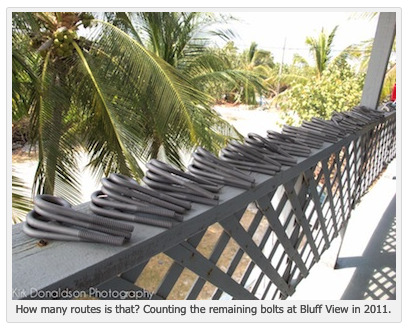 |
|
|
John Byrneswrote: Please, do not ever lower directly through a glue in. Always use a biner. The inconvenience of removing a biner for the next guy is much less than the inconvenience of replacing a glue in due to pre-mature wear from a rope running through it. Imagine if everyone did what you suggest... it could quickly become a problem even if you're rapping on popular routes. |
|
|
At the current moment, I would agree that glue-ins seem the best long term solution. The reasons I do not use them: It is too steep, I often get so gassed I can only get 4 bolts in, in a day (I don't wanna waste a tube). My one concern long term is that the epoxy is currently fine, however one brand begins to fail for unforeseen reasons in 50 years. Thus a bunch of bad glue-ins that are impossible to identify being out in the world. |

|
climb2corewrote: I agree with climb2core - in fact I've seen a glue-in worn 1/4 of the way through for exactly this reason - it was the bolt before a tough crux, and people would bail by lowering straight from the bolt. Please leave a carabiner instead. |
|
|
Straying from the 316 vs 304 a little but is best long term solution to minimize # of holes... initial install: 3/8 mechanical > 1st rebolt: 1/2 mechanical > 2nd rebolt: 1/2in glue in > nth rebolt: ?new tech? This is all assuming rock is decent and you are using appropriate material for your area. |
|
|
John Byrneswrote: So the info about what is necessary on a sub tropical or tropical island is really unnecessary to most of us. You like to project this experience to us but really you should be posting this elsewhere. I started doing bolt replacement work circa 83 - 84, in that there where a number of dowels, poorly placed self drive, and 1/4 inch Rawl Drives here in NC that would have eventually killed someone. I have gone back and reworked all of those early jobs, that where hand drilled with 3/8 or larger stainless. When i bought my first power drill in 90 I also bought my first stainless bolts. I heavily promoted stainless with my acquaintances when it was nearly an unheard thing in the early 90s. So yes I am in it for the long haul. I wouldn't be placing bolts now that I thought would be bad in 20 years when I might still be climbing. Buying good quality hardware does not mean spending the most that is possible. I only buy the best available mechanical bolts. I mostly use Bolt Products glue ins that are now all A4 (316). The first ones I bought were A2. So comparing what I do to people who where and are placing carbon steel bolts in this century is being dishonest. I re-use 304 hangers from the 80s all the time, not because I am cheap but because throwing them away would be wasteful. I will continue to use 304 5 piece bolts because they have advantages over wedge bolts and glue ins. In all my time replacing anchors here in the mid-Atlantic I have seen not a single bit of corrosion on a piece of 304 hardware. |
|
|
Shawn Swrote: This is my personal philosophy. Longest use out of the same hole location. As long as the materials used are appropriate its theoretically a great idea. |
|
|
John Byrneswrote: No one said access fund says to use titanium everywhere, but okay.
If you're seeking praise for you efforts here you go. Thank you for doing good work. Clearly you have a life that gives you plenty of expendable income to travel the world putting holes in rock for fun. Congrats? |
|
|
Greg Barneswrote: If that's the case on a popular route, then a fixed draw (steel biner) should be put on that bolt. I still believe that leaving a biner is poor form. |
|
|
Mr Rogerswrote: EDIT: Hey, forget it Mr. Rogers. I was a fool to suggest that we use the best materials available so our work lasts as long as possible. This is social media after all, where if you say the sun rises in the East, someone will tell you you're full of shit. |
|
|
John Byrneswrote: John I appreciate your work and I think I have convinced my wife to go to cayman brac next winter. If you are developing a crag, and 304 has been fine for the last 30 years. Spending half as much on bolts seems reasonable especially since half the routes anyone puts up won't be climbed much.
The fundamental issue is that we lack a dataset to tell us 304,316 and titanium stack up over the years. The case could vary well be 304 lasts 50 years or 304 lasts 10 years I think trying to be observant of the hardware at your local crag might be the best dataset any of us have
I don't disagree. |
|
|
Thanks for the recap Puppy Lovr So to sum up what I’ve learned in this thread so far… Hardware choices ranked best to worst: 1. Glue ins 2. 316 bolts 3. 304 bolts 4. Absolutely don’t use anything lower quality than 304. Am I on track? Also curious… as far as mechanical bolts… Are the 5 piece generally considered superior to wedge? What about double wedge? Best to worst? 5 piece Double wedge Single wedge Is that about right? |
|
|
Elijah I think you are oversimplifying. It depends lots on the environment/rock quality. I'd rather start with a mechanical bolt then replace with a glue in some day if possible. |
|
|
It depends on the rock type. I have had great luck with 1/2" 5 piece but not so much with the 3/8ths version. YMMV. i have had great results with 3/8th wedge bolts for everything except steep sport climbs where the hangers get pulled up while lowering. in those situations glue in is best. YMMV |
|
|
John Byrneswrote: A biner is bad but a fixed draw is a-ok? I struggle to see your stance here. |


