Mountain Project Logo

Repair the damaged sheath on your climbing rope

Yoda Jedi Knight · · Sandpoint, ID · Joined Apr 2019 · Points: 0
phylp phylpwrote:

I’ve been doing that for years. I use a thick cotton poly thread, doubled up, just use a blunt nose needle to weave thru the sheath. The thing I like about it is you can easily feel it when it runs through your fingers. 

Got any pics?

phylp phylp · · Upland · Joined May 2015 · Points: 1,142

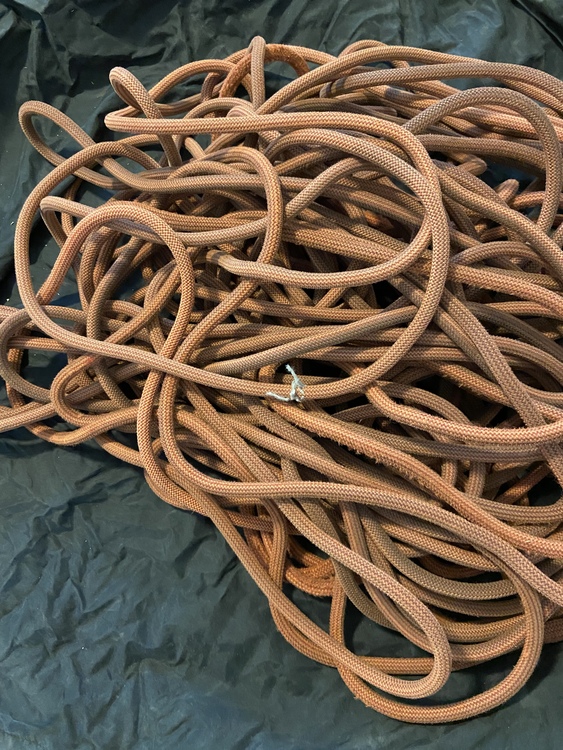
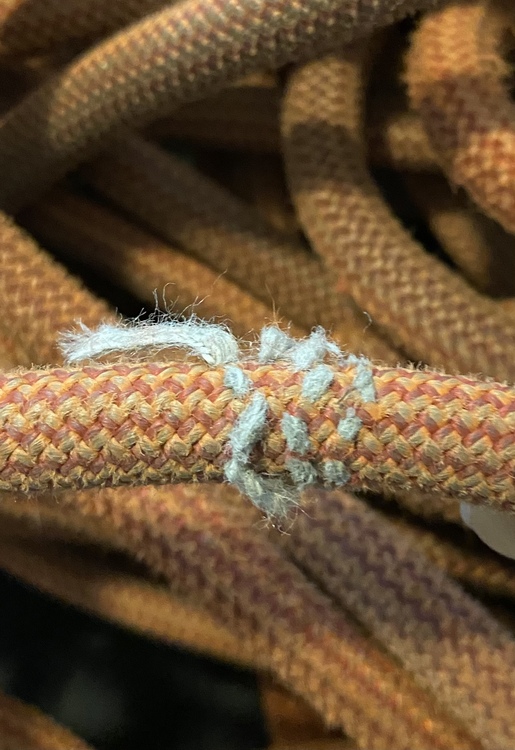
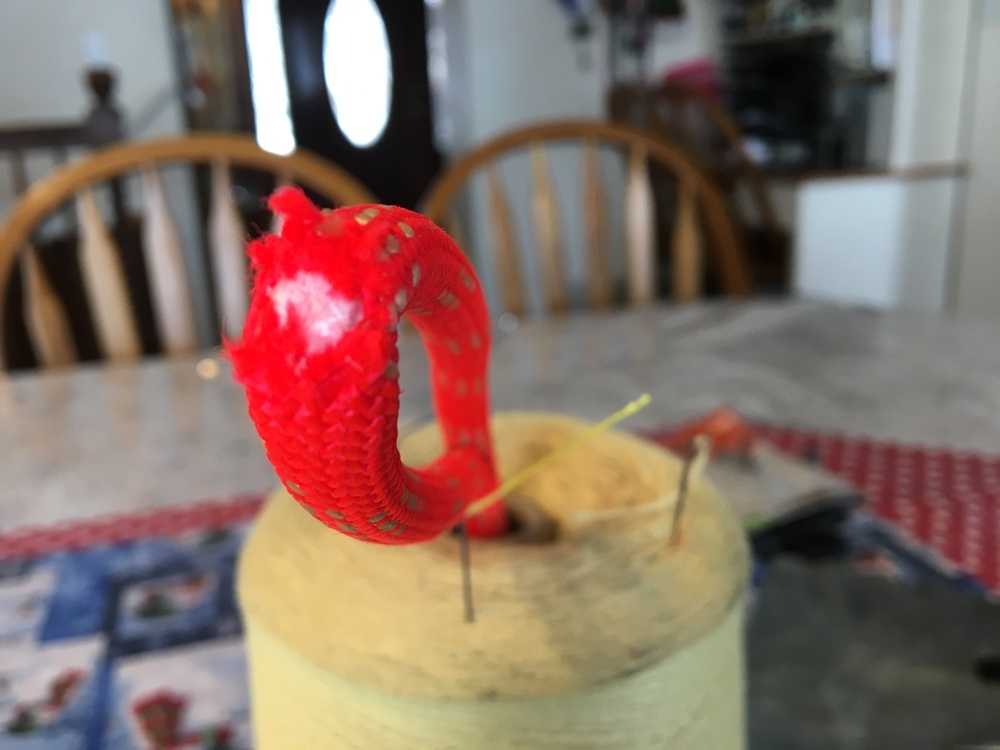
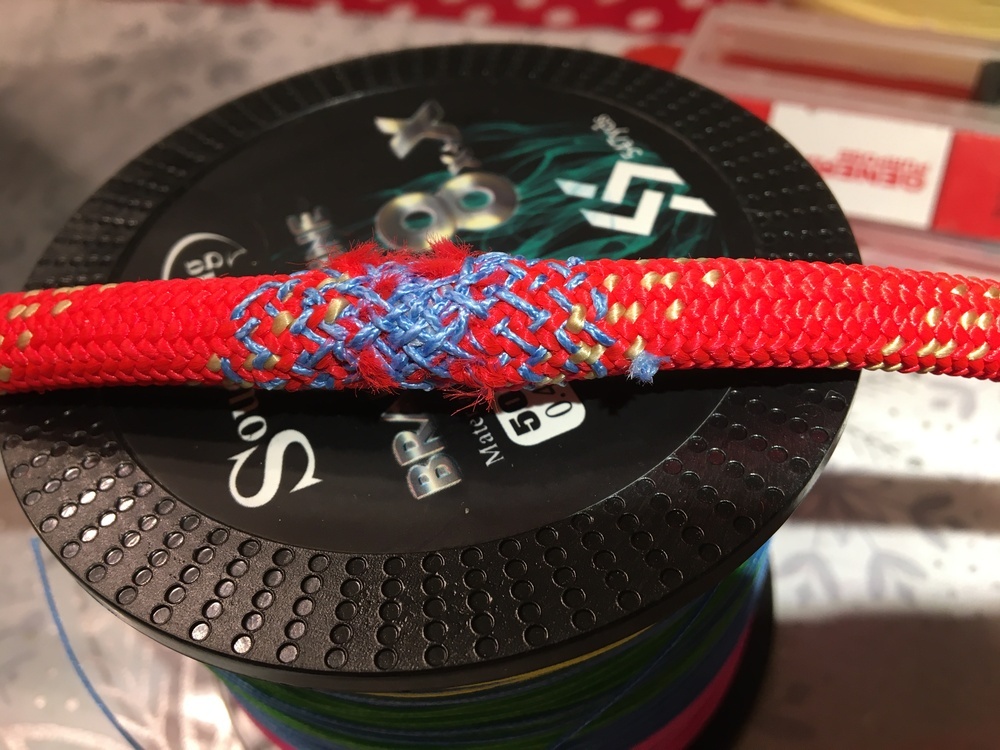
This rope is from 2017, so the weave has frayed quite a bit but still easy to see and feel.  I just like this method more than re-inking my rope.  At dusk or in deep shade,even with rope dirty, it’s so easy to find.
phylp phylp · · Upland · Joined May 2015 · Points: 1,142

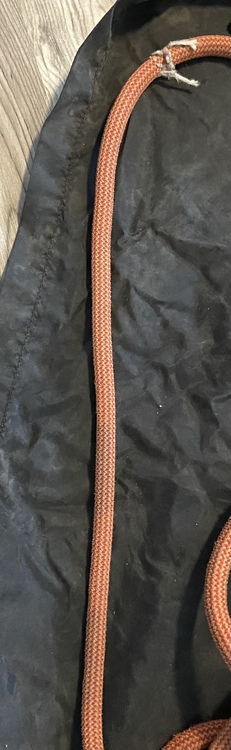
Btw, can you even make out the two original marks downphoto from my weave?  I often find it the case, when I run a new rope through, that the marking is offset from the real middle. I put the weave at the real middle. 

Patrick L · · Idyllwild · Joined Jan 2019 · Points: 0

Hmmm I'm no structural engineer or textile professional, but I sew a lot ( have a good amount of experience with fibers and fabrics) and am a lifelong angler and I fish offshore in the ocean a lot. If a person has dyneema (spectra) fishing line and it is taught, it cuts through stuff like butter. 

If one person is hooked to a fish with monofilament (regular fishing line) and another with dyneema (spectra)- we call it braid- and they touch while they're both under tension, the braided line will cut the mono instantly, even if they're the same weight (strength). It slices into skin and flesh no problem, I have sliced my pinky finger to the bone by tightening a knot with too thin of braided line. 

Not sure how to factor any of that into this discussion, just saying that in my experience, dyneema thread or line can and will cut other materials very easily. It doesn't stretch(give) at all. 

Crotch Robbins · · Unknown Hometown · Joined Apr 2003 · Points: 307
phylp phylpwrote:

I’ve been doing that for years. I use a thick cotton poly thread, doubled up, just use a blunt nose needle to weave thru the sheath. The thing I like about it is you can easily feel it when it runs through your fingers. 

Same. Works great though I have to warn new partners who otherwise think that there's something wrong with my rope.

James M · · Colorado Springs, CO · Joined Sep 2017 · Points: 80

You guys are making me feel so much more confident in my ropes   

Brian in SLC · · Sandy, UT · Joined Oct 2003 · Points: 22,822

Beats duct tape!

Dave Olsen · · Channeled Scablands · Joined Dec 2019 · Points: 10
Desert Rock Sportswrote:

Yeah, don't do this. Especially don't do this with dyneema. Had you used yarns with material and twist matching the strength and stretch of the original yarns, and extended them far enough, they would basically be a form of splice... but the bulk would be higher.

If you fall, and load that splice, with a highly static thread, right over a carabiner, best case it unravels, worst case the dyneema threads CUT more of the original threads.

DO NOT DO THIS.

Spectra (Dymeena) thread doesn't appear to "cut" nylon webbing that I have seen on draws and such.

Nylon Web sewn with Dyneema

(Some types of dental floss are pretty strong)   

Tradiban · · 951-527-7959 · Joined Jul 2020 · Points: 212
Jordan Daywrote:

I repair ropes all of the time.  It is a great way to be environmentally friendly and save money.  When repairing an area that is just fuzzy and weak I do a less dense more spread out weave into the sheath.

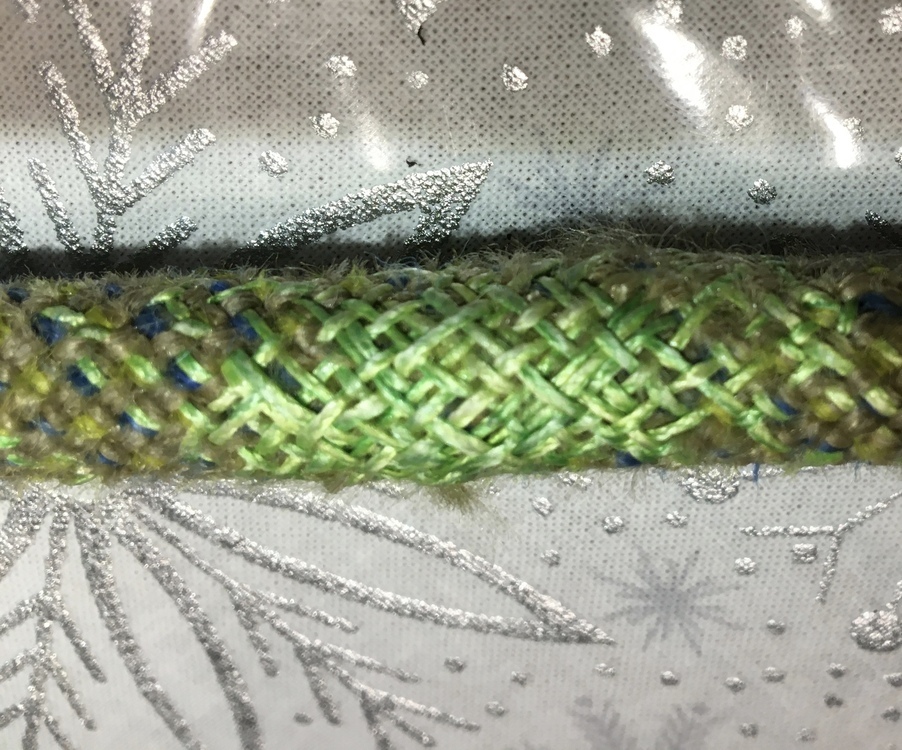
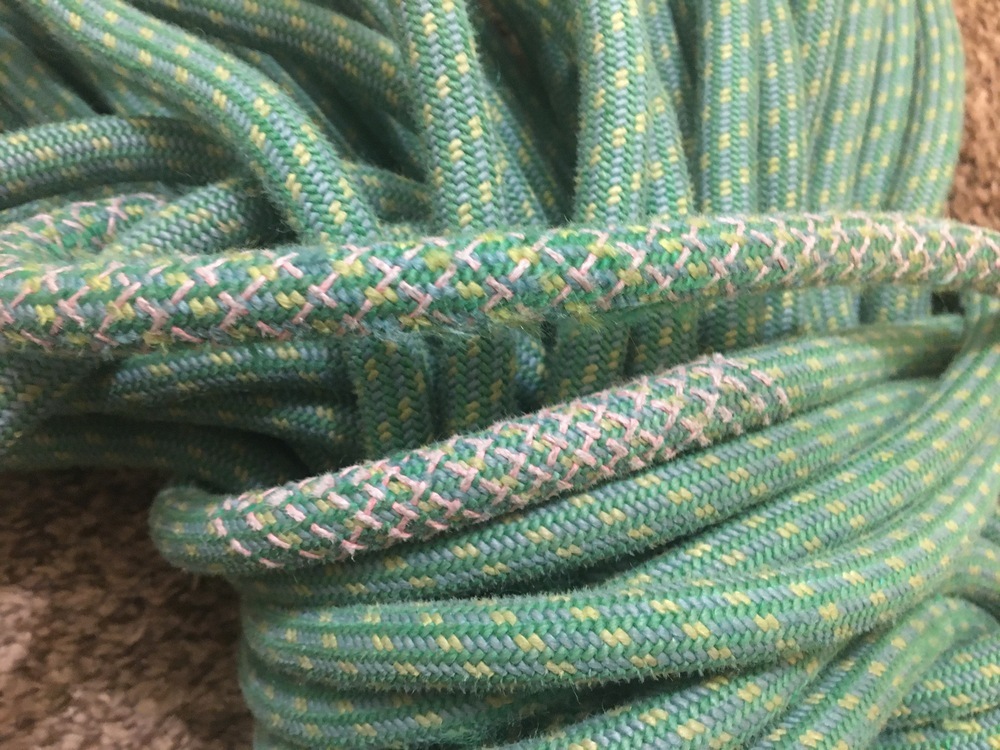
In this photo the sheath was badly damaged but not the core.  It was not nearly as damaged as the orange rope shown below.  I used green dyneema fishing line and followed the direction of the yarns in the sheath.  In the central area of the repair I didn't run the needle under the yarns except when doubling back.  In the edges of the repair you will see places where my green line weaves in and out of the sheath strands.  I did all parallel lines in one direction first, then all the lines in the other parallel second while weaving the needle in and out through the first initial lines.  The rope above had severe damage, but my repair is smooth enough I don't even notice it when rappelling, and barely do so when belaying.

This repair is only on this side of the rope.  I only go all the way around the rope when doing a less dense pattern.  This is to avoid causing a thick, stiff section in the rope.  Don't pull tightly with the needle.

I don't do repairs if the core is damaged.  If the core is bulging out of a sheath tear that is very challenging to deal with.  Unicore ropes help avoid this.

This dyneema fishing line is my favorite but you can also get great results with the much cheaper 8 or 9 strand line instead of the 16 strand. Ebay is also a good source.  I find .45mm 130lb line is ideal.  The repairs last forever.  In the link they simply specify PE line.  This is short for High Density Polyethylene which has the trade names of Dyneema or Spectra.

It will take you some practice to get repairs as nice as the one above!

edit: Testing Results - These were done in February 2023, a year after the original posts.

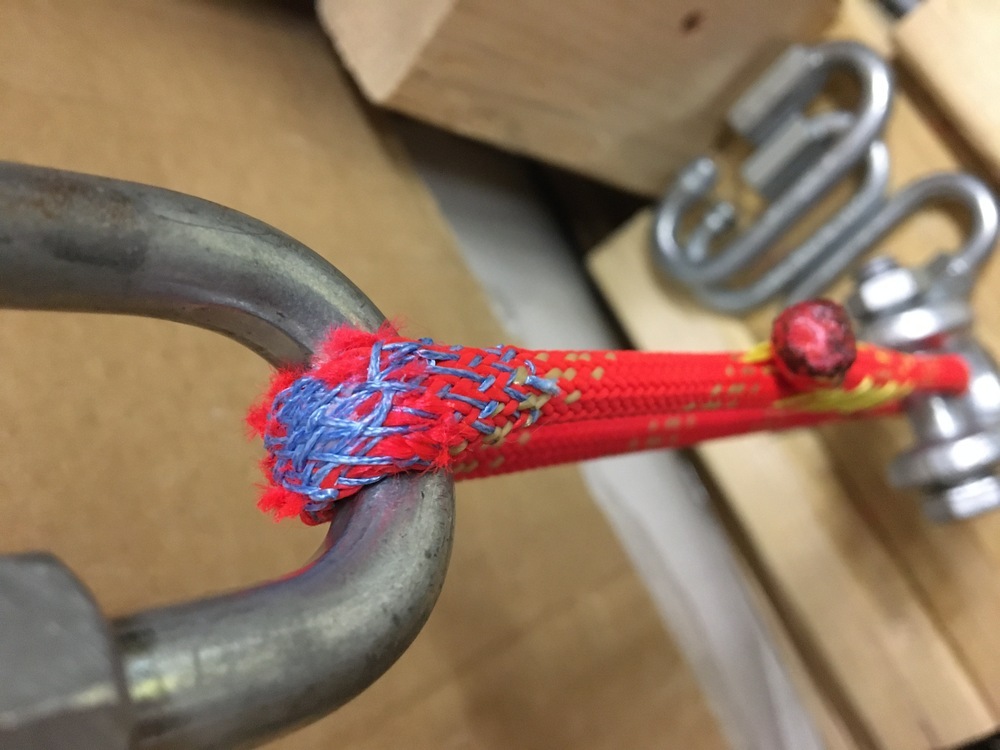
I used a new rope for testing.  In the photo I cut through half the sheath strands without damaging the core.  When I broke it on my pull tester I was surprised to find the breaking strength was only reduced by 10% compared to a control test break with an undamaged section.  This particular half-rope has a very thick sheath so I would have assumed a lot of its strength to be in the sheath.

Above I cut through half the sheath again without damaging the core.  The repair is woven through the sheath only, it does not disturb the core.  You will see that there are far less repair threads than cut threads.  I can only put in a certain density of repair threads before a lump is made that is difficult to rappel or belay past.  This particular rope has a tightly woven sheath(Edelweiss) where it is increasingly tight and difficult to pass the needle into the sheath as the material is added.  You can add a higher density with a loosely woven sheath.

The repair was positioned in the most vulnerable place on the test rig.  It broke at almost exactly the same force as the equally damaged test piece with no repairs.  The repair threads caused no additional damage to the sheath.  It was evident they broke before the rest of the sheath or the core did.

In his third post below(made previous to this date) Desert Rock Sports wrote about the repair on the top green rope:

If you want to really just isolate that section so it doesn't stretch like the rest of the rope, you will have to do quite a bit of reinforcement making sure they are long enough in the length of the rope to transfer the load, and enough of them, and that they are tensioned correctly (balanced) or just the most taught ones may break when the rope tries to stretch. If you have a good way to do that and know how much is enough, great.
Alpine / expedition... that is understandable and regrettable to have to choose repairs over just knotting to isolate the section. I get that you can't really lead on a rope with isolated sections since they wouldn't pass through pro though and sometimes a rope can be too short to be really useable.

My take on the test:  I have to completely agree with Desert Rock Sports analysis in the post excerpt above.  One repair test obviously is a tiny sample but I have become convinced that it would be extremely difficult to make a repair that would restore the rope to its full strength.  I am reasonably convinced that as long as you don't sew through the core, this type of repair method is unlikely to either weaken or strengthen the rope.

My buddy did his first repair on this rope of his above.  Nice!  This rope had excessive abrasion in the repair area that would have continued to deteriorate quickly.  The repair completely stopped the damage from progressing.  We have used this rope forever, both before the repair and after.  I have climbed on dozens and dozens of ropes.  I love this one the most.  It has perfect handling and with the exception of the damage shown, has been almost impervious to wear.

The fuzzing and breakdown was stopped before any significant strength was lost.  A well loved rope saved!

My take continued:  I think this type of repair method is highly useful for expeditions where you don't have replacements for damaged ropes.  You can even do a really quick crude version of this while on the wall so that you can repair a heavily damaged sheath that would otherwise be hard to rappel on.  I have done a lot of repairs including quick ugly ones in the field.  They all make the rope hold up a long time.

I have had great luck climbing on repaired ropes that had abraded areas or light sheath damage where the strength of the rope is only slightly reduced.  I would never attempt to repair a rope with core damage.   I would not do repairs for the heavy damage shown on the orange rope except for expedition type scenarios, or for getting down a wall.

Sketchy but fair. Ride on!

Jordan Day · · Highland, UT · Joined Mar 2010 · Points: 3
Mikey Schaeferwrote:

Do you have a link to a page showing the whole process?  I’d be curious to learn more.

This could be good info to have on long remote expeditions where it isn’t possible to just run to the store and buy a new rope.  I’ve climbed on many core shot ropes that are just wrapped in cloth tape or I’ve taken a lighter to cauterize the frayed section.  Both “fixes” are less than ideal.

I don't think there is anything I could show that anyone couldn't learn from just copying the photos(don't sew through the core) and spending a few hours working on old ropes.  

Remember my conclusion was that this type of repair is unlikely to either strengthen or weaken the rope.  My past experiences suggest that a very heavy repair, with equal tension in the repair threads would be necessary to strengthen the rope at all.  This repair would have to encircle the whole rope and be even all the way around.  It would also have to be as strong as the original sheath.  I have tried those type of repairs, they feel impossible to do.  They just cause a big fat stiff lump in the rope that is unworkable for rappelling or belaying.

The repairs on the two green ropes simply protect them from further damage.  I suggest only repairing ropes with light sheath damage - no core damage.

Nkane 1 · · East Bay, CA · Joined Jun 2013 · Points: 475

Very interesting update!

Ken Tubbs · · Eugene, OR · Joined Sep 2018 · Points: 1
phylp phylpwrote:

I’ve been doing that for years. I use a thick cotton poly thread, doubled up, just use a blunt nose needle to weave thru the sheath. The thing I like about it is you can easily feel it when it runs through your fingers. 

My very first rope was from Chouinard Equipment and did not have a middle mark.  (Actually, my first rope was a Goldline.) I wrote a letter to Chouinard Equipment asking for advice for a middle mark. I received a handwritten reply from Yvon himself that recommends this. He also recommended similar marks 20 feet from each end so you know how much rope is left.

It's important to be clear that this repair is ONLY for sheath damage!

Guideline #1: Don't be a jerk.

Climbing Gear Discussion
Post a Reply to "Repair the damaged sheath on your climbing rope"

Log In to Reply
Welcome

Join the Community! It's FREE

Already have an account? Login to close this notice.