
 Continue with onX Maps
 Sign in with Facebook






What width runners for alpine draws?


|
|
10 or 11 mm There have been tests that show significantly more durability over time with 10-11mm slings over thinner ones. Unfortunately tests are in german. |

|
https://issuu.com/sensit/docs/dav_panorama_4_2015 around page 60 |
|
|
I like the BD and Camp 10mm ones, They weight half a gram more each on my scale compared to the 8mm Mammut. But the Mammut develop that super fuzzy, stick to every piece of velcro within a quarter mile issue very quickly! |
|
|
Kevin Mokracekwrote: In the DMM tests, the dyneema slings without knots failed at 21 kN or more (you don't tie knots in alpine draws, so that's the data you want to look at). That amount of force is FAR more than any of your trad gear can withstand, so even if you were to have a force that high in a fall (you won't), you'd break your cams/nuts before your slings. Even with knots tied in them, the slings broke at over 10 kN, which is stronger than the requirement for cams (5 kN) and nuts. So even if you're tying knots in your alpine draws (?) and taking HUGE falls onto them, good chance your gear breaks first. Those DMM tests were high fall factor, static, (no dynamic rope), rigid mass falls onto fixed slings; this has very little crossover into roped falls onto alpine draws, and using it to inform that decision may be a misapplication of that data. |
|
|
Eliot Hackwrote: Agreed. I also like a rubber keeper on the rope side biner. I use the Petzl XS ones from the old ange draws which work great with 6-8mm slings. |
|
|
Jakob Melchiorwrote: Probably shouldn't do that.... 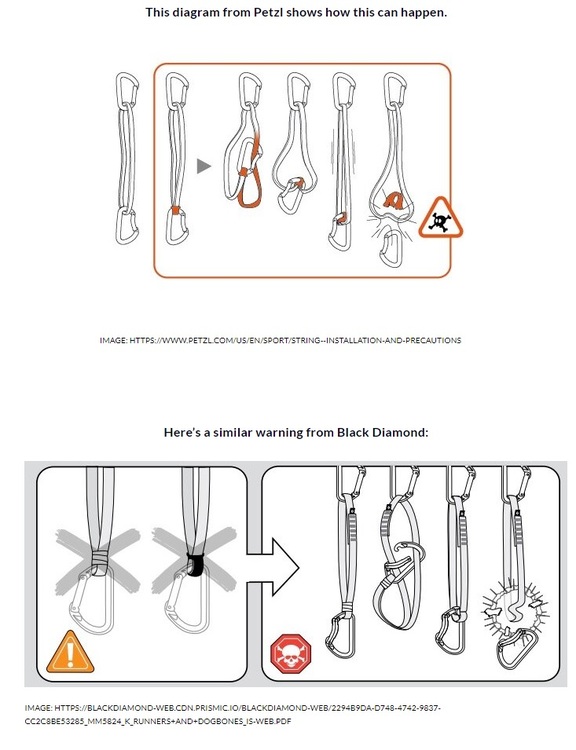 From Petzl and BD via Alpine Savvy https://www.alpinesavvy.com/blog/dont-put-rubber-bands-on-an-open-sling?rq=sling |
|
|
|
|
|
PatMaswrote: This. Once I also discovered the 8mm weighed the same, any so-called advantage was lost. Also, who buys two sets of draws for trad? Nylon for cragging and dyneema fur multi+ -- wtf? Set of trad draws, set of sport draws. |
|
|
Jakob Melchiorwrote: Do NOT put rubber keepers on open slings. Everyone should know this. |
|
|
Nylon seems to last longer. |
|
|
This might be a stupid question but how can 8mm, 10mm, and 11mm Dyneema slings all be rated 22kN? |
|
|
Glad someone reminded us of the no rubber keepers on slings point. Seems like it would be OK, but it isn't and the Petzl diagram shows why. |
|
|
Josh Rappoportwrote: Because even a few strands of Dyneema, in ideal conditions, are rated to 22kN — but very delicate! |
|
|
Josh Rappoportwrote: Probably some are stronger but they are tested/certified to comply with the 22 kn norm. |
|
|
John Vwrote: So does this mean that kN ratings are always minimum breaking strength? Does this mean they are rated to break at no less than 22kN? |
|
|
Matt Nwrote: Also the 8mm Mammut contact has a noticeably longer "seam" stiched portion that makes them kinda funky to use in a lot of circumstances. |

|
Omg just get 60cm Black Diamond 10mm slings. Dont buy mammut slings they get fuzzy. Thats all. |
|
|
Josh Rappoportwrote: Correct. For all gear the rating is intended to be minimum breaking strength. Some gear has been shown to hold much higher loads than it’s rated for. This means that 10mm slings are likely to be stronger than 8mm slings in reality despite the rating. It’s not super relevant though as there are many weaker links in a climbing system, notably the rope and your body. |
|
|
Rachael v2wrote: This is only part of the story. You do see broken dyneema slings out in the wild despite having a higher MBS than other parts of the climbing system. There's a few reasons. 1) the nature of how slings are used. They go over rough stone and edges and often get dragged back and forth as tension builds and releases in the rope 2) Knots lower forces needed to break them, but more realistically knots concentrate wear to specific areas (eg. next to the bartacks) 3) Age. The MBS rating is for new slings, it declines over time. One of the advantages of nylon is that the "depreciation" curve of the MBS basically flattens out around 18kn. It's more like 12kn with dyneema, so with a bit of specific wear or a knot you can break a dyneema sling with normal forces generated in rock climbing. 10mm+ dyneema will stay stronger for a lot longer than 6 or 8mm and is more resistant to abrasion and age. Given the tiny weight differences I'd say that alpine climbing with long approaches is the only place the 6-8mm dyneema makes sense. |
|
|
Josh Rappoportwrote: Per EN 566, sewn slings must meet a minimum spec of 22kn. Many that exceed that just get labeled as 22kn... there's no requirement I know of to label the actual MBS. |


