
 Continue with onX Maps
 Sign in with Facebook






Best Tool Retention System For Beginners
|
|
Wondering what people are doing with novice ice climbers to reduce the risk of dropped tools. I've tried all three of the obvious choices and they all have drawbacks. 1) Leashes - Annoying, hard to adjust, cut off circulation in hands, hard to put on and take off. I can't believe I used these for years when I started climbing. 2) Tethers - Even a toprope fall there is enough stretch in the system to exceed the length of the tether. This can cause the tool to be yanked out of the ice and launched straight at the climber. 2a) Breakaway Tethers - I know that most commercial tethers aren't rated for body weight, but in practice most are strong enough to easily yank a tool out of the ice. I made some custom tethers that attached to tools with a small piece of elastic. They were strong enough to hold a dropped tool, but would break if the climber fell with the tool sunk into the ice. I still think this is a valid approach, but it was tricky to implement and never worked as well as I had hoped. 3) Leashless - The obvious choice is to climb leashless, like virtually every experienced climber. But I've seen so many beginners drop tools that it is only a matter of time before someone on the ground gets hurt. Obviously people on the ground should be aware and avoiding anything that comes down, but falling tools are so dangerous that I'm uncomfortable going with the "don't get hit" approach. It has occurred to me that strong tethers, clipped to the rope might be a good solution. It will be impossible to drop a tool, but a falling climber won't yank a tool out of the ice. A climber falling on toprope holding one tool will have double the tether length to fall before yanking the stuck tool out of the ice. Has anyone tried this and have experience (good or bad) with this system? I'm going to try it this season, but if anyone has suggestions in advance I'd love to hear them. Yes, I'm overthinking all of this. Welcome to my world. Thanks for any thoughts on the subject. Jeff |

|
I’m sure someone will follow up with a longer way of putting this but basically, the only times you should really have any kind of leash (in my opinion) is when it’s high consequence to lose a tool like on some large alpine route or while soloing. Otherwise, unless you’re drytooling, there hasn’t been an instance when I’ve known anyone to have dropped a tool without other circumstances causing it and it being consequential to the days outing (I.e. we can’t keep climbing because we’re short a tool). All and all, if it’s a worry about it falling on someone, that is not solved by leashes, it’s solved by giving enough room at the base of a route and everyone wearing helmets. |
|
|
Jeff Deutsch wrote: You answered your own question. You wouldn't/shouldn't be taking a beginner on routes where the loose of a tool is high consequence. If your concerned about a tool hitting people on the ground they are too close or not paying attention. Keep people further away. I've seen WAY more people get hit with ice causing injuries. I've never witnessed anyone, or even heard of anyone getting hit with someone else tool?? If you are trying to create a problem just to solve it. Find a solution to keep ice from falling and hitting people. (Other then staying further away/paying attention.) That should keep ya busy for a while. |
|
|
So basically I'm in total agreement with you, but I see it differently. People get hit with ice, causing injuries. Even though we do our best to keep people far out of the ice fall zone. I've also never seen an injury caused by a dropped tool. But I have seen dropped tools, almost always dropped by novice climbers. The consequences of being hit by a dropped tool are likely significantly greater than the consequences of being hit by falling ice. Since we both agree that even with best practices it is impossible to always keep people out of the fall zone, doesn't it make sense to look for a way to reduce the chances of a dropped tool falling on someone? I would like to know if there is a good way to prevent this unlikely event that has very high consequences. I'm not trying to convince anyone that this is a good idea. It is perfectly reasonable to have novices climb leashless and just make sure the fall zone is clear (like you would underneath any climber). But I'm also interested in hearing from anyone who thinks that some sort of tool retention system is a good idea, and how they might implement it. |
|
|
I use a version of 2a. Loop of thin shock cord then clip standard tethers to the cord loop. It's not gonna hold much. On the X Dream I sewed up a little loop of ribbon because I wanted it to be flat since it goes through the handle and I find the cord annoying there. But same idea. 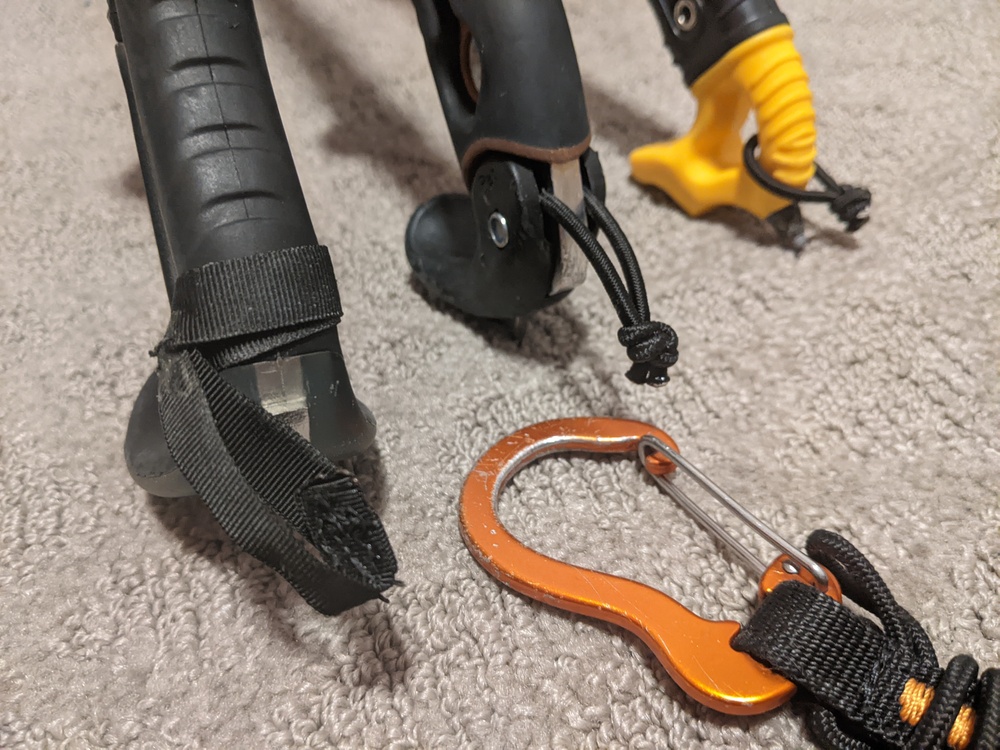 |

|
This. Perfect for beginners top roping ice. |
|
|
I think you have done a good job covering all the potential problems and solutions. Part of learning how to ice climb is learning how to not drop ice tools, without relying on tethers. I prefer to have beginners start without tethers in terrain where a dropped tool is not consequential. It helps if people learn how to avoid dropping tools, without relying on tethers. |
|
|
Probably clipping the tether to the rope, and having the beginner climber carry a small third-tool? I know some older climbers would regularly bring a small tool with them in case of a dropped tool. Maybe a small mountaineering axe with a pommel would be easier to find than an old third-tool? Drawbacks: hard to keep track of and switch around the third tool in a group setting and difficulty climbing with the smaller, clumsier tool. |
|
|
If you are teaching and useing your own tools you would be well advised to teather them unless you want to spend half the day digging through the powder looking for your tool and going home empty handed.... |
|
|
Clip to the rope. |
|
|
I’ve taught a lot of new climbers and have always used tethers for them. I don’t like the idea of my tools being dropped/damaged and or lost. I have never thought of having people tether to the rope rather than their harness. I really like the idea of tethering to the rope for new climbers. I’m going to try it next time I’m out with a new group. Thanks. |
|
|
I've climbed with beginners two days this season and have used tethers clipped to the rope both times. Haven't found any reasons to dislike the approach. I think it is the best option for what I'm trying to achieve. |
|
|
I like the Blue Ice leashes. Nice and light. Never found leashes to be a problem up to WI4. Requires a little tiny bit of forethought then following and cleaning, otherwise never had an issue. |
|
|
Kenneth Campbell wrote: Yes. Clip the tethers above the tie in knot/anything used to tie up the remaining tail of the rope, so that the bottom of the tether can slide up the rope freely. |


