
 Continue with onX Maps
 Sign in with Facebook






Upcoming new ice screws


|
|
I was using the new screws with mixed success today in -10 F temps. Petzl aluminum screws placed quicker in the same location. May have been coincidence. Have video but having probs loading |
|
|
Did Petzl and BD figure out how to keep the steel tips from breaking off? I think it was mostly BD. I haven't heard of that issue with BI or Kailas, but those are newer and haven't been used as much. |
|
|
|
|
|
I played around more with the Blue Ice aluminums, and still find them superior to my Petzl aluminums (I don't have any BD alum). And yet, sometimes you just need steel. Aluminum performance seems variable -- I was goofing around placing a bunch of screws in sticky wet ice recently, and in one spot a BI aluminum got stuck halfway in, but then I moved it a couple inches away, seemingly similar ice, and it went in (with a little resistance). Steels always went in. I got a handful of the new Blue Ice steel screws, which are freakin incredible. Blue steel, like in Zoolander! I've used them a handful of times this season, and I suspect everyone is gonna copy them -- they weigh about the same as other aluminums, which is amazing, and have none of the limitations. On my home scale, the 13cm BI steel is identical weight to the Petzl 13cm. Granted, Petzl measures to the hangar, BI the entire distance, thus Petzl is ~1cm longer, hence my "about" the same wt disclaimer. In the longer screws, the alum are still a touch lighter. Still, we're talking a few grams. I can sneeze more than that. Putting a few of each Petzl alum and BI steel on 'biners, I can't feel any difference in weight, which is amazing, b/c with other steels you do notice. Seems this could make aluminums, and their limitations, obsolete (funny how fast that happened)? The BI steel, like the BI alum, still have a wider bore than Petzl or BD, too (see photo), so more thread contact/holding power, and easy to re-use old holes. Guess the main weight savings come from their getting the wall thickness down to 0.8mm (visible in photo). In my usage so far, they slice right into the ice. I've been loving them. Supposedly they'll be available in the US next month -- they're in Fabien's link just above, though unfortunately I only read 'Merican. Ha. Ah, looks like they're now on the U.S. site: https://us.blueice.com/products/aero-ice-screw Photo of bore and wall thickness of the new Blue Ice steel vs Petzl aluminum: 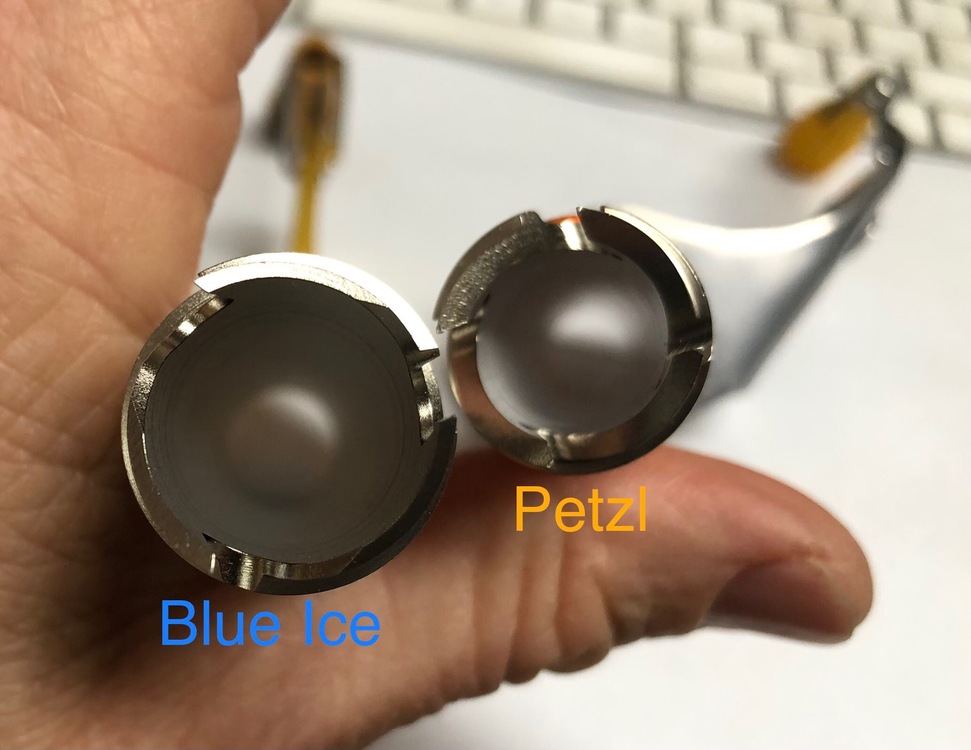 |


|
Ok this is fascinating. We are slowly zeroing in on the mysterious black magic at work with screw design/performance. Kelly - can you (or anyone) confirm that the teeth geometry of the BI steels is exactly the same as the BI aluminums? (Aside from wall thickness obviously) If so, and if the data holds in terms of warm soft ice “seize up” , that the steels work where aluminums don’t, then this eliminates the “core plug base” adhesion to main ice as a root cause (proposed by some screw mfrs … maybe even Blue Ice if I recall) and narrows it to what I’ll call “tooth chip” release. Maybe still something possible with ice plug freeze in the bore due to the metal heat transfer diffs, but I doubt it. Theory: the thicker wall of Aluminum screws results in a “fatter” chip being cut by aggressive Aluminum screw teeth, and in soft ice, the tooth dives deep but can’t cut or chip off the softer chunk that stays adhered to the main ice at the base, thus seizing up. The steels, with smaller wall thickness have less area of “chip base” to break free and thus cut through more easily under certain conditions. Also why backing off and “ratcheting” an aluminum can often fix the problem. Crap. Just when I thought I was done buying screws…. |
|
|
Kelly Cordes wrote: This has been my exact experience so far, but not just in wet ice - in cold hard ice as well. They bind to a halt, and then move the screw say 6 inches and magically it is fine. It's a head scratcher. |
|
|
Interesting stuff! Shepido, yeah, so bizarre. I haven't had the binding happen yet in cold hard ice myself, but uff, that fully sucks as well! Indeed, such a head scratcher. Mark, pretty cool that you're making sense of all this. I think I'm following (gonna first recharge my think box and then re-read your post). Is it kinda like the thin steel slices through like a razor blade, versus a battle ax? Fascinating stuff. The tooth profile looks identical to me. Here's a photo from one angle (you can also see how much thinner the walls are). My friend at Blue Ice said that after they made the walls thinner to lessen the weight, they then did their standard cutting tests and were pleasantly surprised to see the cutting performance go through the roof. While I haven't used them a ton in the field yet (slow season where I live), they sure go in nicely. Blue Ice aluminum on left, steel on right: 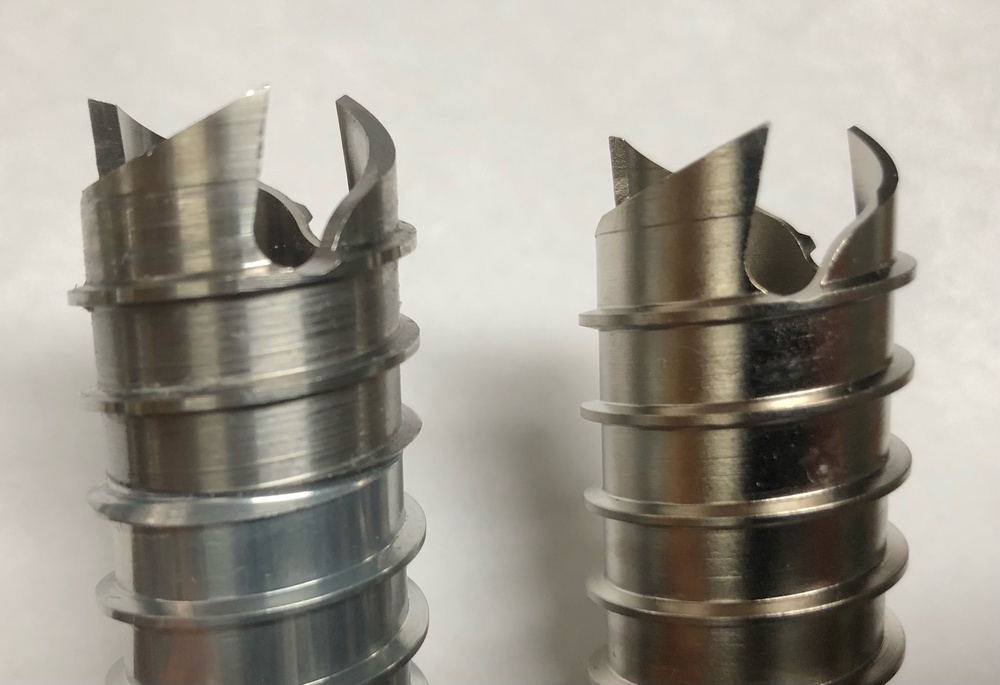 |
|
|
Will the thinner walls have the same strength? |
|
|
One other idea I'd like throw into the pot of questions: is it possible the metal is shrinking from the cold, but not consistently along it's length, until it's placed again. Aluminum expands/contracts differently than steel. Having worked as a machinist, I know it doesn't take much for something to bind. Speaking of binding; does anyone remember placing those old Lowe Alpine R.A.T.S? or placing one of those Mountain Technology screws, which were steel?
|
|
|
akafaultline wrote: Given the wider diameter tube, probably. |
|
|
What I’ve sort of figured, is that when you have screws that are say 5 degrees in temp , placing into 20 degree wet ice, the colder screws freezes the unfrozen water that’s in the ice instantly. |
|
|
Eliot Hack wrote: That's an interesting idea, the thing is it should be harder on the second try, which, if you read some of the posts state that it's easier. |
|
|
I wouldn't buy another aluminum screw if those BI steel ones turn out to be as good as they sound. |
|
|
Mark Pilate wrote: Hmm...this is a fascinating theory. Do you know if there is a difference in wall thickness between BD and Petzl Aluminum screws? Because I will say without a doubt that the BD aluminum bind up WAY more often than Petzl aluminum for me. I sold all my BD aluminum because I couldn't stand placing them in steep ice. If the BD ones have thicker walls this would give good evidence to your theory. |
|
|
Mark Pilate wrote: A screw is driven in by it's thread pitch and all screws have an identical pitch of 1/4" per revolution. Each tooth cuts 4x.062"/rev or 3x.083". The aggressive teeth only enhance the starting process. Once started the old style teeth perform just as well as the aggro style. A couple of problems with your theory. What I have found is, whenever a screw got stuck, there was a hard plug about an inch into the tube. What is clear is that it's a problem with all the aluminum screws. When I hear contradicting anecdotes about a which brand is better. That just tells me that nobody has figured it out yet. LL Biner wrote: Yes metal shrinks with a decrease in temperature but the problem is that the screws are colder than the wet ice. So they would actually warm up as they are screwed in. |
|
|
There is huge difference in the thermal expansion of aluminum vs stainless steel. Even if the ID of the aluminum is larger than the steel tip, it is very understandable that the core the steel cut can be tight in the contracted aluminum. The thermal conductivity of aluminum is also way more that stainless. So the air temp will keep the aluminum cold, freeze the wet core and make it expand inside the aluminum. Kinda points to the lightest steel screw possible being the way to go. |
|
|
And I just happen to have an old Chouinard Screw handy. The tip with teeth is a seperate piece welded to the tube. The id of the short portion with the teeth is 12.9 mm and the rest of the tube measures 14 mm. All the more modern screws I have handy have straight though bore. This including the brand new aluminum BI unit. Wondering why they could not make the ID of the steel portion smaller than the aluminum portion on these fancy screws? And no I aint going back to using the Chouinards |
|
|
rocknice2 wrote: True, maybe another factor is the ice is being cooled down by the relatively colder screw and freezing the plug in place. Edit: Timothy Pointed this out before I got to it |
|
|
While I like seeing ice screw innovation, I am definitely a bit concerned about the “arms race” to keep increasing the outer diameter of screws. Now people who already have a rack of screws will not be able to reuse holes made with the new Blue Ice screws. I would really like to see some standardization of ice screw outer diameters, with possible exceptions for screws with less than 13cm length. It would be best for the sport, if all ice screws had the same outer diameter to avoid over drilling limited ice on popular climbs into unprotectable Swiss cheese. |
|
|
Karl Henize wrote: Too late, the solution is to buy the newest, fattest screws each season |


