
 Continue with onX Maps
 Sign in with Facebook






How long to construct a 'normal' trad anchor .... before your partner goes insane.


|
|
How long does it take you to build a 'normal' 3 piece trad anchor ? What is an acceptable time in your eyes for a beginner/immediate trad climber to build an anchor ? |

|
I do think it depends a bit on the rock type/quality you are climbing on. My multi-pitch trad climbing is >90% granite, where there are often obvious good quality cracks at belay stances. In those cases it really shouldn't take longer than 5 minutes to make a quality anchor. If you are spending 20-30 minutes on an anchor, that is way too long... If it is a ten pitch route you will spend 3-5 hours on simply building anchors. |
|
|
Nothing personal and I know it won't lessen your stress but I would go ape shit bonkers if you took 30 mins on an anchor. You'd hear about it for sure. Hell you would feel the rope vibrating. 10 minutes, tops. |

|
I’d recommend you just get practice rather than focusing on speed. The more practice you get, the more comfortable you will become with your placements, and the faster you will get. If you’re concerned about speed for now, practice on the ground and choose routes with fewer pitches or that are less time sensitive. |
|
|
The other thing is get one good piece, haul the rope up, put your second on belay (tied off) and continue building while they strip their belay, put their shoes on etc. |
|
|
More than an few minutes in on a simple multi pitch trad anchor and I am ready to pop! That goes the same for myself building the same anchor! |
|
|
Just be honest with your partners beforehand that you are slow about this (you are) and that you would really appreciate any efficiency tips when they are brought up and see the actual circumstances. Tell them before a climb how long you usually take. Keep route lengths short until you are appropriately efficient for longer routes. A partner getting angry about this? I have empathy for them. Still, find another partner until you are more efficient if their anger is crowding your mental real estate. You cannot afford much of that at this period of your climbing career. Search around for how Woody Stark died at Joshua Tree. And he wasn’t the beginner. |
|
|
Mitchell Mitch wrote: Under 5 minutes, even for a noob. Do it like this: -Find two placements, connect with sling or whatever and tie master point, clip locker to master. -Find third placement, tie to your master biner. -Done. Obviously there will be some circumstances with trickier placements but the formula is simple and quick. Forget the whole "triple equalized" thing, looks good on paper, harder to execute perfectly at every belay. The most important part is that your placements are solid, if in doubt add another connected to your master. Godspeed! |
|
|
In addition to basic practice on the ground—slotting nuts, placing cams, cordelette or rope, belay device set up, etc., also think about building up your library of anchor options. That is, at the end of a pitch, you can be faced with myriad possibilities: a tree, a single big boulder, horizontal cracks, a single vertical crack, widely spaced cracks, an anchor set up by your feet, or a possible anchor ten feet back from the edge, you’ve used up most of your gear/slings and need to improvise, and so on. If you already have in mind a way to deal with each potential anchor type, then you can immediately go into action rather than being indecisive on what to do. also… I’m with Cherokee on this one. |
|
|
Jim Titt wrote: I don´t think haning from a single pice is best practice. |
|
|
If you are taking 20-30 minutes to build an anchor, you are probably slow at placing pieces on a trad route. Stick with single-pitch climbs until your gear placements are quicker. So you can quickly identify the the correct size to grab off of your harness/sling, then quickly place it. Ask an experienced partner to show you how to speed up. Look closely at the anchors they build and ask how they chose that particular anchor configuration and location. 20-30 minutes is insanely slow. |
|
|
Where is most of your issue? I'm going to first echo the sentiments above of getting lots of practice in. Practicing from the ground sucks, and is monotonous, or at least it is for me, but it will pay dividends. Are you having problems finding bomber placements, linking them all together, or getting the anchor oriented in direction of pull? If it's all 3, or 2 of 3, you either need to find a patient partner and be forthcoming with them before you hop on a route, or you need a lot more practice somewhere on the ground. Honestly, if I partnered up with you and you told me that you couldn't build a suitable 3 piece anchor in under 20 or 30 minutes, I would opt for a day or at least a half day of ground practice with you before I'd feel ok hopping on a route with you and trusting your anchor. 30 minutes to build a 3 piece anchor is exorbitant, and indicative of a lack of experience- and if that's the case, it's suspect automatically. Get more practice, and practice using just the rope, a cord, or a few slings. Become proficient in using different methods and sooner or later, the anchors just start jumping out at you with regard to efficiency and the best method to use in a given scenario- e.g. one vertical crack to use, a few horizontals, spread out placements, ledge, no ledge, etc. |
|
|
Tradiban is right. Make sure your focus is on getting three bomber pieces, and not on connecting them in any special way. Equalization is a myth; bomber gear=safety and speed. Fiddling with slings is a great way to waste time. How long does it take you to place pro during the climb. It should take no more than 3x that long to build your anchor. |
|
|
I think one thing that could help you is to come up with a basic anchor that is your go to. Then have a number of modifications you can make to it when it’s not possible to make your go-to. You will get really efficient with that system and then over time with the modified versions and you will just show up to the belay and know which version you’re going to make. But if every time you get there you start thinking “hmmm I could use the rope, but I have all these slings, maybe I could equalize those, but then why did I carry the cord?” It’s going to take forever. Have a general plan you always do then modify it to fit the situation. |
|
|
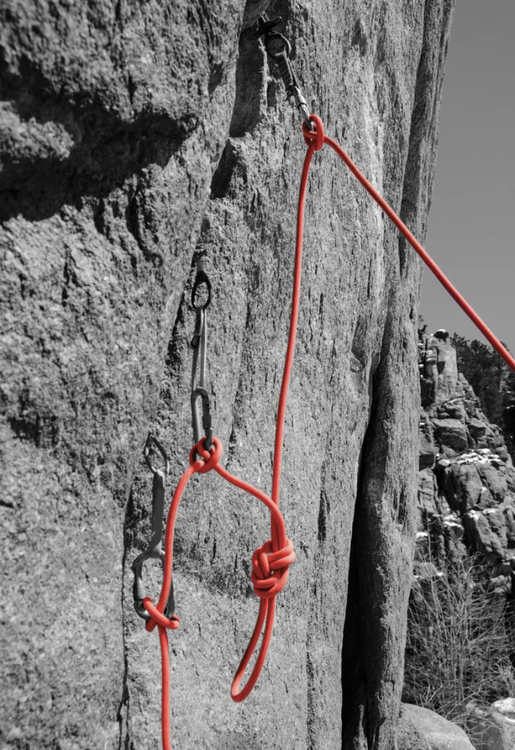 Do this assuming gear is good. You are tied directly to the bottom piece. Rope you haul and belay is connected to top piece. Guide mode from master point, and it can all be at a comfortable spot, easy to handle, and won’t tug you around if follower falls. 5 minutes to build and haul rope seems reasonable. |
|
|
I would practice on your own, until you can get it down to less than 10 minutes every time. Try to shoot for an average time of 5 minutes or less. I suggest going to a crag with a lot of cracks at ground level and make as many anchors as you can, while timing yourself. If you can find experienced friends that also want practice anchor building, you can make it a group event. Alternatively, I would suggest hiring an instructor to coach you on building anchors or join a group course on anchor building. |
|
|
Practice building anchors on the ground with an experienced partner. That time frame is rowdy for even a new leader. Sounds like you are over thinking or stressing about gear. Work on identifying solid gear placements without having to try 2-3 or more pieces. Test your finger/hand sizes in cracks so you can gauge which cam fits in the crack right off the rip. Example…..index finger at the second knuckle snug in a crack for your is what size cam? How much of your hand fits in a .75 sized crack? This will also help you when leading as you won’t fiddle with gear. Learn your sizes then your brain will know what size gear fits based off what part of your finger or hand fits in the crack. |
|
|
Some good advice in the thread. I’ll add, when you’re new, it’s not a bad thing to take your time, not feel rushed, and ensure your pieces are placed well. You have to be responsible for your own safety, and make gear and anchor evaluations for yourself. 20-30 minutes is a really long time, but sometimes if you are trying to rush that l can make things worse. Slow is smooth, smooth is fast, can be a good mantra. Knowing your order of business, with a mental checklist also good. Ideally the issues that are causing you to take 20-30 min could be sorted primarily in a class / clinic, with a more experienced partner that you follow to see what they do, on the ground where a bunch of odd and common cracks are available, by reading some good books and practicing at home, etc., and not on a trade route with parties behind you, or a partner who wasn’t aware you would need that long at the end of each pitch and wasn’t prepared for that type of day. My experience has been that climbing stoke can easily fuel the energy and determination one needs to sort this stuff. |
|
|
Jim Titt wrote: While this may be acceptable to experienced climbers I'd be wary of advising a self described newbie to do this. |
|
|
I agree with the suggestions to find three good gear placements first and foremost. One thing that helps me (still relatively new to trad anchors) is to carry a 20ft cordelette, 120cm Dyneema sling, and 240cm Dyneema sling. That way I don't have to worry as much about fitting the placements to my soft-good limitations, and can figure a way to efficiently connect everything to a master point regardless of the position of the placements (within reason). |
|
|
For a beginner? As long as they damn well please. I’m about to trust my life to it, and I want them to feel confident, and to be more focused on building a safe anchor than worrying I’m get antsy down below. I don’t expect to move quickly if I decide to swing leads with a beginner for one of their first times, nor would I choose a ten pitch climb or something with tricky gear or belay stations. For myself, or someone else experienced? Like 2 minutes if the belay location and/or gear is straightforward, a bit longer if I have to climb up/down deciding the best place for the belay or for particularly faffy gear situations. Not 30 min though even then. You should focus on building safe anchors, many times and frequently, and as the straightforward ones begin to come easier add in variety of terrain, gear, and situations until you start feeling confident you’ll be able to build a safe anchor no matter what you find (or assess that you can’t and move somewhere else). The more practice you get the more efficient you will become, but don’t focus on speed as your primary goal. It’s not the most important quality of anchor building. 1. Make sure your partners are fully aware that you’re a complete beginner and will need extra patience, and coaching/feedback, for your anchors. |


