
 Continue with onX Maps
 Sign in with Facebook






The latest, greatest 2:1 hauling kit


|
|
After some more thinking on this, I believe I have a way someone could test this. Do a heavy haul where the wire draw is not aligned and is twisting with each pull. Immediately after the haul or part way through it, feel the cable and see if it is warm to the touch. If it is warmer than when it started, then the cable strands are deforming under fatigue (it would be only slightly warmer). You could also check if the outer strands are unwinding and loading up the central strands only as Chris hypothesized. This might need to be tested where the wire draw is being rotated in both directions since the unwinding strength reduction mode would happen when the cable is being untwisted whereas the fatigue weakening mode happens when the cable is being twisted more. Either way, these wire ropes are not typically used in applications where they are simultaneously loaded and twisted. A better solution may be using something like loop of webbing or cord. Or even a loop of wire rope instead of a single strand as Chris was alluding to. |
|
|
Thanks for the detailed rundown, Tyler. That component is a pretty important part of the system; if it fails things can get pretty hairy. I guess I hadn't thought too much about that scenario until now. I have my 2:1 hauler set up with a beefy sport dogbone rather than a wire draw. I know, this thread is about the pure, mechanically optimized 2:1 setup, but the nylon dogbone really doesn't stretch much. I feel like the gains from swapping it to a wire draw are going to be pretty minimal. |
|
|
Pretty interesting problem. Glad everyone involved is OK! I'm a few holiday beers deep so heed the following as such. Basically we have a cyclic combined loading applied to the wire draw. The field data point and subsequent MP analysis suggests the draw fails at an unexpectedly low axial load when it is being bent and has undergone many load cycles on the wall. It is possible to describe this with an interaction diagram 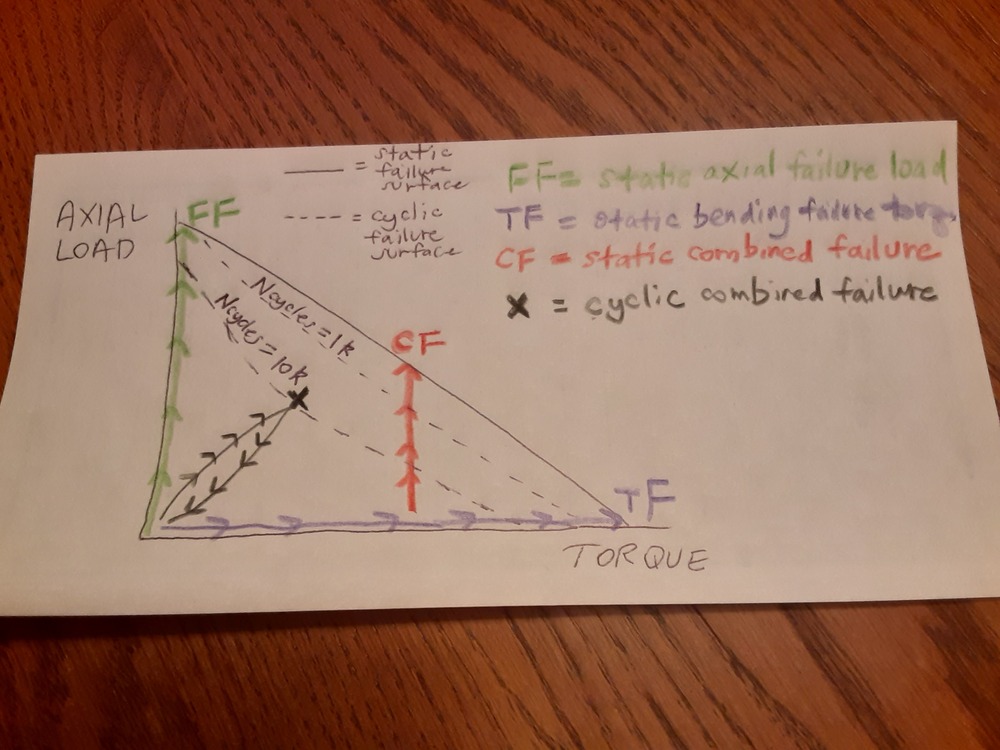 Where green load path is pulling on draw in one single go, aka gumbies practicing in the boulders purple load path is SUPER gumbies somehow bending the draw horrendously and not even pulling up the haul bag at all, not even a single pound hauled red load path means the draw is bent, held at that constant torque, then pulled to failure. The hypothesis with static failure plane drawn as such, is it will break at a lower axial load but not that bad black load path is the situation at hand. The static failure plane is contracting in the "load space" of our interaction diagram. More cycles will contract it further and further due to cyclic fatigue until the draw fails at quite a low load. P.S. I'm really making all this up but sure would be fun to test in the lab! P.P.S. credit where credit is due-- Mom located the technicolor pencils for illustrative clarity |
|
|
Tyler Karowwrote: As Tyler mentioned, only a small handful of draws where made from a 7x7 wire rope. To my knowledge all draws have been replaced with an upgraded 7x19 5/32” cable. The cable itself has almost double the breaking strength as well as being more flexible to account for the torsional forces the draw may see when hauling. I take great care in the manufacturing of the gear I make, I know that everyone who uses my gear relies on it to perform as expected. The expectations are not taken lightly. Anyone who thinks they may have a questionable piece of kit I made is free to contact me so we can determine if a replacement is warranted. I have no problem sending out replacement gear when necessary. |
|
|
Another good option might be to use a dyneema loop from a Metolius PAS - breaking strength 30kn and very very low stretch. |
|
|
Jeremy Baumanwrote: Or just use a shortie dyneema sling, you'll need to double it up so it doesn't gang too low but it works very well and was my system before moving to the wire draw. |


|
Increasing the breaking strength will also increase the lifespan of a steel wire cable given that the load to load limit ratio is reduced. However, we still need to look at the tension fatigue properties of the material. Dyneema will have a longer lifespan under cyclical loading than steel wire. Dyneema was scored with a Thousand Cycle Load Limit of 90 while steel wire scores 60, aramid 73, and polyamide (nylon) 55, based on the OCIMF Guidelines for SPM Mooring Hawsers test for comparing tension fatigue. We will not know why the wire draw broke without a material failure analysis, but what we can say is that dyneema should not fail under any of these hypothesized scenarios. Plus, dyneema weighs less. |
|
|
Or just 1:1 |
|
|
^^ ok on a short wall. Too much pain on a Grade VI, especially considering the weight of the beer . |
|
|
Google Mohr’s Circle, and the 1700 rating is for a straight piece of perfectly loaded material in a lab - expecting that strength out of an assembly from some rando’s garage is super uninformed and naive. First - that traxion+cable+biner absolutely needs a backup - a locking draw between the haul line and back to the strongest part of the anchor. 2 people space hauling a 7 day load that just got stuck under an overhang is an immense load for a microtraxion - it boggles my mind these have become commonly used for El Cap hauling. The rated working strength is about 500 lbs - pithy. I would use a pro traxion minimum, and backup up. Even though some voodoo math done by Petzl has caused them to rate the pro and micro at the same working load, it isn’t rocket science understand a piece of metal weighing 3x as much and is larger in every dimension is going to be considerably stronger - and is recommended by the manf for the application - the micro is not. |
|
|
James Wwrote: Perhaps they share the same weakest link? |
|
|
James Wwrote: Could you be more specific on the failure method of a micro traxion that you think may occur? And why is a pro traxion less likely to have the same failure method? Does this failure method relate to the 2:1 setup being discussed in this thread or only space hauling The micro is actually recommended by Petzl as a hauling device. See pic below. 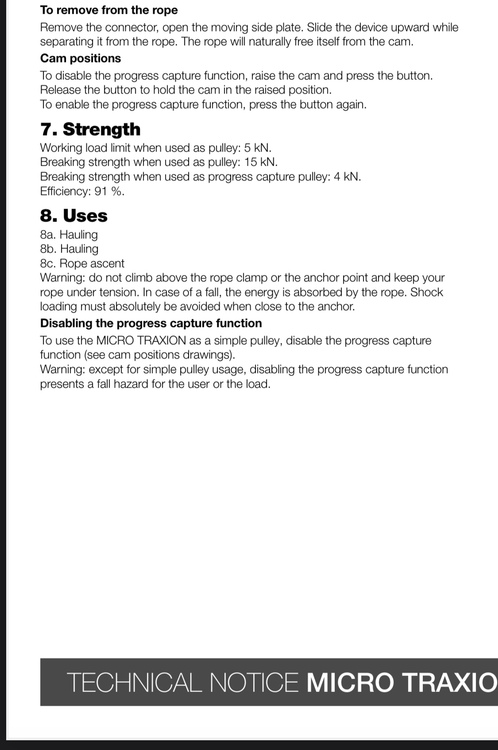 |
|
|
It kind of is. Material science, physics, mechanical engineering, thermodynamics... all things that go into designing rockets. But all joking aside, the issue we face is that we make assumptions about the gear based on specifications without understanding the conditions for which they are tested and rated. For most gear, we find certification markings as each batch must be tested and meet certain criteria before receiving such certification. These tests occur in a controlled environment with given variables. We cannot apply those certifications to situations beyond those within the test. The Micro Traxion is certified by CE EN 567, UIAA to have a WL 2.5kN and breaking strength of 4kN. If we can't trust that the certification is valid for hauling, then what can we trust? Almost every piece of gear you own will have a certification. Now, can we trust a wire draw with no certifications? |
|
|
James Wwrote: The microtrax doesn't hold the hauling weight, that's covered by the pulleys on the z-cord. The microtrax only ever holds the static weight of the bags in normal use, and when space hauling, it holds the weight of the space-hauling climber during the hauling sequence and it holds the static weight of the bags and the space-hauling climber during the z-cord resetting. |
|
|
MICRO TRAXIONI'm surprised this Micro Trax device is only rated 2.5 kN each side. Concur with James - would be spooky hauling loads on a typical 3-man two-week nailup. I have used the Kong Block Roll for over fifty walls - it might be big and klunky, but its huge pulley makes 1:1 hauling dead easy. A 2:1 hauling ratchet fits over top perfectly, and you don't need to lower the cam with a wire. Its extra efficiency and ease of use more than compensates for its extra weight. Highly recommended by Dr. Piton. 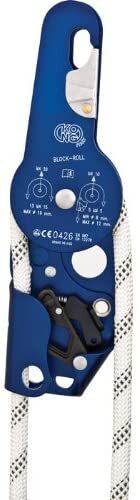 |
|
|
I don't see why people are worried about this. A regular load of .8KN (179lbs) of force versus something super heavy at 1.5KN (337lbs). Either way it is well under the 2.5KN working load limit AND when you use a 2:1 haul you never load the Microtraxion with anything other than the static weight of the bags! It doesn't matter if you are bouncing on it to free it from something or wrenching when stuck on an overhang....all that force is in the 2:1 and transferred to the haul line at the basic....the Micro sees none of it. I can see the issue if you are building a typical 3:1 with the haul line itself. Anytime you use the rope itself as the way to build mechanical advantage you run the risk of putting more force on the Microtraxion than just hanging dead weight. But this whole thread is about a 2:1 with a Zed cord. In theory you could haul 2.5KN of bags (562lbs) which would be the working load limit. Just so you know in the rigging world the Working Load Limit (WLL) is typically 1/3 of the Minimum Breaking Strength (MBS). |
|
|
Here's a 2:1 setup that uses the Kong Futura MiniBlock instead of Microtrax for the progress capture (was suggested back in 2015 in this thread) and eliminates the wire draw (the MiniBlock is the smaller version of the heavyweight Block-Roll that PTPP likes to use). The eye at the bottom of the MiniBlock facilitates a nice clean vertical alignment. The MiniBlock weighs about twice as much as a Microtrax (but that weight gain is offset by no wire draw). Its pulley is burlier, at 12 kN MBS on each side (vs. 7.5 kN for the MT). The two devices have the same MBS when used as progress capture (4 kN). 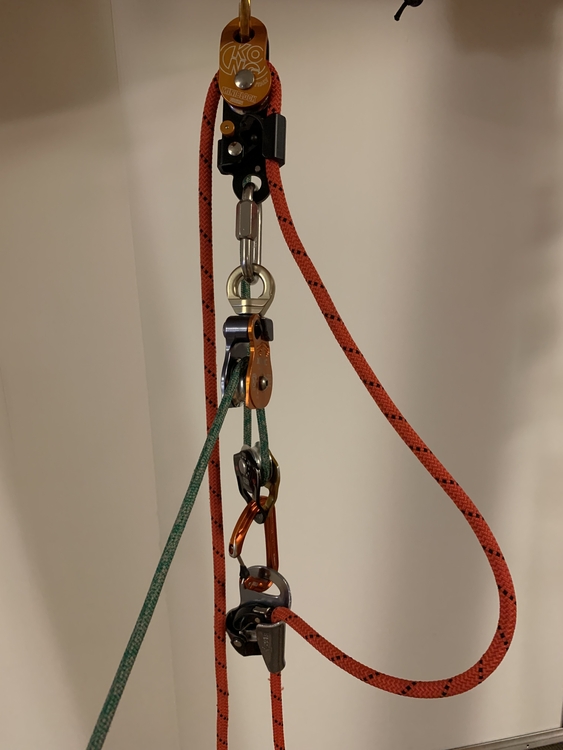 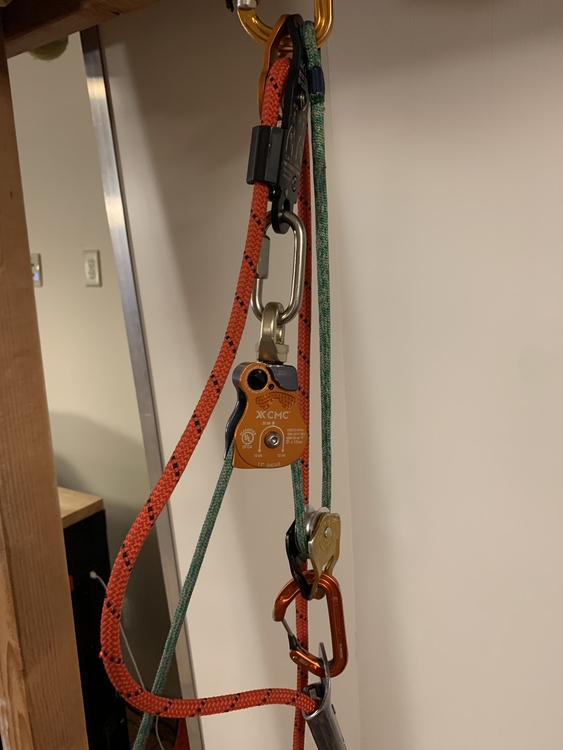 |
|
|
Andy Wiesnerwrote: I’ve checked out that Kong mini roller. It’s pretty rad. My only problem is that the slack end is on the left. I pull haul slack with my right hand so I’m not sure this would work for me in the manner I prefer to haul. It could be flipped around but then the toothed cam is on the backside. Maybe I’m just too picky. Maybe I’ll just buy one an play around with it. |
|
|
Yes, I have gotten used to.pulling right as well. Ahem... |
|
|
Mark Hudonwrote: Skot and I have been working on the 2:1 kit for years and you will simply not make any significant improvements to it at this point. Are they working on a significant improvement meow? |


