
 Continue with onX Maps
 Sign in with Facebook






Accident at Haus Rock near Keystone, CO (Petzl Shunt accident)



|
Remember that self belays were, not that long ago, an approved use of the Shunt. It says so on the last iteration of their technical notice with pictures and all. Then they quietly removed this approved use from the most recent technical notice. This move was just a clever way for Petzl to reduce their risk of litigation while still making sales. Bottom line: People are still out there using the device in extremely dangerous ways, not knowing the dangers. Petzl knows though. And they're the individual best poised to save lives. A recall would save lives. Drastically changing their language would save lives. Legal responsibility aside, do we really want a company selling us safety products that stands by and does nothing about a situation like this? |
|
|
John RBwrote: Yeah stunning footage for sure. I'll be interested to see the two-strand results which to me would/should be the standard mode of use. |
|
|
Craig Faulhaberwrote: 1. If you used a backup, even using a shunt as your main wouldn’t allow this to happen. I don’t know a single company that ever said “TRS with a single device” 2. You are mad that technology changes and because of that you want to recall a device for a method it is not recommended for anymore? I want Toyota to recall my truck because the technology has changed in 12 years to be safer and more Effective. Same goes for my house built in the 70’s.... Your approach to the solution means that every old piece of climbing technology should be recalled. Take some self accountability and realize that if you had a backup you would be ok. You decided to not use a backup and learned semi-technical rigging from a YouTube channel. I find it very hard to point the blame at Petzl. I do however agree that Kirkpatrick and others shouldn’t be advocating use like they do |
|
|
Let's forget about my accident. It's done, and I'm not mad. But we should spread the word because there are plenty of others out there using this system. It's important to have some compassion for others in our sport -- people I think of as family. I talked to Petzl to ask how we could get this info to the climbing community and got shut down. I would like it if a company selling a safety device would tell it's customers about the known catastrophic failure modes of the device, yes. Especially if it is well known that this would save lives. |
|
|
Petzl’s lawyers are going to be all over this one. Any change to the device instructions in response to your accident could be used as a basis for you and others to claim that Petzl is partly liable. |
|
|
Hson Pwrote: Presented without analysis, context, or comment: Federal Rules of Evidence, Rule 407: "When measures are taken that would have made an earlier injury or harm less likely to occur, evidence of the subsequent measures is not admissible to prove:
But the court may admit this evidence for another purpose, such as impeachment or — if disputed — proving ownership, control, or the feasibility of precautionary measures." https://www.law.cornell.edu/rules/fre/rule_407 |
|
|
Insert name wrote: Until recently, solo-TR (or "self lining" as Petzl calls it) was an approved use of the device. They quietly changed this without broadcasting widely why they did this. Did they know about this catastrophic failure mode? If they did, why not shout from the rooftops this information in the interest of saving lives and limiting injury? Ok, so now its only approved use is for an abseiling backup. What would you say if I told you I set up a test with an ATC and a Shunt used as a backup and the Shunt inverted (I did this on purpose) and then when my hand slipped on the rope during rappel (also on purpose) the Shunt released the rope entirely and I went flying down the rope. Are you still going to blame me, the user for this happening? Bottom Line: if a device like this can completely detach from the rope merely by being loaded upside down, then it should NOT be used as a primary, a backup, or in any capacity in which your life is at stake. Use a micro or a grigri or something else that doesn't have this failure mode. |
|
|
Nkane 1wrote: Ok, hmm… this is clearly a good thing. Imagine the fucked-up moral calculus that would otherwise be occurring on a daily basis. I withdraw my previous comment. I, clearly, ANAL. |
|
|
Insert name wrote: I believe the original tech specification showed (via a set of icons) a climber using the Shunt as a self-belay on an overhang, and it was X'ed out (as in "not recommended") but showed a separate icon with a climber on vert without the contraindication. I haven't seen this document myself, so I'll stop here and let others chime in, but I'm fairly certain that it was a supported use at one point. Regarding "how could the device flip?" I've done a fair bit of big walls and rescue work, as well as "normal" rappelling to descend from a multipitch climb. Sure, if you're weighting the rope, rapping straight down a clean face, it's unlikely. But oftentimes you encounter a ledge midway down... sometimes even bushes or a tree. Your gear gets pushed around. You unweight the rope, determine the next path down the cliff. You have other crap hanging all over you and you're managing the rope. Things can get twisted and tangled, esp on a bigwall or during a rescue when you have a ton of other gear on you. It's absolutely possible that one piece of gear could get inverted (by your body, or the rope, or other gear bumping up against it). If your life depends on a piece of gear that will release the rope if it gets flipped over, you shouldn't rely on that piece of gear! A grigri, no matter how hard you bump it, twist it, invert it, tangle it up with other gear, won't simply cough the rope out and let you die. The Shunt, demonstrably, is a different story. |
|
|
John RB wrote: John, I agree with you mostly...but I've been present when a soloist managed to defeat the cam on his GriGri in an inverted fall, and prevented a slide into the hereafter by hitting his stopper knot. He was injured bad enough he couldn't walk without assistance. I carried his gear out. If the climber neglected his stopper knot, he would have slid all the way to the talus. He had the drilled modification with a loop of perlon and a chest harness. Don't know any more than that. But my point is every manner of setup has a failure mode, no matter how improbable. |
|
|
TR Solo (or self-lining/self-belay) was a Petzl authorized use of the Shunt which is a big reason so many people use it for this purpose. While this technical notice is not the most recent one, it is still available on at least one retailer's website as the current technical notice. Here's one place you can get it as of my posting On the beginning of the second page, read "Only the techniques shown in the diagrams and not crossed out are authorised." Then notice that the climber using the shunt on vertical terrain is not crossed off. So we shouldn't use it on steeply overhanging terrain, we shouldn't attach to the device with a long draw or sling, and we shouldn't hold the cam closed. But TR solo on vertical terrain is ok, according to this Petzl technical notice. 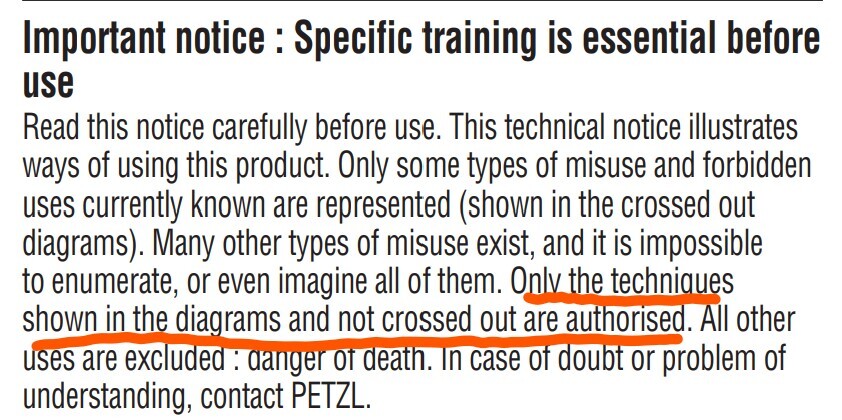 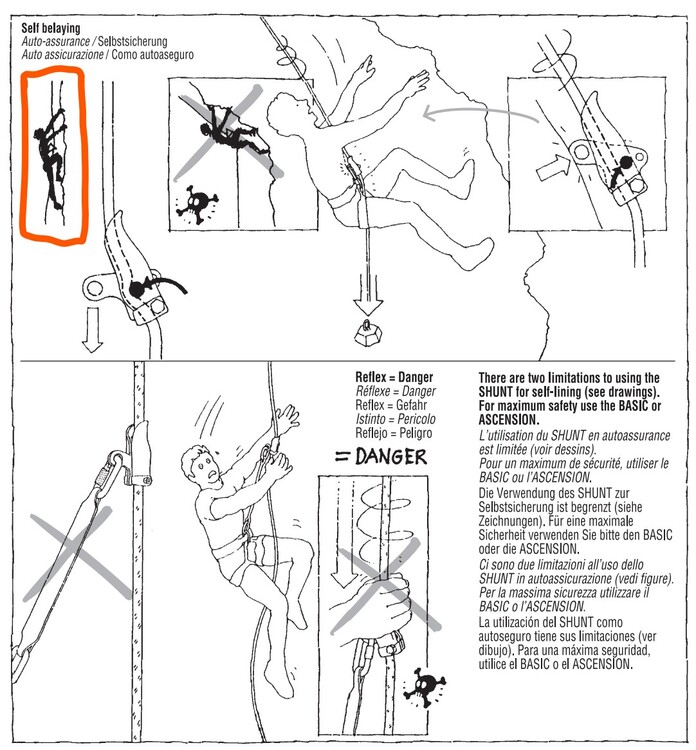 (In case anyone is just seeing this post and not the rest of the thread, this forum is for spreading the word about the dangers of using the petzl shunt in a system used by many top rope solo climbers, in part because of the history of the device being approved for this purpose, in part because of the system and device being advertised by some professional climbers, and in part because there didn't used to be any accident or failure mode information available. The device is known to be able to detach from the rope, so don't do what's in the picture.) |
|
|
Agree with Buck. The root cause of the accident is single device. The accident very likely would have been avoided, regardless of device, if redundancy was followed. Nobody jumps a single parachute. You always have a reserve. It’s standard practice. This incident was analogous to a single parachute jump. Or diving into a cave on a single tank and reg. It’s not accepted practice. I don’t disagree with the information distribution and corrective actions being pursued with Petzl, and I sympathize with Craig and wish him a full and quick recovery, but it seems like the real takeaway of “follow accepted safety standards” is being minimized here. |
|
|
With that, I'm going to try to stop looking at the internet discussions about this device because it is bad for my health. Before my accident, searching the internet for petzl shunt accidents and failure modes didn't provide any results, so I felt compelled to start this forum even though posting things on internet forums doesn't agree with me. Now, searching for information about the device brings up this forum. I think that Yann's video about the device is spreading and doing a good job. Dave Macleod has removed his very popular video which demonstrated the system used by both climbers who fell. Word has it that Andy Kirkpatrick is posting Yann's video (and maybe editing his praise of the shunt for tr solo?). I am still disappointed by Petzl's lack of action, but hopefully the information shared here will help continue to get the word to the many climbers still out there using this specific system (which was the point of this forum). Thanks for the discussion and all of the information everyone! I hope what was shared in this forum will save lives. |
|
|
Mark Pilatewrote: Take a look to the cutout posted 1 post above - presumably for manufacturer's brochure, and count how many devices climber is using. |
|
|
amariuswrote: That’s exactly why I said I agree with the information distribution and corrective actions being pursued with Petzl. But also it in no way contradicts my other points. Nobody learns (or should learn) TRS by glancing at a single product diagram. Plenty of info out there, including Petzl site, about the need for redundancy. It’s pretty common sense…never trust your life to a single point failure That is at least as important to emphasize (and way more life safety benefit to the “at risk” community of newer climbers) than warning about the Shunt specifically. For example, if you just took some of this thread at face value, a noob could say “oh wow, I’m getting rid of my Shunt and going with a Microtrax” and keep climbing like Craig was. On a single line, a single Microtraxion, and back up knots in the rope and only marginally improved his safety |
|
|
Craig Faulhaberwrote: That video is about using a girth hitch as a master point. I think you wanted to link to this one: |
|
|
Mark Pilatewrote: This is the point most worth repeating. Every TR solo device has it's quirky failure modes, though some devices are more reliable than others. A single device setup works great...until it doesn't. Backup knots are not the solution either; most instances we hear of where someone slides to the backup knot still result in an unpleasant outcomes. Hitting a ledge on the way down and breaking an ankles, grabbing the rope and burning their hands, etc. Even if these aren't as bad as hitting the ground, a setup that sends you to the hospital based on failure of one fallible device - not good enough. Two-device setups are, or at least need to be, the standard. Has there ever been a serious accident caused by failure of a 2 microtraxion setup? Or a lift/vergo/microcender/shunt backed up with a microtraxion? For the OP's setup - even if he wanted to use a shunt, all he had to do is add a microtraxion to the setup, trailing below his belay loop on a quickdraw. Adds minimal weight, drag, or setup time. And you can still use the ability of the Shunt to bump down the rope. But it adds a much greater safety margin. The lesson isn't that the Shunt is uniquely dangerous (though I do think it is sketchier than most other popular tr solo devices). Other devices fail too. The lesson is to use two devices. |
|
|
I never said Petzl should be forced by the government to recall the Shunt--I said Petzl should voluntarily recall the Shunt or fix the instructions/warnings. And I never said Craig should sue Petzl, that TRS should be done with just one device, nor that the Shunt is the only rope access or grab device that can fail. Obviously any device used for TRS could fail in some way. But it appears that the Shunt and certain ascenders are the only ones that can come completely off the rope at fairly low loads when oriented improperly. (Other devices could come off at higher loads by hitting a backup knot too hard and breaking or by grabbing the rope too hard and cutting it or shredding the sheath.) Yes Craig is at fault for not using a backup device and he admitted that from the beginning. But this is not a case where technology got better and users of the older devices are demanding free replacements or upgrades. It's a case where new information/failure modes have been discovered for an existing device. If a certain parachute was discovered to fail 20% of the time in cold weather, the manufacturer is morally--and probably legally--obligated to warn users that using it in cold weather could result in death and might very well do a voluntary recall also. The chute maker should not take the position, "We don't have to say anything because we never specifically recommended the use of this chute in cold weather." Nor would they say "Go ahead and keep using it in any weather because it might not be cold enough to worry, it only fails 20% of the time in cold weather, and you have a backup chute that has a 99% success rate if you deploy it in time." If a PFD maker discovered one of their products failed to float after 2 hours in salt water, or slipped off people who fit in the sizing chart because they were unusually short or tall, or the buckles were severely weakened by exposure to beer, they would be obligated to issue updated warnings and/or recall it (since unlike rope access gear users, the typical PFD user probably never checks on the manufacturer's web site to see if their PFD is beer-compatible). They would not get a pass because they never said it was specifically okay for saltwater use or said it's okay to drink beer on the same boat. Petzl already changed recommendations for the Shunt and has always (or at least for many years) recommended using two (non-Shunt) devices for TRS--good for them. But now that it's known that getting above your Shunt or letting it get inverted can result in complete failure, Petzl should add that warning. They already warn that grabbing the Shunt body or letting something jam the cam on other ascension/grab devices can result in a fall and death. They already warn (or used to warn) that using the Shunt as a rappel backup on two strands of different diameters can result in death. It wouldn't be a big stretch for them to change their warning from "Don't use Shunt for self-belay because you might get stuck" to "Don't use Shunt for self belay because it could fall off the rope and you might fall." BTW, when Petz's FAQ says the Shunt cam could get jammed in an overhang situation, do they mean the cam can get jammed down/closed, preventing safe descent, or that it can get jammed up/open, allowing a fall? The old instruction diagram suggests in an overhang, the climber's body or rock could push the body and cam arm together, preventing the Shunt from grabbing the rope properly. |
|
|
Insert name wrote: Yes that's true, and now they also say the Shunt is only to be used as an abseil backup. But as John RB mentioned, the Shunt could also become inverted on a rappel that paused on a ledge or slab or had to navigate obstructions. They could/should still update the reason why it should not be used for TRS. Cam makers put the Attention or eyeball warning next to the over-camming illustration because it indicates your cam could get stuck, not that yer gonna die. But they put the skull/death warning next to the under-camming illustration because that could lead to the cam pulling and yer gonna die. @AV: Yes also true, but many other devices are approved for rope ascension or fall arrest, so users could infer that those devices might also be okay to use for TRS. And Petzl's nice guidelines on TRS (and I think they are pretty well written) don't actually say "don't use any of our devices for self-belay." Instead they say self- belay is risky, it's safer to climb with a partner, it requires more expertise and more care, there are additional risks, use redundant devices (or even redundant rope strands), and you should not use certain Petzl devices for it. In the end they show several combinations of primary and backup devices, suggesting those combinations of devices and ropes could be suitable for TRS. (The Shunt is not in any of the approved self-belay diagrams and one of the pages specifically shows the Shunt should NOT be used for self-belay.) |
|
|
A V wrote: I can see now why the companies do this. With the vagaries of TR solo risk, the safest (liability-wise) and easiest option for them is to just say "don't do it" with no further information. Trango does this for the Vergo. Petzl, to their credit, makes an effort to provide more detailed documentation. But it seems that anything they say can be used against them. For the case presented here, they say "Don't TR solo with this device, due to reason X". Then someone comes to them, "I did the thing you told me not to do, but actually the reason not to do it is Y". If they had just said not to TR solo with it, and provided no detailed reason, they'd be less exposed to the criticism. This is one of the reasons there is do little "official" information on TR solo - it just opens up liability and criticism. Easier to just not say anything. |


