Continue with onX Maps
 Sign in with Facebook






You Suck at Belaying


|
|
This has been discussed ad nauseum, but I just wanted to remind all the dudes out there, that slam their lighter, smaller female partners into the wall everytime they fall, that YOU SUCK! If your climber falls, and they audibly smack the wall, you should be apologizing profusely, and swear you'll do better. You should NOT be 1 foot off the ground saying, "good try", "you good?", "you got this next time". And you shouldn't be saying "go for it, im with you", when you really aren't. If you're "with" someone, it means you're paying attention and you'll give them a proper soft catch EVERY fall. LADIES, if your partner gives you a hard catch regularly, or even once, you should demand they do better, or tell them you won't climb with them again. You shouldn't be afraid to fall, but I get it when a good number of male belayers don't care about your ankles. As you can tell, this sht pisses me off. Learn to give a soft catch, and take the well being of your smaller partners more serious than your fckn bullsht project you're just waiting to get back on. Belaying is more important than climbing or sending your proj... so fcking act like it, BRO! Heather from the east coast... you shouldn't let homeboy belay you anymore, he's fckn going to get you hurt. Check Your Grip is the PERFECT route to fall on, and you shouldn't be getting slammed into the wall with a competent belayer. Dude was about 1 foot off the ground everytime he gave you a hard catch. I almost asked him to stop, but that sht is on you. DEMAND an attentive, good belay (aka "A Good Catch") from everyone you climb with. |
|
|
Jamila W wrote: Obviously. Im talking about when youre not at risk of hitting an object like the ground or a ledge or large feature. |
|
|
Jamila W wrote: No. Soft catch =/= ground fall. If there is a ledge to consider, that's one thing. The route described in the OP should have nothing but soft as pillow catches. |


|
Here's a thought. How about we not assume lighter partners are girl friends, hmmmm??? Or girls? If a partner can't/won't consider weight differences, or speak up and be clear what they expect of their partner, that's on them. But hey, warrior away...you know best. H. EDIT to add, NOTE TO OP: See that word "EDIT"? If you decide to "fix" your OP after the fact? Admit it. |
|
|
Ask for what you need. |
|
|
Jamila W wrote: I'm talking about 95% of the time someone falls, not the 5% of the time someone falls above the first bolt, or above the first bolt just above a ledge. This is not a belay seminar, it's a PSA that your not supposed to have partially fractured ankles after an average sport day at the Red. Your belayer is just garbage, and you deserve better. And no, I'm 99% sure this was not a "couple". Just a group of climbers who don't know how to belay, and climbers who don't know what a good catch is supposed to feel like. P.S. If nothing else, at least this generated a quality meme. Edit to respond to the below post: I hope all the tiny, regularly spiked people see this. @BuckRio Hard catches on gear rip pieces out and you fall way further. And I dont have to "think" about giving a soft catch, I know how to, and it is my stock response UNLESS there's a reason not to. |
|
|
I hope she sees this, dude! |
|
|
Matthew Jaggers wrote: another damn microfracture thread. |
|
|
Matthew Jaggers wrote: Climbing at the Red is damn close to gym climbing. I agree, nobody should get hurt there... If you ever tried that while I was trad leading I would dump you as a partner...falling on gear is iffy enough (a lot of times) without worrying if your partner is trying to "soft" catch you while you pile into a ledge. |
|
|
A V wrote: Then that wouldn't be a ledge to consider :P |
|
|
A V wroteLet me introduce myself, m’lady Lol - this definitely belongs under “missed connections”. |
|
|
|
|
|
Matthew Jaggers wrote: Is a partially fractured ankle like kind of being pregnant? |
|
|
A V wrote: "Spiking" is horizontal impact. Ledges hurt because of vertical impact. |
|
|
I've been climbing for 15 or so years. I don't recall hearing about "soft catches" for at least the first five of those years and maybe a bit more. Does that jive with anyone else's experience? I ask because it feels like a way overblown thing these days. For sure there are certain situations where someone is in danger of swinging back into a feature and a tight belay could enhance that danger, but that is not an issue on the vast majority of falls. Perhaps this occurs more at areas with steeper rock, like the Red? |
|
|
I'm 150 lbs so often the significantly lighter partner and I would prefer the hard catch/shortest fall every time. If the climber is audibly smacking the wall with every fall, they should probably learn to spot their fall like a boulderer would and put their feet out. (And make sure rope isn't behind their leg) Maybe I'm way off but no messing with a soft catch for me please, just give a proper belay. |
|
|
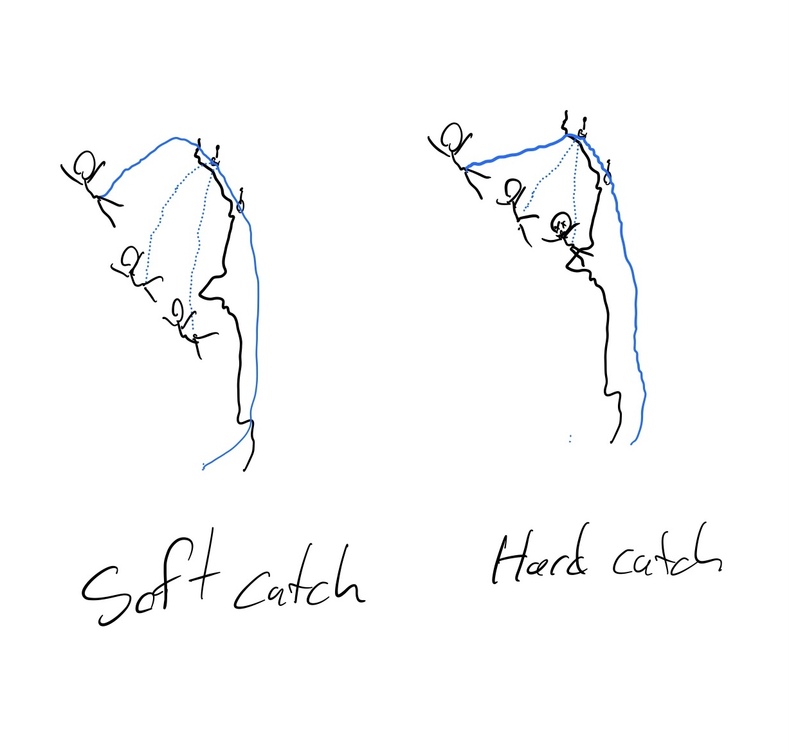
A V wrote: Cute pictures but they don't illustrate the relevant physics. You cannot illustrate a soft catch with a single snapshot image of a falling climber. The process is dynamic. Spiking is caused by rope tension that pulls the climber in a horizontal direction. The goal of a soft catch is to minimize the velocity of the climber when they impact the wall in the horizontal direction. The picture on the left could be a hard or soft catch. We cannot know from the picture because it does not show the horizontal velocity of the climber at the moment of impact with the wall. Picture on the right could also be a hard or soft catch. It also does not show the horizontal velocity of the climber. Climber could be getting spiked horizontally into the wall, or not. But the ledge is not relevant to a soft catch in the second diagram because the rope is already vertical and taught. The climber is no longer falling down with much velocity at this point, but they could be moving sideways pretty fast. The vertical impact with the ledge would be small because the rope has already caught the climber. No different from falling straight down and having rope go tight just as your feet touch. Now it is possible in this picture to avoid the ledge by letting the climber fall farther before the rope catches and starts the inward swing. Maybe that's what you are trying to illustrate, but that's not a soft catch. (It seems you are confusing a soft catch with more slack.)
Calling this out specifically because it's flat-out wrong and one of the common myths of the soft catch. A soft catch introduces more energy into the system - the belayer jumping adds energy to the falling climber. If you "clip a feature" on the way down you'll hit it even harder with an attempted soft catch. |
|
|
Nick Herdeg wrote: I don't know what kind of falls you've experienced but whenever I've had a hard catch (on occasion being caught on the first bolt, for instance) I haven't been able to absorb that impact nearly as well as a bouldering fall. You can easily injure your ankles because of the angle between your legs and the rock. On overhanging routes a soft catch can mean you don't slam into the wall at all and IMO that *is* a proper belay. |
|
|
Matthew Jaggers wrote: The hero the women’s climbing community never knew they needed. |
|
|
 |
|
|
Matthew Jaggers wrote: You changed your OP.....and still don't get it. Lemme fix it for ya: __________________________ Matthew Jaggers could have written: This has been discussed ad nauseum, but I just wanted to remind all the climbers out there, that slam their lighter, smaller partners into the wall everytime they fall, that YOU SUCK! If your climber falls, and they audibly smack the wall, you should be apologizing profusely, and swear you'll do better. You should NOT be 1 foot off the ground saying, "good try", "you good?", "you got this next time". And you shouldn't be saying "go for it, im with you", when you really aren't. If you're "with" someone, it means you're paying attention and you'll give them a proper soft catch EVERY fall. CLIMBERS, if your partner gives you a hard catch regularly, or even once, you should demand they do better, or tell them you won't climb with them again. You shouldn't be afraid to fall, but I get it when a good number of belayers don't care about your ankles. As you can tell, this sht pisses me off. Learn to give a soft catch, and take the well being of your smaller partners more serious than your fckn bullsht project you're just waiting to get back on. Belaying is more important than climbing or sending your proj... so fcking act like it, PEOPLE! To the climber from the east coast... you shouldn't let that partner belay you anymore, they're fckn going to get you hurt. Check Your Grip is the PERFECT route to fall on, and you shouldn't be getting slammed into the wall with a competent belayer. Your belayer was about 1 foot off the ground everytime they gave you a hard catch. I almost asked your belayer to stop, but that sht is on you. DEMAND an attentive, good belay (aka "A Good Catch") from everyone you climb with. _____________ Not so hard, really. And? Reading this to rewrite it? If the belayer is off the ground, they were lifted, no? Not soft enough for you? (And yes, there are special circumstances that need more/less rope) I got to watch my not so light climbing partner have heaps of fun belaying our buddy this season, who sheepishly admitted to recently having "topped 250". They didn't mention by how much. Both happen to be dudes, but I've had climbers, male and female, both heavier and lighter than my 130ish. That's not even all there is to it. Giving a good catch when there is a roof involved, isn't about "lighter", it's about that roof. It's a climber/belayer partnership, after all, and both need to know what to expect. That's just simple communication. Can't do that? Go home and take up knitting...or hope someone decides your business is their business and posts on your behalf. Best, H. |