
 Continue with onX Maps
 Sign in with Facebook






Mt Rogers Accident Lawsuit (impossible scenario)


|
Short roping does fit better than them pitching it out with a 50m or 60m rope. With the references to the client falling the length of the rope, it would be quite remarkable for the guide to have then survived a couple hundred foot fall. |
|
|
Bill Lawrywrote: Just a guess, but maybe this the route they were doing? (Photo from David Jones's 2012 Rogers Pass guidebook, my annotation). It's the SE Ridge of Mt Rogers, PD+, and it's the only route on the mountain that fits the account in the lawsuit. Jones describes it as "one of the best moderate climbs in the Hermit Group... exposed, highly scenic, good rock and fun climbing... climb directly along the crest of the SE ridge over firm quartzite (5.5 to 5.6) to the summit". 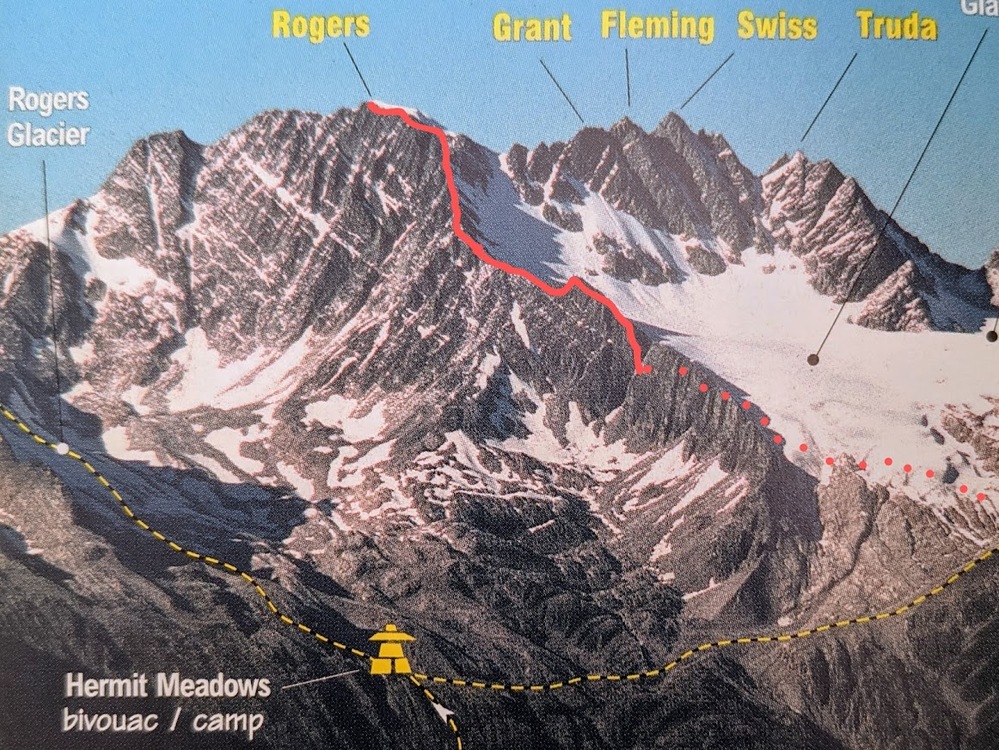 |
|
|
k rwrote: You can always make an anchor stronger. In the same way that you can always frame a house with bigger boards. It's totally normal under the 'building code' for guiding alpine terrain to belay off of a stance or horn without any extra gear. It gets used by hundreds (probably more like thousands?) of guides hundreds of days per year and we frequently have clients fall or hang on said stances. It's not a substandard practice.
If you'd ever actually tried to do this, you'd know that it doesn't work very well. Certainly not 'easily.' In response to the short roping comment, yes, it's super dangerous, but it's a very effective tool when properly used. (much like a rifle, chainsaw, router, jack hammer, motorcycle, etc. etc.) Similar to belaying off of stances, short roping is probably used tens of thousands of guide-days per year. A lot of people react negatively to seeing guides using basic guiding practices because they don't really understand the tool they saw being used. It's ironic that this conversation is happening parallel to the 'guide wages' thread. This is exactly what clients are paying for: a deep understanding of the tools required to safely navigate rock and alpine terrain in an efficient manner and years of practice and experience applying them. Additionally, if you look through ANAM, guided trips are firmly in the minority of injuries and deaths in North America, so the system appears to be working. (though clearly something broke down in this specific instance) Bringing it back to this accident, it's impossible to know what actually happened. Clearly a lot is missing given how it's described in the press release. It's also really unlikely that the client had a good idea of what was going on up at the belay given the fact that he was almost certainly well below that point and probably didn't have a good view of exactly what was going on. If the guide wasn't concussed and is able to remember what happened, it'd be interesting to hear their side of the story, but trying to pass judgement now or even then is a pretty fruitless task. |

|
Max Tepferwrote: I agree with pretty much everything you stated, but I'd caution against this sentiment since it's quite unverifiable without base rate information. |
|
|
IMO anyone looking to climb an alpine route in general, and ESPECIALLY in Glacier NP -guided or not- and not expecting to deal with the danger of loose rock, either didn’t belong there or was looking for an excuse to file a lame frivolous lawsuit. |
|
|
Derek DeBruinwrote: Fair point. I'd love to see this actually studied! |
|
|
Mark Pilatewrote: You do of course realize that this was in Glacier National Park, BC? Only about 300 miles north of the one in Montana. It's actually got pretty good rock, at least by alpine standards. And also real glaciers. |
|
|
A V wrote: I think ANAM is a good source of information, but it being self-reported immediately brings up issues for comparing guided vs un-guided in my opinion. Kind of “well duh” chances that a paid professional would be more inclined to not report on their own screw-up when it means putting food on the table or not in the future, compared to a weekend warrior where reputation doesn’t really mean anything. And I know reports can remain anonymous, but still. |
|
|
Martin le Rouxwrote: Well don’t I feel like a dumbass. I thought he was referring to the Canadian side of Glacier NP in Montana (Waterton Park in Canada). I guess I should pipe down and brush up on my Park names/locations and alpine destinations |
|
|
Many solid posts above. Nothing to add except about this …
My bet is that the lawsuit will also play out that way unless the guide’s insurance or company’s insurance decides to pay some nuisance fee rather than a more costly litigation despite winning. Well, that plus the earlier admonishments here about belay methods/types and anchoring techniques were too much to let stand all by themselves. They have a place in this discussion to be sure. But not by themselves |
|
|
A V wrote: Not really, because: Matt Spethwrote: The self-report makes the data much less robust compared to something like air or highway travel data. There's also the issue of severity: near misses and less significant accidents/injuries are less likely to be reported. Hell, even severe incidents can go unreported, such as this mega classic example: https://vimeo.com/7858740
A guide/service might be more inclined to report so they don't lose their permit, but I could see it going either way in some contexts. And the ego of that weekend warrior might still get in the way (see above). Max Tepferwrote: I would, too! I've thought about what the design of that might look like, but haven't yet attempted to make the connections needed to get the data since... A V wrote: There's a handful of places where permits are required for all overnight use, though I'm not aware of any where permits are required for all parties including day use. That would constrain the data set a bit, but would still likely offer useful insight. The other challenge would be in comparison between guided and unguided parties, as there are probably many confounding factors to address: popularity of route (maybe a more popular route has less loose rock but more people to find and knock off that one inopportune cobble), difficulty of routes, conditions and timing, the popularity of the location and style of climbing in general (many of the places with permits are bucket list alpine objectives, hence the need for permits), the likelihood of climbers to hire a guide generally and in those locations specifically, etc. More to the point, the NPS might be reticent to provide access to data for a variety of reasons, so I haven't put in the effort yet as I have other ongoing projects at the moment. |
|
|
Derek DeBruinwrote: One of the biggest problems with analyzing climbing accident statistics is that it's almost impossible to get reliable data on the number of climbers or climber-days. There are a few exceptions, such as Denali and Rainier, but in most areas no-one really knows how many visitors are there to go climbing. As you point out, there are some areas that require overnight permits, but I'd guess that many if not most of those permits are issued to hikers, not climbers. In any case, it's not always easy to to make a clean distinction between hiking, unroped scrambling and technical climbing, particularly in alpine areas with lengthy approaches. |
|
|
Martin le Rouxwrote: True. The short list off the top of my head as I was writing was Denali, Rainier, Tetons, Whitney, maybe North Cascades NP. If the associated itinerary information were available, it could be used to differentiate "climbing" from "hiking" in whatever manner would be most useful to study. |
|
|
Derek DeBruinwrote: For certain regions, doesn't ANAM source data straight from rescue services? (granted I'm sure plenty of accidents occur without SAR ever being activated, but you'd for sure catch the most serious ones? Either way it wouldn't fully solve the problem, but I don't think it's true to say that it's exclusively self-reported? As to whether or not guides report to ANAM, (which they likely don't in most cases) they do report internally and, anecdotally, my experience paying attention to the in-house reporting would indicate that the frequency of accidents and near misses is less at guide services than it is for the public in a given range. |
|
|
|
|
|
Jason Antinwrote: Paywalled |
|
|
Cliff notes anyone? I'm not paying for any subscriptions. |
|
|
Climber Sues Guide for Negligence After a Near Fatal Accident In July 2021, Ian Manson, 63, hired local guide Jeffery Mitchell to take him up Mount Rogers in Glacier National Park, British Columbia, Canada. Now, after a near fatal accident, Manson is suing Mitchell, Revelstoke Alpine School Inc. (the guiding service), and the Association of Canadian Mountain Guides (ACMG) for negligence and breach of contract. Manson and Mitchell began their ascent on July 15. On a pitch at approximately 9,8400 feet, the two were connected via 30 feet of working rope. Mitchell, who had just led the pitch in question, opted to belay Manson via a hand-over-hand belay. He did not set up an anchor system. After the two exchanged the respective “on-belay!” and “climbing!” commands, Manson began to climb. Mitchell, who was directly above Manson, then “tested the stability of a large fridge-sized frock with his foot, causing the rock to dislodge and then fall,” stated the civil claim filed by Manson’s counsel, MacKenzie Fujisawa LLP. Manson, who moved to dodge the rock, was grazed in the head. Mitchell let go of the rope, which caused Manson to fall at least 20 feet before the rope became taught. He then hit a ledge and stopped. Mitchell, in turn, was pulled off his ledge. The civil claim continued: “[Manson] grabbed the slack rope that was dangling from Mitchell’s belay loop with his bare hands, braced himself, and held on, in order to change the arc of Mitchell’s fall and to try slow Mitchell’s rate of fall, to prevent Mitchell from falling further and to prevent further injury to both parties.” Both climbers were airlifted to different hospitals. Manson, according to his counsel, sustained rope-burns to his hands, arms and torso; lacerations to his hands, arms, torso, and right leg; a hematoma [bruise] to his right leg; and psychological injuries including anxiety, post-traumatic stress disorder, and insomnia. Neither Mitchell nor the Revelstoke Alpine School could be reached for comment or clarification. Mitchell is a certified guide both through the ACMG and the International Federation of Mountain Guides Associations (IFMGA). He’s also a Salomon ambassador, Capow Guide, and Selkirk Tangier’s Guide. MacKenzie Fujisawa LLP filed a notice of civil claim on Nov. 9, 2021, with Manson seeking compensation for “general damages, special damages, and costs.” Some of the listed charges stated: “the failure of Mitchell to receive adequate or sufficient training in shortroping and/or short pitching [moving with clients on a shortened rope] and/or holding actual loads in test situations; the failure of Mitchell to anchor in at the upper belay station; the failure of Mitchell to comply with professional standards or practices for belaying.” Another listed charge was “the failure of Mitchell to select a ‘shoulder belay’ or ‘seated belay technique.'” Kevin Dumba, Executive Director of ACMG, told Climbing: “Hip and shoulder belays are professional guiding techniques described in detail in The Technical Handbook for Professional Mountain Guides published in 1999 by the ACMG and the AMGA.” Dumba continued that both methods are considered appropriate belay methods. “With these belays, the guide and their braced position become the anchor,” he said. “They are commonly used techniques in 3rd, 4th or easy 5th class terrain, and often in ‘short roping’ scenarios, where: low loads are anticipated; loads will be held for very short periods of time; the guide is in a braced position appropriate for the anticipated load; when a ‘slip’ rather than a ‘fall’ is anticipated; the terrain is low angled or stepped; and the route traverses, is near or on the ridge crest.” On short roping, Dumba added: “It is an important tool for professional guides. The rope may be shortened for safety in areas where long ropes increase hazards such as rock fall or impede moving over terrain more quickly for efficient progress.” The details Dumba provided were based on general best practices, although he could not speak to this specific case. |
|
|
Honestly curious what even is a “hand-over-hand belay”. Is that just like, coiling the rope? A hip/sholder belay sounds like a reasonable effort. Also, what possible good can come from testing the block in that situation. I hate these sort of lawsuits, but I have to admit Mr. Mason may have a valid case. |
|
|
Mike Spencer wrote: According to this story, the client did not sign a waiver. from msn.com/en-ca/news/canada/w… ........Lawsuits such as this are rare because guides demand clients sign waivers that are legally enforceable shielding them from liability even if they are negligent — leaving injured climbers or their loved ones with little recourse after a serious or deadly accident. “The cases are dismissed before trial or during trial,” explained lawyer Christopher Watson of MacKenzie Fujisawa LLP . “This case is important because Mr. Manson did not sign a waiver. This is a unique opportunity to shine a light I think not only the standard of care that should be expected of mountain guides or the ACMG but also, in one way or another, the aftermath of guide-led incidents when it comes to the internal investigations that follow."........ |


