
 Continue with onX Maps
 Sign in with Facebook






Accident at Haus Rock near Keystone, CO (Petzl Shunt accident)


|
The person on the scene who described the fall to me said that Craig fell in a twisting motion, sort of cartwheeling to the side. This probably caused the device to be turning sideways as the rope came taut. The rope was likely a 9.5mm dynamic rope at 35m length (I had a 70m and cut it in half as a gym rope, giving Craig the other half... he's been using this lately). I can find the brand if it'd be useful, but any dynamic rope is going to get skinny when it stretches. If you look at the slit in a shunt where the rope would have to slip through... it's tiny. You'd never imagine a rope would fit through it, but yet this 100% happened. |
|
|
Every time I read about somebody wanting to know how to rope solo I think to myself… Don’t do that. |

|
Hello Everyone! I really appreciate all of the comments and discussion. I only get a few posts a day (didn't realize this yesterday), so I'll try to answer a few important questions in this one post, and I'll post again a bit later. The rope was dynamic 9.5. I had fallen on it a bunch that day, and I was only 15 feet from the anchor, so it was pretty elongated. My method for switching over to my Grigri to lower to the ground was to go in straight to both anchor bolts, put on the Grigri, take off the Shunt, so it wasn't that kind of error. (Although since having taken that big fall, I have questioned whether I made a huge error like this, there were witnesses to confirm this was not the case.) My backup knot was just a couple feet below where the crux starts, making it maybe 6 feet below my device when I fell? The climber who watched the entire accident tried to analyze what may have happened, and we've been in touch. I think his insights are quite valuable. He reattached my shunt to my rope at the crag, took some pictures, and shared some thoughts. First the pictures: 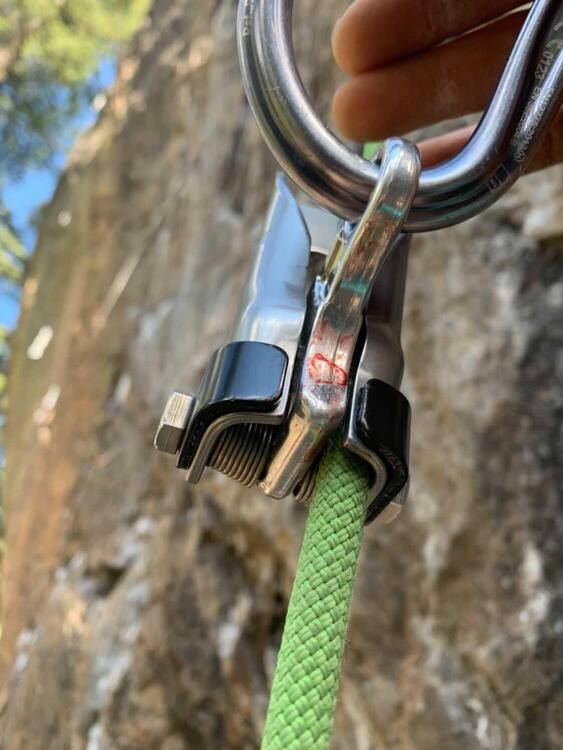 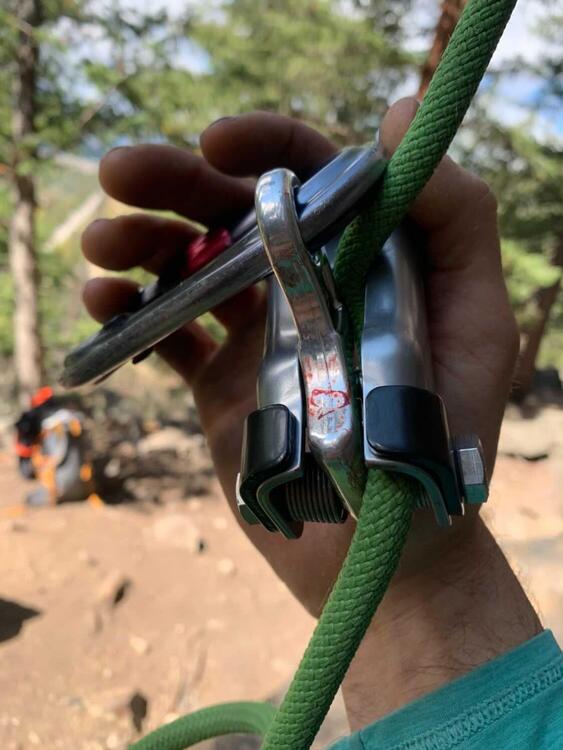 The witnesses thoughts (they were more eloquent than this, I am just paraphrasing): In short, the device was loaded at a strange angle that flexed the C shape of the Shunt and the rope slid out. A more specific possibility, is that the device may have been loaded when the rope caught in it similarly to the second picture (instead of the typical shunt fall where the carabiner loads the camming device first). This could snag immediately, creating some large and odd forces causing the device to open. The important point here is that if the rope snagged, the time it took to load my weight onto the device could be dramatically reduced versus a typical shunt fall, thus increasing the forces. Combine this with an angle that isn't parallel to the strongest direction of the device, and it could fail. Again, these pictures were taken post-accident and this is the device it happened on. The Shunt completely removed from the rope when I fell, and the climber just re-attached the rope to analyze. Thanks again for all of the thoughtful discussion. Craig |
|
|
Sorry to hear about your accident. Glad you are going to be ok. You are very lucky. I don't consider what you used as backups to actually be backups. You were still 100% relying on one attachment to the rope. A clove or an overhand on a bight clipped to a locker on your belay loop would be a separate, independent connection to the rope. It would have prevented this accident provided the rope didn't break. Some people rope solo on 2 independent ropes. |
|
|
Craig, if you have time and are willing, I think you should reach out to Dave MacLeod to let him know what happened. He has followers all over the world, there are probably a lot of people using his exact set up. People need to know that the backup knot has to be clipped to the harness to prevent this type of catastrophic failure. |
|
|
Craig Faulhaberwrote: That is a great shot of how the rope might start to wedge its’ way into the gap there. It may not matter. Still, I’m curious if having the lever arm as far towards the top end of the shunt as practical makes that narrow gap become more like a generous funnel given the way the edges of the shunt’s body flare apart near the top. Of course, the biner / rope will limit upward travel at some point. aikibujinwrote: +1 His caution about not letting your body defeat the cam indicates he does not shy away from sharing possible failure modes. |
|
|
Craig, so sorry to hear about this! Very glad to hear you'll make a full recovery. Good luck on that journey, wishing you the best man |
|
|
I think your partner has the most probable cause identified in that second photo. Extra points for blood still on the device. I just noticed it’s not actually a C section of metal capturing the rope around the cam, it’s geometrically less than that. Petzl’s 3 piece reinforcement seems nearly useless as well - the bolt holes have tolerance and will gaul at low forces. I’m convinced. Yeah - no thanks to that device - but definitely thankful someone was able to hopefully walk away from this after taking one for the team. |
|
|
Looking at the 2nd picture, Craig, I am no longer surprised the rope was able to get through: a 9.5mm will likely pinch down quite a bit when placed under force, and the metal on the shunt is designed to deform (as another poster above mentioned). Seems like the forces wouldn't need to be all the high for this to happen. My best guess on what limited info we have right now: as you fell, the shunt slid down the rope 2m to the knot tied in the rope. You are going about 6.3m/s at this point (assuming no friction, although there was probably some). Because of the twisting nature of the fall, the rope was oriented as in picture #2 above. Hitting the knot as you started to decelerate against the knot caused the rope to compress (get skinnier in the notch) as well as causing the metal of the shunt casing to bend open. Since you were near the anchor, there wouldn't be much rope stretch, so the impact force assuming 10cm elongation would be about 10.8 kN. That's a very jarring fall if you had stopped, but considering the rope came out, you may not have felt much of it. If you get the device back, we should do some testing and see if we can recreate this rope-slipping-out scenario to better understand what happened. Either way, no one should be using a shunt for TR soloing... and I've emailed Dave MacLeod asking him to put a note on his video warning people that this can happen. |
|
|
Was there any use of a secondary device , other then backup knots? |
|
|
Hello again! I agree with all commenters who say that a second line, a second device, a backup knot tied to my belay loop would have prevented this accident. Unfortunately, the simplest solution (simply attaching the backup knot that was below me to my belay loop) wouldn't work because the rope needs weight below to feed through the Shunt. To be fully honest, the reason I was using a Shunt in the first place was the appeal of the convenience and quickness of being able to lower below the crux for multiple quick attempts at the same 10 foot section of rock. And while my assumption that a rope couldn't pop out of a Shunt was obviously wrong, I think that many people looking at the device could come to that same conclusion. We may also think things like "If I can trust a Grigri to keep me safe, why not a Shunt?" or "They test these things like crazy and wouldn't create a device that allowed this to happen." or "I googled 'Petzl Shunt failure' and didn't find any cases". I thought all of these things before going out there with this system, so I felt safe doing so. I just don't want other people to make that same mistake. I see that the video that teaches this setup is by far the most popular TR solo video on YouTube with almost 300k hits, so globally there are a lot of people out there using this setup right now. So I am really happy that so many folks are focused on why the Shunt let go of the rope, and how we can keep other people from making this same mistake. I really want this sport to be as safe as possible, and learning from each other is the best way to make that happen. I am so appreciative of all of the discussion and comments here. Keep the conversation going, and be safe everyone! Craig |
|
|
My thought, is that some devices have a way to keep them from opening, no matter what happens. A regular ascender has a place to hook a carabiner or maillon through the two parts of that U shape. You can unlock it, but it's still on the rope. Same with a loaded grigri. If the cam somehow failed, you're still on the rope. And, then that overhand on a bite down below comes into play. It seems a serious design flaw that there is no way the shunt (never used one, never seen one until these pictures) can have this simple, mechanical, foolproof backup, to at least keep the thing on the rope. Best, H. So glad you're still here, OP, and hope you heal up well and quickly! Thanks for sharing all of this, too! |
|
|
Craig Faulhaberwrote: This is the classic tradeoff of toprope solo isn't it? The "safer" the setup, the incredible increase in annoyance to transition to lowering. The safest setups lock you into the system completely (which can be its own problem as in overhanging routes). And so a simpler setup with more convenient transition becomes alluring, maybe even safer in some ways (KISS after all), until you encroach the other limit of not enough backup. This is all until someone invents the perfect TRS device, a system both failproof attached to rope on ascent and easy to switch to rappel. |
|
|
I'll also add that, from my experiences using a grigri and ascender combo in a sort of self belay system for gym route setting? That anything/everything on the rope can get into wonky mischief all on it's own, just from you rattling around above or near it, loaded, unloaded, various amounts of slack....it all lets stuff happen that would rarely be possible in normal climbing rigging or scenarios. That's why those extra steps and rigging are there, and why TRS is maybe not the place to work problems other than simple laps up straightforward climbs. Add in anything else, and the odds of less than fun outcomes go way way up, imo. It's a free hanging, fixed rope.... don't defeat that and introduce a rope slicing fall possibility. Don't introduce getting inverted. Don't skimp on stuff that keeps you alive, or skip it, "just this once". Etc etc And? Don't solo... solo. Be somewhere other people might be around, just in case. Climbing without a partner is one thing, climbing all by your lonesome is a whole other beast. Best, H. EDIT to add, the Star Trek jet boots would be great for climbing solo...unless you forgot to charge them, lol! |
|
|
I know in rope access situations Shunts are no longer allowed because of the aluminum construction and SafTech Ducks are used because they are made of steel. I wonder if this sort of issue is why… |
|
|
simplyput .wrote: Haha I came back from one of my first sessions using the Duck to assess a route that I'd like to do at some point, and saw this post. Definitely think the Duck's construction has something going for it in that sense, though think I might be adding a quicklink below the device to catch on a backup knot... or some all-together better setup. Either way, definitely a good reminder that weird stuff happens out there, and we should assess the methods we consider 'safe' as often as we use them. |
|
|
tobias bundlewrote: My system is shunt on top, attached via carabinerbto 12cm dogbone, attached to harness via mallion. Shoulder strap keeps shunt upright and feeding. Attached directly to your harness is a microtraxion. Attach this to same rope or 2nd rope. I personally tie backup knots. To lower you can either open the micro then drop down w your shunt or attach a Grigri and lower the shunt onto the gri and rappel down. It's super convenient, super fast, functional, and safe. Many devices have a known failure mode. The shunt is a great tool if you account for the weakness of the device. |
|
|
Wow Craig. I’m so glad people were there to help and you’re still with us. Hope you heal up quickly and all of your rehab goes well. Erika |
|
|
Craig I'm so glad this is recoverable for you! Keep your spirits high and thanks for posting this up for others in the future. Please let us know if we can help you in anyway. When you're well again you might consider writing it up for the AAC accidents in North American Climbing: publications.americanalpine… |
|
|
I had never heard of the shunt and looked it up out of curiosity. Looks like the Shunt is designed for 10-11mm rope when used single strand and 8-11 when you have two ropes in there. Maybe this is how the rope was able to come out of the device? Also looks like its a rappel back-up by design typically, would a gri-gri be able to work in this sense? Glad to hear you're on the mend! |


