
 Continue with onX Maps
 Sign in with Facebook






Why are some climbers so against assisted braking belay device?


|
|
There are some purists that always insist on using ATC belay devices, and think assisted braking belay devices could enforce bad habits. I totally understand that lead belay with Gri Gri is not fun, but there are some assisted braking devices such as Click Up, or Giga Jul that feeds slack very smoothly. Obviously, NEVER let go of the brake hand but unexpected things could happen such as falling rocks, getting stung by bees etc. You wouldn't know how your instinct would react in that moment. |
|
|
People don’t like change. Also once you learn how to properly lead belay with a grigri, it’s really not a big deal (just don’t use a fat rope). |
|
|
Why are you asking? |
|
|
While I have nothing against assisted breaking devices, I would much rather be belayed by someone who "grew up" using an ATC and refuses to move to an assisted device, than someone who has only ever used a Grigri. Brake-assist belay devices do in fact enforce bad habits. |
|
|
ubu wrote: The DAV (German Alpine Club) did a study and found that assisted braking devices significantly reduce the rate of life-threatening belay errors. It is difficult to claim that they "enforce bad habits" in light in data that suggests you are significantly less likely to die or be injured while being belayed by one. 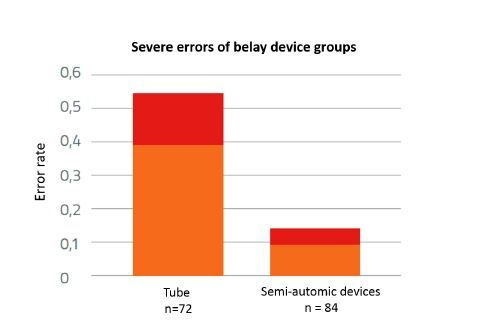 Using an ATC isn't a death sentence. You can safely belay with an ATC like 99.9% of the time. I use an ATC regularly. But you cannot argue with hard data which shows which belay device is safer. |
|
|
a grigri killed my father it's outrageous but it's true it gave him quite the clobber in an alley in Peru it rifled through his pockets it stole his phone and key and ever since I only use my trusty ATC |

|
Kyle Tarry wrote: This doesn't provide any direct evidence for or against what ubu claimed. The claim is accident rates while using an ABD will be higher amongst those who learned to belay with an ABD vs. those who learned to belay with an ATC then switched to an ABD. All of that information is collapsed into the right bar and is not investigated in any greater detail in the linked study. |

|
B U wrote: Because they are grumpy old men |
|
|
Gumby King wrote: I’m a grumpy old man and I mostly use a grigri. |
|
|
Bill Czajkowski wrote: Lolz. I'm a grumpy old man and I'm not that old |
|
|
hip belay or nothing |
|
|
B U wrote: What are you even talking about? Great first post, btw. |
|
|
ubu wrote: Only if you learn bad habits to begin with. And this is true with the GriGri, ATC, jul, Sticht plate, hip belay, and every other damn thing in life. |
|
|
Belaying with a grigri is just an added layer of safety and isn't even difficult. I think it's important to know how to use an ATC or similar devices, but I always prefer an assisted braking device. I'd much rather get short-roped than get decked. I was at a crag in the Red and a guy climbing near us got dropped taking a whip due to a belayer error with an ATC. It would likely not have happened if she would have been using an assisted braking device. He was brought out on a spine-board and everyone thought he was paralyzed. I have no idea the level of experience the belayer had, but at the end of the day, if she would have been using a device like a Grigri, I truly think the accident could have been avoided. Aside from belayer error, there are also just things that can happen. Belayer gets struck by a rock? Has an allergic reaction to a bee sting? A siezure? The list goes on. |
|
|
Taylor McKenzie wrote: That wasn't the claim. That claim was simply "Grigris enforce bad habits." If Grigris enforce bad habits, why does the data suggest that they are SIGNIFICANTLY safer than tubes? I use an ATC all the time, and the vast majority of the time they are perfectly safe in the right hands. But there is essentially no claim to them being safer than ABDs. The data doesn't support that, period. |
|
|
...as compared to those who use or are more familiar with ATCs. How would you best test this? You'd look at people who are familiar with an ATC and Grigri and compare their accident rates to those that are only familiar with a Grigri, and you'd need to assume any differences between those groups are due habits/practice formed when using the respective device (or control for other relevant differences). The study you linked only examines ATC and Grigri users as a whole, not conditioning on past experience, so there is a selection bias issue. Put another way, the graphic and study examine the probabilities Pr(accident | belayer was using an ATC) and Pr(accident | belayer was using a Grigri), but we're actually interested in Pr(accident | belayer was using an ATC/Grigri, belayer has/doesn't have significant experience belaying with an ATC). We care about this latter quantity because of its policy relevance. That quantity would tell us, for example, how accident rates would be affected if everyone who belayed with an ATC was forced to belay with an ABD (as in many gyms) or if ATC proficiency were a requirement for using an ABD.
I agree 100%, there is certainly strong evidence that ABDs are safer than ATCs on average. There is, however, the opportunity to improve safety on the margin by changing the way we train and practice belaying. |
|
|
I use an ATC. Yes, I am old and set in my ways, but, in fact, it is significantly harder to feed out rope to a leader with a grigri (I'm not at all familiar with the other devices mentioned above) than with an ATC. I've tried many times and I just can't feed rope smoothly with a grigri and have had many more 'fights' for slack leading while belayed by a grigri than by someone with an ATC. Additionally ATCs are lighter and more versatile--they work for a broader ranger of rope diameters and you can use them to rappel, so less gear to carry. I don't know anything about the DAV data, but ANAM describes more 'mis-use of equipment' belay accidents with grigris than with ATCs--and more such misuse accidents that those involving belayers who become disabled. |
|
|
Kyle Tarry wrote: I think Grigri is safe. I use a Grigri all the time. Being a safe device does not preclude the Grigri from enforcing bad habits though. I just read the DAV study, it's is too subjective to offer any sort of conclusion. Their study was to passively observe more than 360 people belaying in 11 climbing gyms, so the error rate depends on the subjectivity of the observer. Also, the errors seem to be device specific, which can skew the error rate. For example, with a tube this was mentioned, "the most frequent error was a brake hand too close to the Tube". The same is not mentioned with a Grigri, so is that an error for use of a Grigri or not? The DAV study isn't clear on that. A Grigri is very unlikely to let any rope slip through, so keep your hand close to the Grigri is most likely not counted as an error. If keeping a brake hand close to the device is an error for the tube but not for Grigri, then this skew the data in favor of the Grigri. I've observed a lot of climbers belay while holding the Grigri in their hand. A few times I've seen people hold the Grigri with their left hand and feed out rope with their right hand (no hand on the brake strand whatsoever). Can anyone argue those are not bad habits? Would you develop those habits when you use a tubular device? Not very likely because the climber would've decked a long time ago. A Grigri will often still work and catch a fall when misused like that. So for people who are looking at accident numbers, it will not tell you the full story. |
|
|
Taylor McKenzie wrote: Anecdotal evidence, but used an ATC strictly for 10 years. No issues. One day my climbing partner, same experience and preference, semi lost control and dropped me as I fell from the top of a climb. Somehow they gained control again and I was caught 6 feet above ground, having fallen probably 40. Not sure what happened, but rope was new. Soon after, a guy broke off a huge rock and fell, rock hit belayer, guy plummeted, both died. In both cases everyone was an experienced belayer with an atc. I now use gri-gri or mega-jul almost always. Like wearing a seat belt, you don't really need it most of the time. But when you do, you do. And it's plain stubborn and silly to argue you don't need to wear one because you are a good driver. It really is machismo IMO. Like thinking your balls are bigger if you drive a stick-shift (and it is silly not to learn to do so, just like learning to use an ATC) |
|
|
Kyle Tarry wrote: I love my GriGri but I'm here to call BS on this "hard data." I can't tell if there's a German version that goes into greater depth, but from the article it's hard to tell what they even did, and some of what they did sounds like BS to me. Their "errors" include a failed partner check (which itself includes securing the free end of the rope), and belaying while standing more 1.5m from the wall. For tube devices "the most frequent error was a brake hand too close to the Tube," while for the GriGri roughly half of belayers let go of the brake strand. They go through a convoluted process of categorizing the seriousness of errors, but they don't actually say which errors fall into each category. They address only lead belaying, but grigris are so famous for lowering errors that they built a special panic mode just for that purpose. Honestly I wouldn't be surprised if the authors had a vested interest in demonstrating that semi-automatic devices are superior to tubes. |
|
|
I have a whole variety of devices, from GriGri to a regular old ATC. I usually use whatever happens to be on my harness. If I am climbing with someone who only uses a GriGri and short ropes me, I'll tell them they better get their head out of their ass and either learn to use the tool they have limited themselves to, or learn to use something else. Same goes for one of those "surprise" rapid lowers from a GriGri. I'll normally use a Mega Jul for trad crag day top ropes, grigri for sport and gym and a Mammut Wall Alpine for in the mountains on skinny ropes. |


