
 Continue with onX Maps
 Sign in with Facebook






Interesting thing about climbing technology history, beaks for example



|
It is interesting researching climbing technology, as often big innovations are not even mentioned in the literature at the time. This seems to happen again and again, so you really need to read between the lines and look at evolution of equipment and techniques carefully. It is not intentional of course, but it just happens. Wikipedia page on pitons has been updated lately but no one has added beaks, which are clearly a distinct type of piton and one that has really revolutionised hard aid in the past decades. I just added them. Beaks (hooking pitons) have an interesting history. Because of the iron curtain, no one in the west had conceived of using hooking pitons until Bridwell modified Crack n’ Ups for his ascent of the Big Chill on Half Dome in 1987. Since then, beaks have been essential equipment for big walls all over the world. A5 started manufacturing them in 1988 with a royalty agreement with Jim, as the one who brought the idea to the table. But hooking pitons had already been in use in Czech Republic, and Poland too apparently, dating back to 60’s? That is probably the biggest crux of writing about climbing technology, the fact that news is very nationalistic. There is so much junk and misinformation on the internet, but with the ability to query and translate primary research like Alpine Journals from other countries is a big boon. if anyone is interested in climbing technology history, it’s become my hobby lately, and I am posting on bigwalls.substack.com Below: Wikipedia—plus my beak addition, and the pics of my beaks in late 90’s. Beaks probably should have their own wikipedia article, as how they originated in Europe and evolved after the 80’s is interesting with all shapes and sizes being designed and optimised. 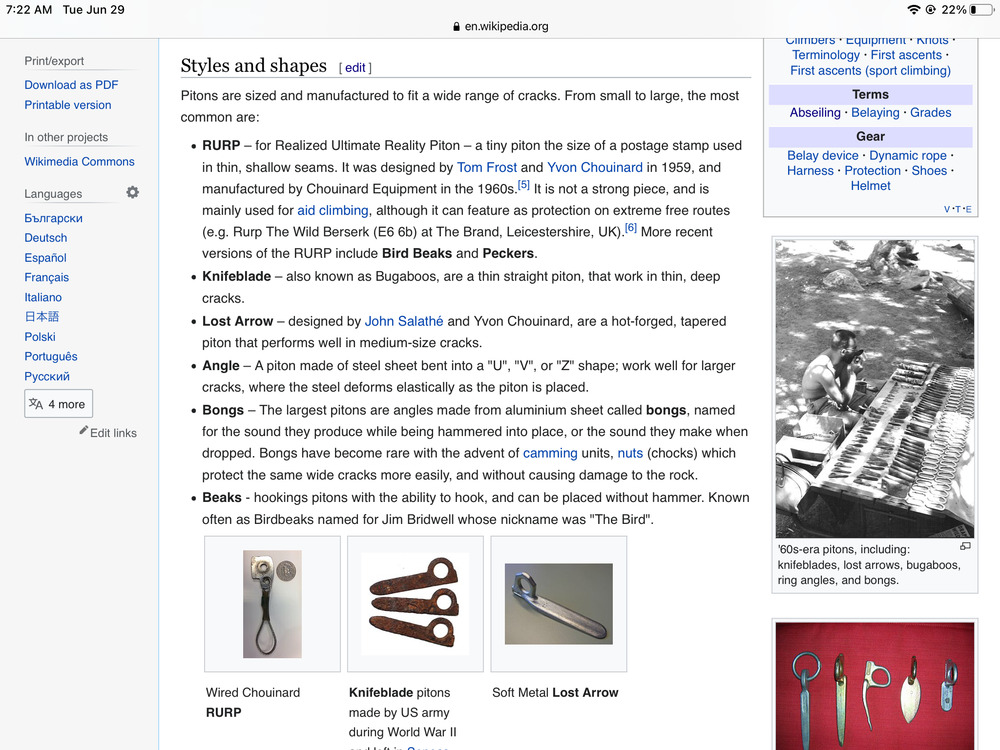 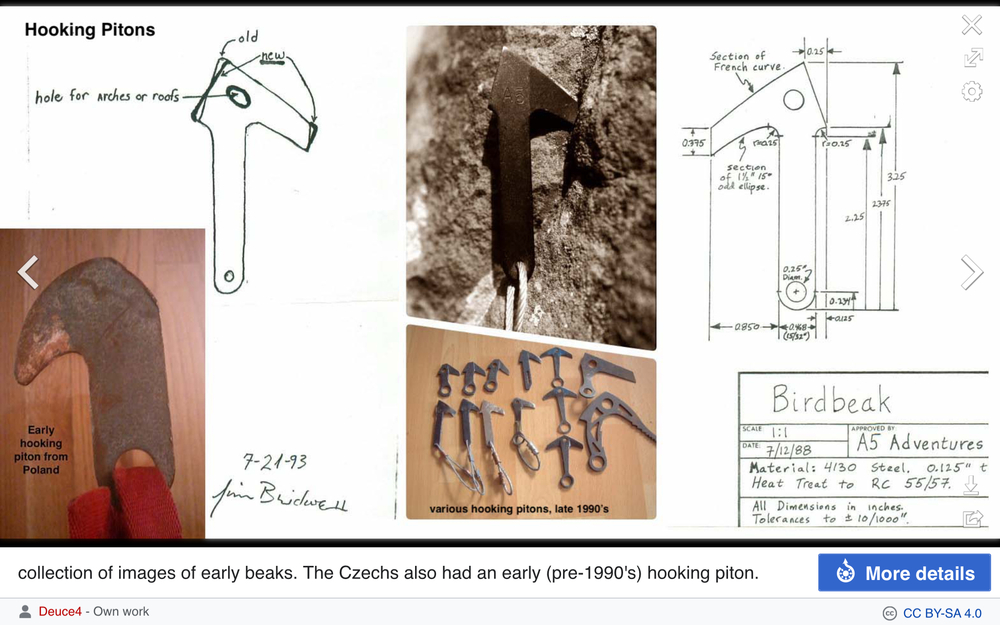 |
|
|
I recall that MSR had something like a beak in the early 1980s or even earlier, but I didn't see any in your bottom photo. I bought a few and must have them in a box somewhere. If I find them, I'll post a pic (unless someone else does). |
|
|
If anyone has any of the Czech ones, I have seen them in the magazine Hory, and Vladimir Prochazka sent me some in the 1990’s, but I do not have any pictures. They were more like a hooking knifeblade. Vladimir featured in Jump, cool film about jumping from tower to tower in the Czech Elbe Sandstone Mountains (Elbsandsteingebirge): mntnfilm.com/en/film/jump-2001 |
|
|
Ah, here is the MSR piton, on Ken Yager’s site. Never heard of these being used much, wonder if there is anyone who has some experience with them. Perhaps there is an old MSR catalog where the use and purpose was described. 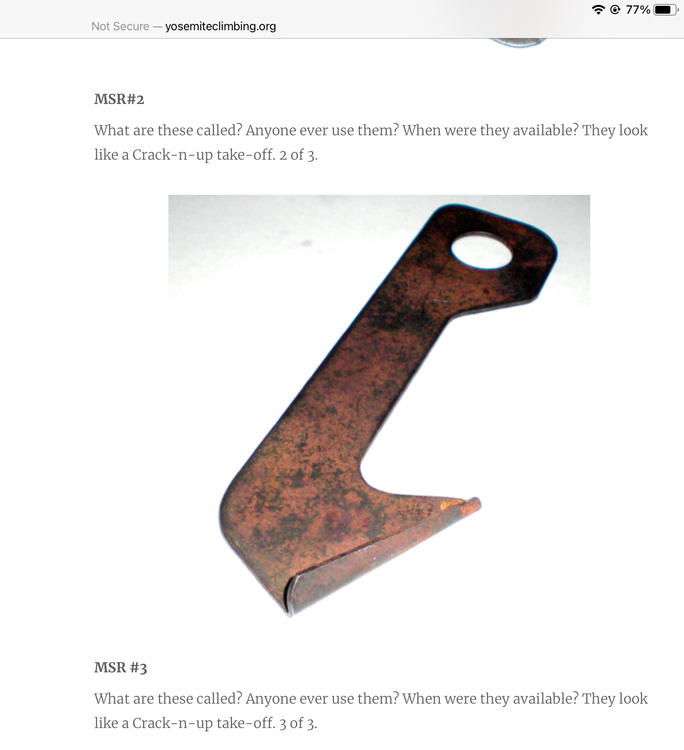 Edit: thinking of these MSR hook-pitons, if that is indeed their intended purpose, they mixed a great concept with an odd twist—that little metal fold at the beak end. Why beaks have made aid climbing so much easier is that they don’t really need to be hammered in much, into the tiniest gaps in the rock. Previously only a alumni-head —maybe a rurp—would have worked in such placements, but would be much less secure and would impact the rock much more. But these MSR wouldn’t be as good as, say, the Polish version of a very short beak, because that fold would be in the way when puttting in thin slivers of openings, where beaks really shine. Maybe they were some sort of clean gear, though, a different kind of gear, more like crack’n’ups perhaps. i suppose even though there are tons of good hand placed beak placements (usually an old placement), it’s still a piton rather than a “clean-climbing” piece. edit2: actually, I recall some of the boldest aid climbers had modified RURPs to be slightly hooking. Mostly they seemed theoretical, as I heard many stories, and probably tested myself, of the modified rurps just shearing with only 1/4” blade in the rock. Maybe some lighter aid climbers got away with it. |
|
|
John I read all of your articles, super interesting stuff! |
|
|
John Middendorfwrote: I got them when I was just starting out and very interested in non-standard gear. Also, I liked small gear and wanted to use these on free climbs, just hand placed with a sharp tug. I don't recall if I ever did. They might have made ones with the lip turned to the other side so they could be stacked, flat side-to-flat side. |
|
|
d-Hope to get in touch with Jacek. Hooking pitons still bit forward in my research--I am still working on 1905 ring bolts. ;) Just came across my old first prototypes--I had a few batches heat treated to different Rockwell hardnesses to see what was best--these were way too hard! Looks like RC41/42 was final spec. Also attached some notes and first A5 Birdbeak product testers before they were offered through the A5 catalog, my modus operandi was(is) to send out a bunch of prototypes to top climbers before offering any gear for sale--this back in the day when everything was letters and film photography, or phone (probably a payphone) so feedback was often slow. 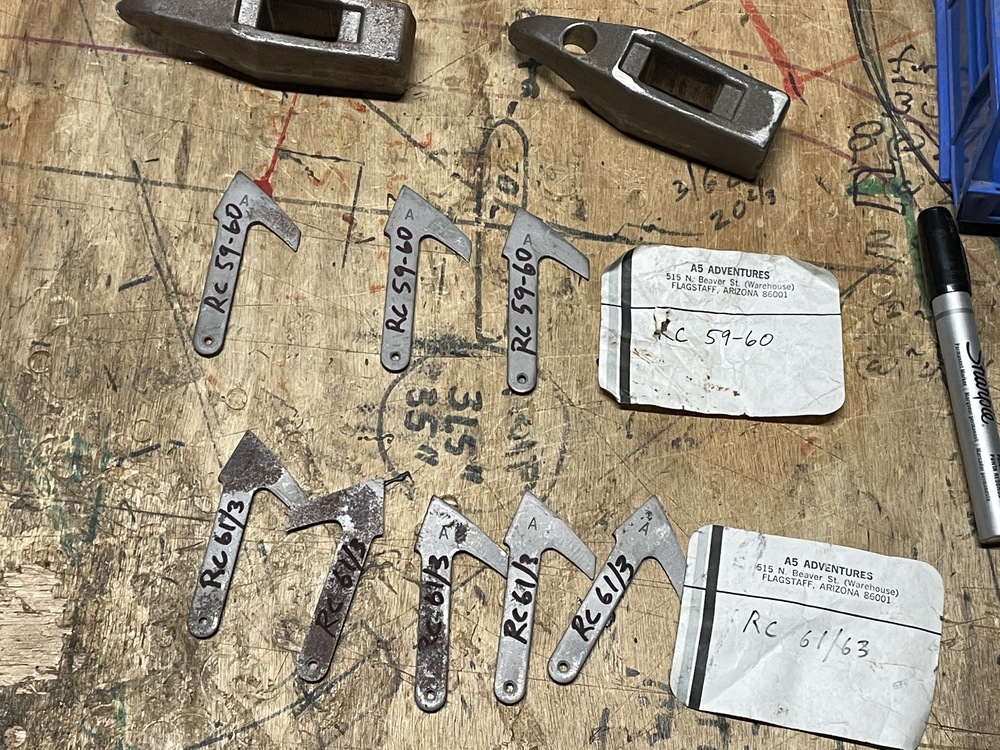 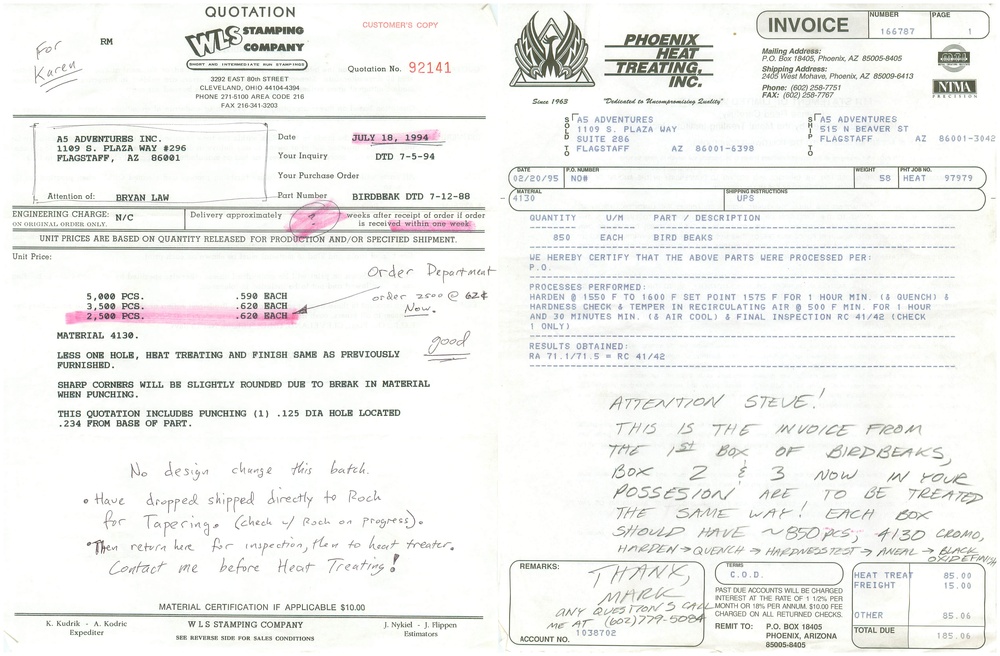 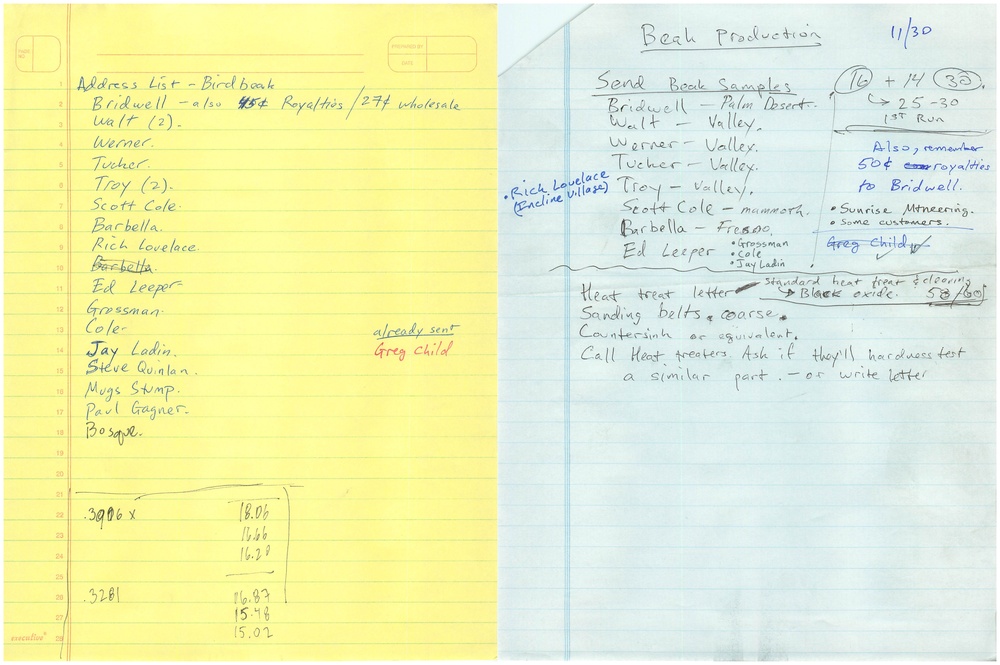 |
|
|
Thanks John! |

|
What happened at higher hardnesses? Did the hammer just shatter the beak? |
|
|
NegativeKwrote: Exactly. I knew knifeblades were at rc41, so they could slip into cracks, but thought it would be worth checking out harder beaks. But they just shatter, too brittle. So in the end, about the same hardness as blades. |
|
|
Found some pics of the Czech beaks--the big one: 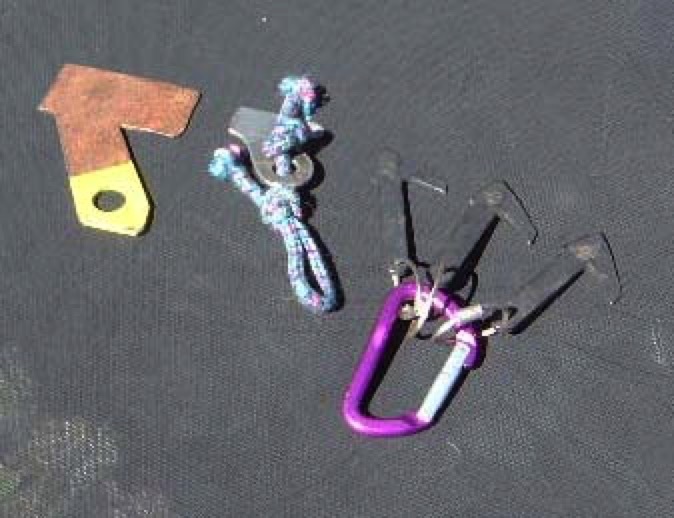 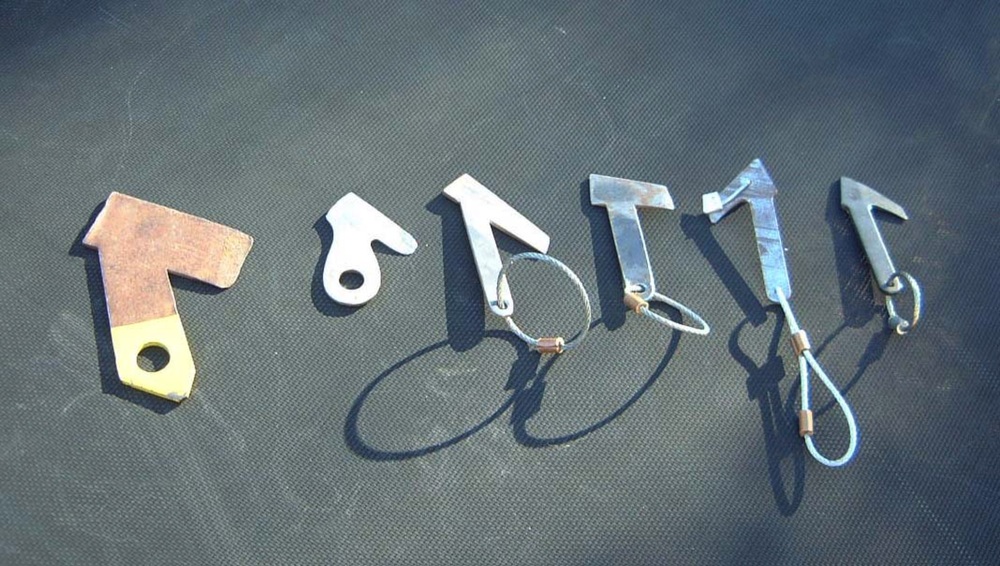 |
|
|
There's a picture of a couple of Michal Pitelka's home-made beaks in 'Passion Eiger', last year's book from Roger Schäli, Rainer Rettner and Jochen Hemmleb; it's on page 206, in the chapter about the 1985 Toni-Hiebeler-Gedächtnisweg on the righthand side of the face of which Pitelka was one of the FA team. |
|
|
Crack 'N Up prototypes first appeared in a 1973 Chouinard catalog supplement Crack 'N Up production versions were in the 1975 Chouinard catalog The MSR hooking "pitons" were called the "Fishhook Chock". They are listed in the September 1975 MSR Newsletter #10 (catalog section), so the article with photos must have been in a prior newsletter. https://www.msrgear.com/blog/wp-content/uploads/2013/03/1975-Sep.pdf I have photos of 4 sizes that Marty Karabin posted on supertopo, but I can't post them here without written permission. MSR also made a version for ice aid called the "Ice Hawk". |
|
|
Clint Cumminswrote: That is so cool I've always wanted to see old catalogs, also ice aid seems terrifying. |
|
|
Marty at Karabin Museum, and Ashby at Vertical Archeology have the best old catalog collections. There is a Utah group, affiliated with the University, I believe, that seems to have a collection of more recent catalogs--does anyone have link? I lost contact as no longer on Instagram. Re: Ice aid--the difference between standing on rigid crampons and in a sling on ice. Too awkward on ice hanging on slings, better to hang off hands and feet. Same use of metal to suspend. Are there any more recent histories of ice tools since Eckenstein? Grivel certainly innovated too. Does anyone know when Grivel started making more rock gear? Pitons, etc. Here is a big question: do any of Grivel's original 1920's hand drill still exist anywhere? Lots of questions still out there. Too few articles in the journals. |
|
|
Very Interesting JM. I love following the history and development of the equipment. It was so much better when small businesses shared and worked on ideas together. Many great collaborations. Here are some photos of stuff from my collection / rack. 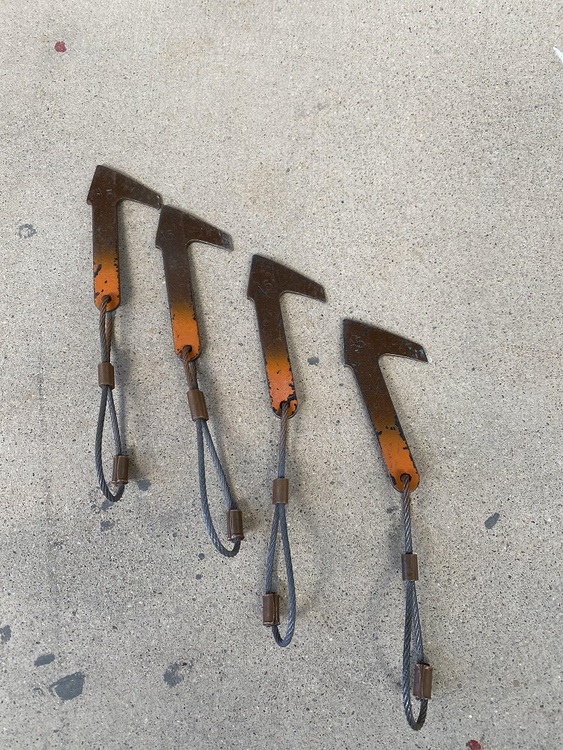 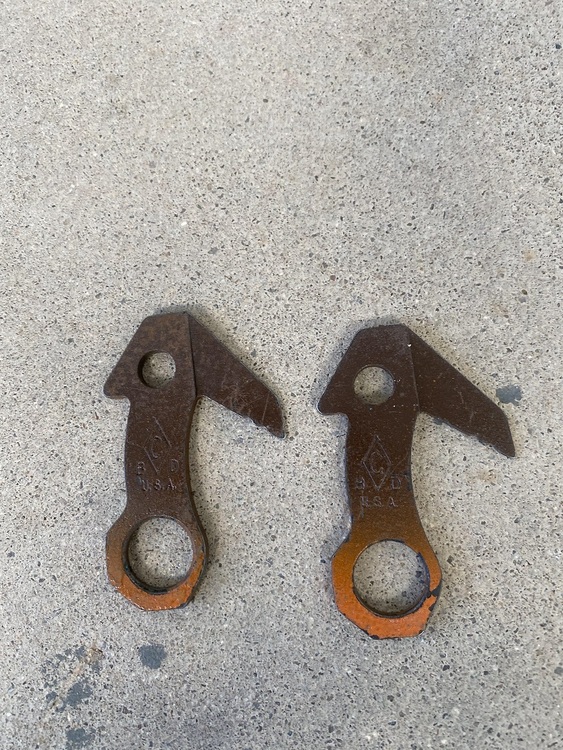 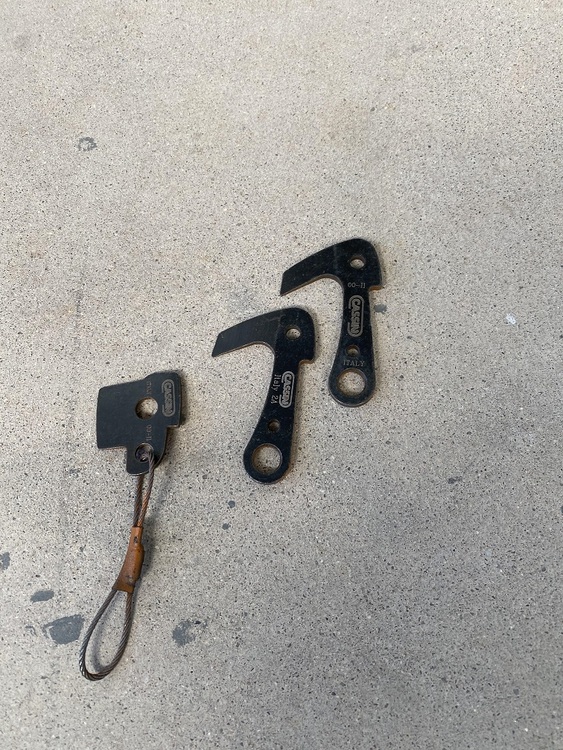 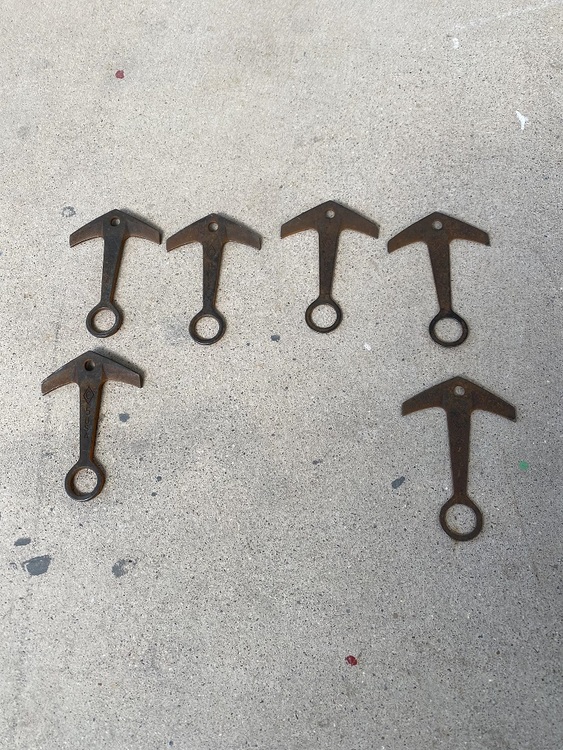 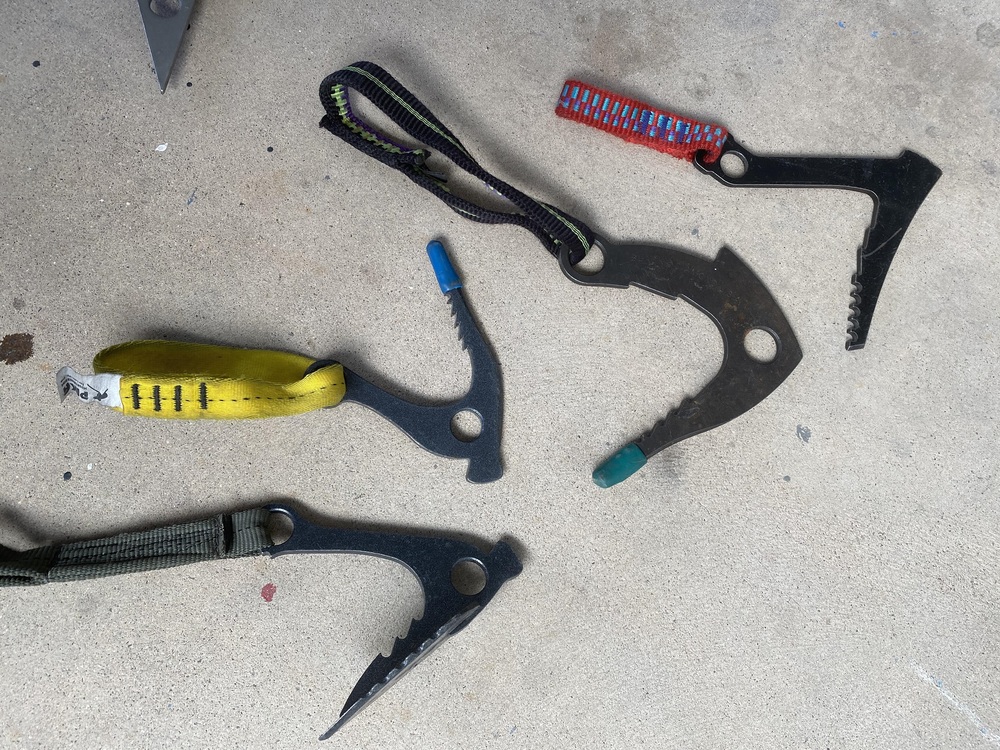 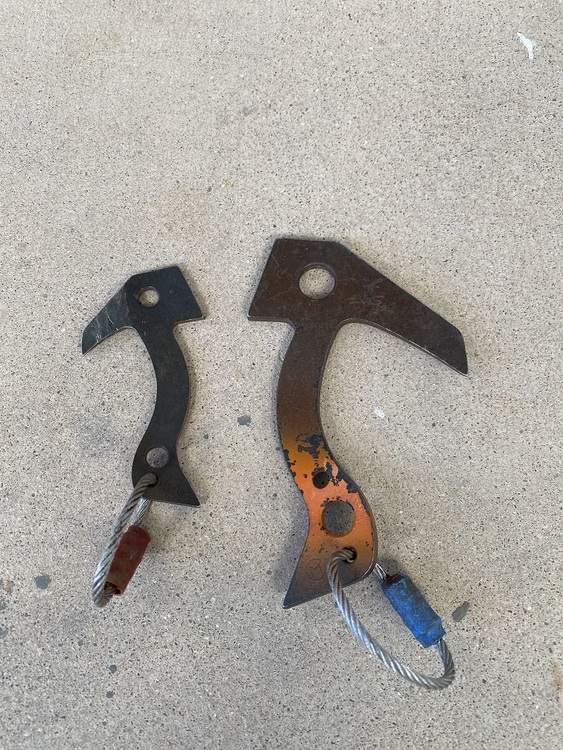 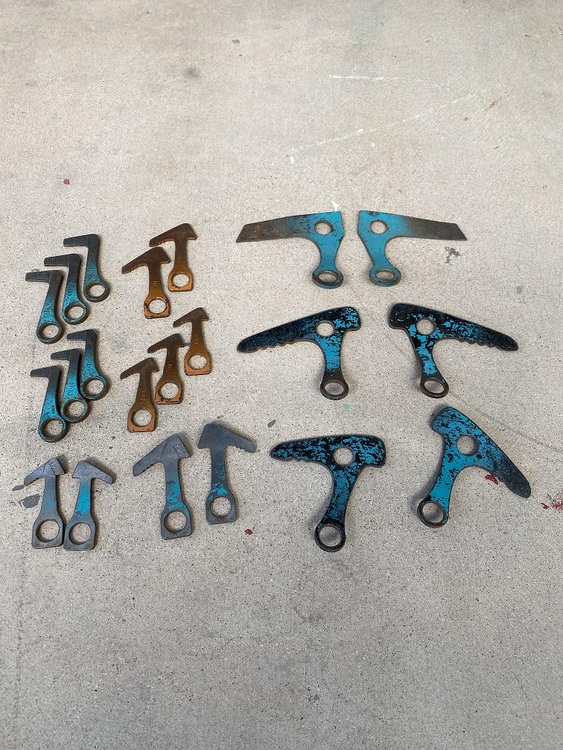 |
|
|
Nice collection. I think Bryan Law designed those swoopy curvy ones, 2nd pic from the bottom. Same fellow who managed my beak production at A5 for a while, in fact his name is on the pic above for the WLS Stamping quote! |
|
|
Those are Moses tomahawks. |
|
|
jc5462wrote: I am pretty sure Brian was working with Moses. Its all on supertopo somewhere, but sadly all the pics have been removed (why Chris, why?). (edit: I don’t blame Chris for shutting down the site, there were too many misogynists and narcissists, but to delete all the amazing historical photos—not even a link to them in many cases, was an unnecessary breach), |
|
|
Finding new stuff. Turns out, Beaks we’re invented in the 1950’s! An example of the “west“ not learning about an innovation for over 40 years. What happens more often when people making their own gear and sharing design considerations. Here is the original inventor, Jaromir Sadek, who came up with the idea for hooking pitons in the 1950s.  |
|
|
John Middendorfwrote: Apparently someone was posting child porn pix and putting him at legal risk ( or something along those lines ). |


