
 Continue with onX Maps
 Sign in with Facebook






Quad anchor is not redundant at the clip in point?



|
I'd like to add this to the conversation: |
|
|
Often, the first practical argument in favor of a quad is that knots are used to limit extension. This ends up being related to the load sharing argument, so I'll address both. There is a lower bound to how close the knots can be on a quad before they are useless, and the limit is farther than many folks think. This is because the offset of the pull angle between an aluminum carabiner and a dyneema sling needs to be about 15 degrees before the static friction between the carabiner and sling is overcome and causes the carabiner to slide. Consequently, to fulfill its proposed use case, a quad needs to have at least 30 degrees of travel in its "pocket." Other materials (ex. cord), twists, and alternative clipping schemes (capturing offset strands) all increase friction, necessitating limiting knots that are farther apart. Some folks tout the ease of pre-rigging a quad as a significant benefit and have the knots as far apart as possible (ex. Dale Remsberg noted upthread), maximizing potential extension and claiming this as a positive feature of the rigging. However, if a component fails, this extension kills the entire party. That's a hell of a gamble. @Nick: I'm most wary of the quad on ice compared to other media, given the extremely variable and unpredictable nature of ice coupled with the potential for long runouts, especially off the belay (depending on one's proclivities). I'd strongly encourage you to consider the banshee belay as an option that still allows for pre-rigging, doesn't require tying/untying knots (though some styles require a clove hitch), and is still versatile and easy for ice. The simplest version of it is simply one ice screw as the focal point and then a single alpine draw to a second screw above (and offset to the side to avoid the orthogonal fracture planes of ice). Very fast and easy to rig for both leader and follower, even using the fattest gloves I own. |

|
Fuckin A. Derek it’s a pleasure to have you in this thread. |
|
|
Mark Pilate wrote: Hahaha. Thanks. I might just clean this up and turn it into a blog post some time so it can be readily referenced in the future. Also, I know I made some fairly strong assertions (though backed by evidence), but I mean nothing personal toward anyone in the thread. Honestly, I'm just trying to move away from potential misinformation/misunderstanding so folks can make fully informed decisions. I'm a big fan of strong opinions that are weakly held, so if folks have other stuff to offer on the subject, I'm happy to hear it. |
|
|
@ Derek--I really appreciate that contribution. Thank you so much. The power of your ideas, and your ability to express these ideas, is superb. You should definitely synthezise those posts into some kind of statement of sticky, and distribute that in the world. All the best. |
|
|
Derek, without swathing through all that info you referenced, where are you finding that traditionally equalized anchors are likely to load share as well as a quad, or that a quad is likely to load share 80/20? |
|
|
DrRockso, a “meta analysis” of most of the papers and data published do show that a quad “equalizes” better than a fixed point, but really to a mostly trivial level of percentages in lab tests. I just re-ran some of my own quick tests down in my own “lab” in the course of this thread and it was around ~9% better load delta distribution for 30 degree load shift (100 lb load) using dyneema (Quad vs fixed masterpoint, N=5 each). Not nearly enough to warrant the risk. You don’t get that adjustment benefit in sudden force application of a fall, just the shock load risk Plus, as shown in the Dale Remsberg pic example, the way quads are typically used with opposite pulls from the two people at a stance, the “equalization” gets negated and it’s equivalent to if there was a fixed point essentially where the two sliding points cross. You do get a damped transfer of movement from either side though. Not enough in my book to make up for risk on nuts and cams, etc. after all, the rock or crack does not have a CE/UIAA rating, and is a mystery and left to good judgment and experience. I wholeheartedly agree with one of your previous points that focusing on teaching solid anchor placements is the key. The goal here is to clarify some misunderstandings and eliminate some false assumptions so people can make the best decision at the time. |
|
|
DrRockso RRG wrote: I don't know of a comprehensive meta analysis (though this is probably a topic deserving of one in the sense that it would be low hanging fruit). I believe it's rigging for rescue (or maybe SAR3?) that has lots of data on load distributing systems (slow pull testing), both fixed length and sliding, with all kinds of riggings. There's a paper done by Tom Evans (I think?) that looks at failure of an anchor component with rescue loads. Even the DMM videos provide comparative data for relative loading (even if the numbers themselves aren't particularly useful given the solid masses and lack of rope in the tests). The CAI has drop testing data, as well as the DAV and a small amount from ENSA (most of which is not in English). Most/all of these are in the references for the paper I linked. A number of other references are included in the comments near the bottom of the page for the below article (search for comment by Ron Funderburke). You can also find a number of one-off tests Jim Titt has done and posted in these forums. https://americanalpineclub.org/resources-blog/2017/7/31/anchors Before going farther, I want to emphasize again that the drop test at FF2/near FF2 is the one that matters as it produces loads of concern (since previous testing makes clear that lower FF doesn't produce high enough loads to be problematic). In a leader fall, the force that dominates is gravity, so the vector of pull is always net down. However, depending on where the leader is when they fall, the load typically comes from one side or the other (it would be a rare fall for the leader to come straight down since typically they would typically be landing on the belayer). Consequently, if using two load cells with high speed data collection, the comparative load often settles to something similar to what's seen in slow pull tests. However, the initial load can be multiples larger on one anchor point compared to the other based on where the carabiner sits, the belayer is at, which side the leader fell from, etc. I wouldn't say an 80/20 is "likely" with a quad (and if I literally said that I'll go back and edit it), but it is certainly possible for the holding the initial fall. I think of it like this: the load distribution between two points in an anchor is likely Gaussian (aka normal distribution/bell curve) for a sliding system and a fixed system. The measure of central tendency for the fixed system will be shifted toward less equal load distribution compared to a sliding system, and at the tails, the sliding system with be closer to the goal of 50/50. But there will be significant overlap in the middle between the two options (probably about 3 or 4z I'd guess), and you're likely on target for 65/35 split in either case a lot of the time. (See below for a not-to-scale and purely hypothetical visualization of what I mean.) For example, a vertical crack with a fixed anchor will get you close to that (and will get you roughly 60/30/10 split with 3 pieces). Most of the time, I don't think there will be a substantive or field-reliable difference for a competent anchor builder. 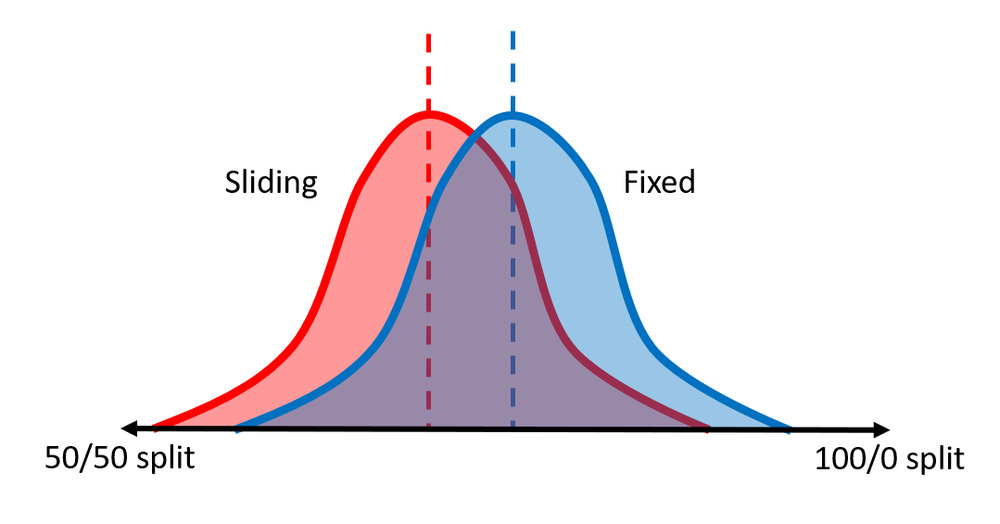 Consequently, this gets back to whether it is of value to attempt to reduce the load to any given piece by distributing the load in the first place. If you don't clip a piece of the anchor as the first piece of gear (and didn't rip a piece out of the anchor and therefore cause extension), you're looking at max loads around 6kN (maybe 7). If you check out the link to the multipitch climbing site I posted above, you can see why it's probably not worth worrying to much about load distribution at all. Practically speaking, I'll often still attempt load distribution to some extent. That's simply because distribution likely improves the probability that I won't rip my anchor out of the wall and we have simple rigging options that do a decent (if imperfect) job of this. |
|
|
Dumb question: isn't clipping 3 strands of the quad the same thing as clipping 1? In the load test videos of the quad, with 3 strands clipped, when one leg blows, the master biner slides down to the limiter knot, then the knot pops through the biner, and the biner ends up on the single-strand side. (Then, when loaded again, that single strand tends to snap at one of the limiter knots.) Wouldn't it make more sense to clip 2 strands as a general rule? |
|
|
John M wrote: Because when that single strand blows the whole thing is junk. Yes clipping 2 strands make the most sense. If using a quad makes sense to you. |
|
|
Amalgamated some of my thoughts from this thread and added a few other ideas into a quad explainer for those who are interested: https://staff.weber.edu/derekdebruin/fixedpointbelay/The%20Quad.pdf |
|
|
Derek DeBruin wrote: good stuff. |
|
|
Derek DeBruin wrote: Seems like your bell curve chart isn't based on any real world data. My experience is that I regularly see people tie 2, 3 and 4 peice prequalized anchors where 1 peice is taking a 100% or close to a 100% of the load and the other peices are merely acting as backups. It's certainly more than 1% of the real world examples I see. It's not a deal breaker for me, but I think it's unfair to assume that the vast majority of folks prequalized anchors are seeing meaningful load sharing. |
|
|
DrRockso RRG wrote: True. I did state that it was purely hypothetical and meant to illustrate the bigger concept of the significant overlap between the systems with regard to load sharing. I don't know of any such data, and collection would be onerous, if not impossible. I couldn't just recruit folks to tie anchors without biasing them toward being on their best anchor building behavior so to speak, but it also probably wouldn't work well to hang off a static line as folks arrive at a belay to say, "So, before you clip into that, I'm just gonna install these load cells..." Just the same, I hope the purpose of the chart was clear and not confusing.
Fair point. Without data we are left with anecdote, but I don't doubt you. Maybe I was being too generous in assuming folks could tie a knot and pull down on it. But, to me that also seems a much more fundamental skill. And as I state in the section on risk management, and as others have agreed (you as well, I think? I'd have to go look), the bigger skills are belaying, placing solid gear, climbing well, etc. In that sense, if you're at a point where the concerns of load sharing and extension are on your radar because you've mastered those other fundamentals, I'd hope you could tie a knot effectively. I'm not even going to pretend that my climbing partners represent an unbiased sample, so I really don't know. |
|
|
Don’t need to hang out at multi-pitch belays, Might set up just such an example to collect that kind of comparison data at the local gym. Set up some example 3-4 piece anchor points with all load cells feeding into a computer and have numerous volunteers tie both LS and LD anchors and compare results. Can also plot results against years of experience to see if veterans are statistically better than noobs |
|
|
Guess I’m trolling?!?! But seriously:
If you’re one of those people who goes out and buys a PAS (failing to come up with other examples) etc… probably a great knot for you. It’s a niche, gadgety, tool, for a single-use application, that its means can be accomplished a multitude of other ways with the standard climbing gear on your harness. It offers no advantage other than convenience in the form of telling your brain “I do the clip, clip the thing to the anchor, when I do…”. People who need an item to be a solution to a scenario, the quad is perfect for. It’s also humorous because it’s for non-advancing sport climbers! The quad has no application outside of sport climbing or top roping. Did I get something wrong? |
|
|
Mark Pilate wrote: Thought about that, but don't you think the very nature of that experiment creates bias that will no longer meet the real-world criteria? I have to imagine that if I ask folks to tie anchors in a gym for a study they'll be doing their very best, when in the field they might indeed just leave the single piece getting most of the load as Rockso describes and call it "good enough." |
|
|
I think even the data from what you describe would be skewed Mark, both because people would be hyper aware of getting the equalization just right vs real life (hopefully you're not telling them what the purpose of the study is, though if they see you putting load cells in it might be pretty obvious for some) and the fact that the direction of load is often changing, the belayer is not always weighting the rope in the exact direction the follower is falling and likewise the leader might factor 2 onto the anchor from different directions as they climb up a diagonal crack for example. Derek I 100% agree there are more important things to focus on. Tom, go climb a 20 pitch route with all bolted anchors and mostly all hanging belays somewhere like Potrero Chico, and then do the 20 rappells down. The quad is pretty awesome for things like this, 40 less anchors to tie and untie. |
|
|
Walt Dog wrote: Thanks for chiming in. I'll let Rockso (a guide) and Mark (former guide) share more about themselves if they wish, but if what you meant was to ask about my credentials I'd be happy to share. If not, then frankly this isn't helpful. I'm a certified AMGA Rock Guide. I teach the AMGA's Single Pitch Instructor program. I also teach climbing at a university. I've presented on a variety of topics and audiences at the AMGA Annual Meeting every year for the last 7 years. I've authored articles for the AAC's education program. And since I'm not just some science nerd who doesn't do anything in the real world, sometimes, I even go climbing. Outside. "Danger" is an interesting idea, since it's all relative. I mean, it's not like climbing itself isn't dangerous and it's amazing it hasn't been outlawed completely and guides can teach it at all. In many cases a quad is acceptable, but the danger comes from a low probability edge case. Does that make it "highly" dangerous? That really depends on how danger is being defined in relation to something else. From a systems risk management perspective, low probability high consequence hazards would be better managed by a default selection that can handle those edge cases, which is really the crux of this discussion. Finally, just because one is a guide doesn't mean they're infallible or actually have the best practices. Guides have been wrong before (the kreuzsicherung comes to mind as one example) and everyone is still subject to their individual and/or collective biases. Plus, guiding itself is biased toward certain techniques. Guides tend to like masterpoints and plaquettes, so their clients often end up learning and mimicking these techniques, even if they're not strictly required for recreational climbing. In short, guides can (and absolutely are) wrong sometimes. And that's okay. We can collectively question existing methods, consider new ones, study them, and change techniques accordingly. That's how we make progress. Edit to add: Rockso, we definitely agree on the two bolt anchors. Getting sendy in Potrero on nice 2 bolt anchors for 20 pitches is a great application for the quad in my opinion. |
|
|
Derek DeBruin wrote: We did a study mabe 10 years ago as part of the "equalisation is a myth" project and even with unconcious bias the results were truly appalling. We asked random climbers to rig multi-piece anchors in pieces we'd already placed all over the place (not the nice textbook group) and outdoors where visual clues are lacking. Most commonly the centre piece in 3 piece anchors saw no load, with 4 piece mostly 2 random legs saw no load. 80-20 on the remaining was normal. Basically you have to expect only one piece is being loaded at any one time. |


