
 Continue with onX Maps
 Sign in with Facebook






Current Sports Medicine Fellow doing research at Cleveland Clinic. Investigating risk factors for indoor gym injuries. Would love if you could take 60 seconds to fill out a brief survey for me!


|
Thanks for reading! As my title mentioned, I am a current sports medicine fellow at Cleveland Clinic. There is very little research investigating risk factors for indoor rock climbing gym injuries (and no studies looking specifically at risks for indoor gym injuries within the United States). I thought this would be important to look into further, especially with climbing being added to the Olympics. Please consider filling out my brief survey if you are >18 yo and have climbed at an indoor rock climbing gym within the United States. I have already sent my survey out to many of the rock climbing gyms in the United States Thank you! And please let me know if you have any questions! Sincerely, Lee 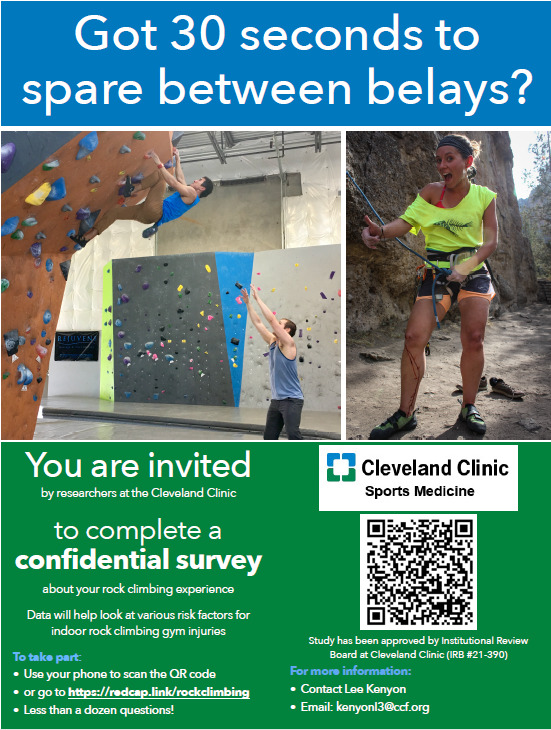 |
|
|
Why does your poster have someone climbing outdoors if you're looking for gym climbers? Also it seems like hours spent climbing inside a gym vs outdoors would be important. I only climb outdoors and I am sure others are similar |
|
|
General demographics survey? Age weight height gender experience level? Trying to figure out who gets hurt in the gym most often? |
|
|
Levi X wrote: Great questions. Although my survey is directed towards people who participate in indoor climbing and indoor injuries, one of the main hypothesis looks specifically at whether outdoor experience affects risk for indoor injuries. There have already been studies that looked at risk factors for outdoor climbing injuries, which is why I was curious if risks were similar for gym injuries. I agree, looking more closely at indoor vs outdoor gym hours would also be important. Since this is more of an initial investigation, I didn't want to have the survey get too lengthy or complicated. Appreciate the suggestions and will definitely keep it in mind for future research! Thank you! |
|
|
Ben jamin Pellerin wrote: Basically, yes. Hoping to find trends and identify risk factors for indoor injuries. Hopefully this information can be utilized by gyms for future education and injury prevention. It will also be helpful for the field of sports medicine to better educate those athletes interested in climbing. |
|
|
Lee, I found you question about the number of years of experience rather odd. I think your question went up to 5 or 6 years, with one year intervals? Why not something like 1-3 years, 3-7 years, 7-15 years, 15-25 years, more than 25 years. |
|
|
phylp phylp wrote: But if Ive climbed for 3 years which option would I select!? |
|
|
Gumby King wrote: This is what happens when I type stuff after my 9 PM bedtime. |
|
|
phylp phylp wrote: Thanks for the input. I agree, looking back I probably could have worded the question better and provided better options. I only went up to 5 years as I was sort of assuming there would be little variability between answers once people have been climbing for >5 years. I am most interested in seeing if no experience, short experience (1-2 years), medium experience (2-3 or 3-4 years) is vastly different than this with what I consider longer experience (>5 years). |
|
|
Gumby King wrote: Sorry for the confusion. I realize the breakdown (or at least the way I intended it) should have been:
|
|
|
Curious what you define as "injured". I answered no, as in the common climber/MTB/other sport lingo I've been "hurt, not injured". That translates to I've hurt myself, but nothing I need a doctor or extended time off to treat. There's also a huge number of climbers with time-bomb overuse injuries in their tendons and pulleys, that may not yet or not ever present as acute injuries. |
|
|
Lee Kenyon wrote: Lee, I got some bad news for you... PLEASE take some of this into consideration. --- Niko is on to something as well. For injury, are you looking at accident-based injuries (like bad landing or being dropped) or overuse injuries? |
|
|
Lee Kenyon wrote:risk factors for indoor rock climbing gym injuries (and no studies looking specifically at risks for indoor gym injuries within the United States Disregarding injuries related to lead falls, and focusing on acute or over-use injuries, just based on my own experiences and friend's experiences, I do think there is a contribution of indoor gyms to climbing injuries, the question is how to tease out the data. Before there were climbing gyms, I had long periods each year where the weather made it difficult to climb out side, and I used those periods to cross-train, which I think was a great thing to do. Now, with gyms, and climbing being so much more fun to me than cross-training, it's much harder to make myself cross-train rather than climb. After the advent of gyms, I could train climbing indoors many more hours than I could ever have trained outdoors: when it was dark, I could train in the gym after work. When I was too busy to travel to climb on weekends, I could still climb in the gym. Climbing became a year round activity. The other "dark side" of gym climbing is the ability to top-rope stuff. Outside, you have to do the work to get the rope up on hard stuff. In the gym, you can push yourself on routes you wouldn't touch outside, because you have that toprope. So if the question is: are people getting more acute and over-use injuries because they have access to gyms, the answer is probably yes. I'm retired now and a much higher proportion of my climbing days are spent climbing outdoors vs. the gym. But for the typical working stiff, this pattern is likely reversed. Regarding injuries and experience, here is my own trajectory: there are injuries that happened when my body wasn't climbing conditioned and I was uneducated about injury prevention, these were mostly minor, maybe the first 5 years. Then when I was experienced, and my body was strong, conditioned and at its peak, there was a period of about 25 years where I got injuries (pulley tendons, elbow tendonitis, rotator cuff and labrum tears, knee meniscus stuff relating to off body positions etc.) because I was climbing harder and training harder. The gym was where most of the training occurred because of my work schedule. I also had outdoor fall-related injuries of the acute type during this time period, that wouldn't have happened in a gym fall. Thank God I had great sports medicine docs/surgeons and PT people during all that! Then there came a long period of about 8 years where I was injury free because I was really knowledgeable about the warning signs leading up to injuries, had a long list of "maintenance" routines for all my damaged body parts, and I kicked back from pushing myself to my limits. Now it seems like in the past year or 2, I'm just plain in the category of "old" and It's easy to get little tweaks and sprains doing what seems to be almost nothing! But I have climbed 25 days since the start of the year so I'm still managing to do it and have fun. Good luck with your research interests. |
|
|
Niko Hawley wrote: Hi Niko, Thanks for the reply. For people who answered "yes" to the injury question, it led them down a different pathway of questions. One of the questions looked at "severity of injury", for which I utilized the UIAA (International Mountaineering and Climbing Federation) Medical Commission Injury Classification for Mountaineering and Climbing Sports as shown below: 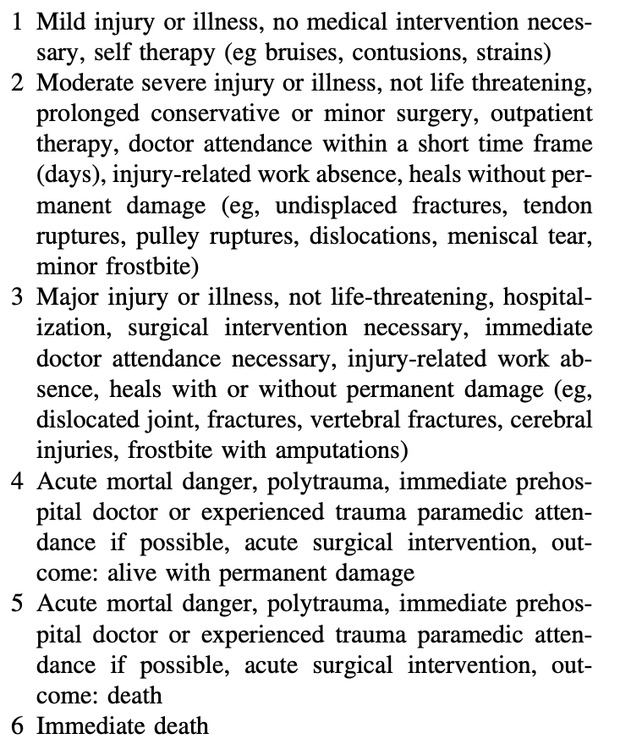 And Gumby King: Thank you for the link to the Stanford question design! The powerpoint is really helpful. I'll have to take that into consideration on future surveys. I agree that COVID will definitely be a factor impacting the data. A research study is required as part of my 12 month fellowship, so if anything, this can be a stepping point for future research projects. I sincerely appreciate all of the input! Thank you all :) |
|
|
Lee Kenyon wrote: Definitely |
|
|
Gumby King wrote: Great advice. Fortunately this research project shouldn’t have any lasting career effects and was more for personal interest and fulfilling a research requirement. Research isn’t a component of my upcoming job. I do still hope to get some helpful data. As I mentioned, research looking at indoor climbing injuries is very limited and it is always good to get research started somewhere! This project was totally non-funded and strictly a creature of my own free time. |
|
|
Gumby King wrote: This. =========== There's another issue, to me that wasn't clear looking at the survey as a respondent what I am supposed to do (from Canada, didn't fill but looked at). Say I have a repetitive strain injury. Your questionnaire seems implicitly geared towards traumatic injuries, where you can pinpoint the moment it happened. Lots of climbing injuries (majority?) are of that type. As a respondent, I have 2 choices:
My guess is most people would choose 1. But then again, having that ambiguities means you have 2 respondents, with a similar situation, that will yield vastly different surveys.
"during your injury". I could take it as "what type of climbing I was performing when the injury occurred", which by context I think is what you mean, also given it's a single-choice question. However, the phrasing "during your injury" does imply that you COULD refer to the type of climbing I was practicing while still recovering from the injury. |


