|
|
David Deville
·
Mar 17, 2021
·
Fayetteville, AR
· Joined Oct 2013
· Points: 90
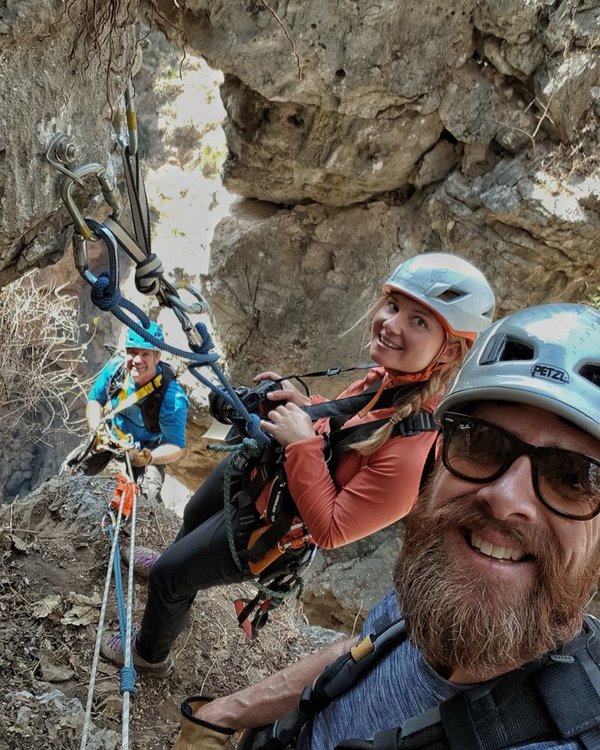
Somebody better school these gumbys before they get benighted.
|
|
|
D B
·
Mar 17, 2021
·
Gardena (South Bay)
· Joined Sep 2017
· Points: 30
I don’t check my post for 2 days and come back to 3 pages. Thanks for all the responses. I mentioned it but in particular I’m thinking of multi pitch routes in Red Rock. I have a lot less experience than a lot of others on here but wouldn’t call myself a beginner, well at least in terms of systems. I’m planning a couple of RR trips and plan on using pre-built quads. After reading all of the responses I’ll go with non locking carabiners on the bolts to secure the quad. It’s more about ease, speed and laziness as opposed to saving a couple of ounces.
|
|
|
Yoda Jedi Knight
·
Mar 17, 2021
·
Sandpoint, ID
· Joined Apr 2019
· Points: 0
Dan Daugherty wrote: Oh crap. You just mentioned using a pre-built quad. Get ready for the next round, folks! UsE tHe RoPe GuMbY! yErGoNnAdIeEeEe!!!!
|
|
|
D B
·
Mar 17, 2021
·
Gardena (South Bay)
· Joined Sep 2017
· Points: 30
Yoda Jedi Knightwrote: UsE tHe RoPe GuMbY! yErGoNnAdIeEeEe!!!! Nah, almost never. Too many reasons not to.
|
|
|
John Tuttle
·
Mar 17, 2021
·
Just a dude, playing a dude.
· Joined Mar 2020
· Points: 235
curt86irocwrote: https://www.mountainproject.com/forum/topic/109372292/clove-hitch-fail what do i win? Nothing. Pure climber error that could have affected any combination of knot and biner. People come unclipped from all kinds of things because of their own errors and locking carabiners do not fix that. If a Clove is properly tied and weighted it will never come spontaneously unclipped from any carabiner in a climbing application.
|
|
|
rgold
·
Mar 18, 2021
·
Poughkeepsie, NY
· Joined Feb 2008
· Points: 526
I see a lot of clove hitches tied but not really cinched down. I think it possible that such a knot could ride over the carabiner gate and open it. Of course, the "solution" is to always make sure your clove hitches are fully tightened, but a locker does provide an extra measure of security and makes sense if the load direction might change significantly. You're still in trouble because the gate is being subjected to an outward load...
|
|
|
Buck Rogers
·
Mar 18, 2021
·
West Point, NY
· Joined Nov 2018
· Points: 240
David Devillewrote:Somebody better school these gumbys before they get benighted. Hazel! Damn she's the Bomb! Made looking through this thread worth it! 5.14 trad leader right there, and on sketchy shite, too!
|
|
|
Kedron Silsbee
·
Mar 18, 2021
·
El Paso
· Joined Aug 2013
· Points: 0
John Tuttlewrote: And there you have it why beginners are slow: They simply refuse to see how much they futz with gear instead of reducing their needs to the simplest that works. What was the consequence of it coming unclipped? Nothing? Better add more lockers because you can rather than learning how to avoid the situation? The problem is that it is never just the time to screw/unscrew just once, its that it gets done over and over at every belay with beginners: 1. Oops, gate facing the wrong way (screw/unscrew). 2. Lemme add a sling to that (screw/unscrew). 3. Can I clip my pack there (screw/unscrew). 4. Can I clip in there (screw/unscrew). 5. Can I unclip there (screw/unscrew). 6. Opps, its frozen, can you weight/unweight it? (screw/unscrew). 7. Dang, something in the gate and it won't come unlocked. Fiddle fiddle. 8. Oh, gotta carry 6 cause this route has 3 bolts at each belay. who the fuck does this? every newbie. 9. Oh, forgot my lockers at the changeover, now what do I do? 10. Dropped a locker, worry worry worry lets retreat. 11. Welp, guide mode...need 2 more lockers. Now I'm carrying 8 up Bird Land when Robbins, Pratt and Frost did the FA of the Salathe Wall with none. That's the time that gets wasted when you use lockers that you don't need to be using. Yes - beginners are slow because they do too much unnecessary gear-futzing. As you get more experienced, you have a better sense of what shortcuts you can take from the "textbook" way of doing things that, in that situation, don't compromise your safety unacceptably (whatever that means to you). Starting to take those shortcuts before you have enough experience to determine in each situation which ones will increase your risk negligibly, and which ones will kill you 1% of the time you do them seems like a bad idea. The "simplest that works" is a very non-trivial thing, and a lot of experience people have been killed by taking the wrong shortcut at the wrong time. Belaying with a non-locker "works", but I think almost everyone would agree it isn't a good idea. That said, I've climbed for > 10 years without regularly putting lockers on anchor bolts, and I've never seen even one carabiner come unclipped at anchor. Furthermore I've never heard about an accident that would have been prevented with lockers at anchor bolts. Based on this, I don't worry about it unless there's something unusual.
|
|
|
curt86iroc
·
Mar 18, 2021
·
Lakewood, CO
· Joined Dec 2014
· Points: 274
John Tuttlewrote: Nothing. Pure climber error that could have affected any combination of knot and biner. People come unclipped from all kinds of things because of their own errors and locking carabiners do not fix that. what about people who come unclipped because of unique circumstances that have nothing to do with user error (i.e. lead fall)? Would you like me to link to those accidents as well or are you just going to hold your ground an insist lockers don't add a level of protection ;) there are at least 2 that i know of off the top of my head... edit: the use of lockers is a risk mitigation factor...and since we all have different levels of dealing with risk, it's a personal choice.
|
|
|
Franck Vee
·
Mar 18, 2021
·
Unknown Hometown
· Joined Apr 2017
· Points: 260
John Tuttlewrote: You are missing the forest for the trees. Gates freeze, not because of cold but from grit or from tolerance issues (see Petzl Attache) or tightening them while weighted etc. I haven't had locker "freeze" (seizing is probably a better term, if that's not a well freezing issue) in 10 years of climbing. I do clean my stuff once a year (most years) and retiring gates that don't open/close smoothly, so that might be it. At any rate I have a hard time being such a major issue that is has a material impact on climbing, unless you can tell me the circumstances under which this may legitimately be an issue. Tolerance issues aren't exclusive to lockers, and at any rate once again proper inspection (or well, really, just paying minimal attention) to stuff would quickly indicate a problem. You're basically bringing bad climber gear management that causes an issue (e.g. potential malfunction of lockers) in order to support the idea of getting ride of the locker. Me thinking it makes a lot more sense to get ride of the root cause here, which is poor gear management. What we are talking about is a Syndrome of over-reliance on additional safety measures contained in gear (that manufacturers are only to happy to provide to the newbs) as a substitute for Experience that will tell you what is or isn't needed. Leave the lockers behind and understand your systems.
That's a legit point, but again you're bringing in a poor climber's habit (blind reliance on stuff) to justify getting ride of stuff. And once again, it seems to me it makes a hell of a lot more sense to get ride of the underlying issue (blind reliance on stuff), as opposed to lockers.
You're basically trying to make this a binary thing (you either USE LOCKER or your either KNOW WHAT YOU'RE DOING). That's a false dichotomy. The first ascent of the Salathe Wall or The Nose was done without one single locking carabiner. Now people are saying you need 6 or 8 to do a one pitch climb FFS? Locking carabiners are not a substitute for knowledge or judgment but beginners use them as such. Don't understand if something is properly clipped or not? Use a locker...
Yes, and climbing used to be done mostly using hip belays and protecting exclusively with nuts. That's not an argument. Your average beginner isn't lcimbing the salathe either. The Syndrome of over-reliance on gear leads to slow parties. Slow parties facing darkness then rush rappels and their setups, misuse gear in the dark and make route finding errors. Fumbling on pitch one and two leads to epics on pitch 10 etc. etc. Standard carabiners, with the rope attached to them with tightened clove hitches have never been recorded to come unclipped from anchor bolts in the history of climbing. I would be happy to admit being wrong if someone can provide documented proof otherwise. Telling people to use locking carabiners on anchor bolts on a standard free climb is an over-reliance on gear that leads to inefficient climbing and promotes a lack of understanding of just what is risky and what is not. A few free standard carabiners are more all purpose and useful on the totality of the route. Take those instead (and you'll never have to cut your way out of a belay like some have using lockers).
Well again, you haven't really shown how that difference (locker vs not) has a material impact on the time your average beginner will take to perform the climb. You're promoting a marginal time saver that would be completely lost in the sea of ineffectivness & time wasting that goes on when newly climbers, and even intermediate, climb longer climbs. You're just stating that, and I don't think this is true. Again I've never had to cut any slings due to a locker seized up in 10 years of climbing. I can't from the top of my head think of someone I know who had to. Take it or leave it.
Mostly going to leave. I mean you get at point that at some point in one's climbing comes a time where smaller optimization make sense. This topic would me a sensible one quite a ways down the road. It's much easier for a beginner to mess up a clove hitch than to mess up locking a biner - worst case ends up being what you promote, e.g. a unlocked biner. Your response to the previous guy who linked the clove hitch failure topic was interesting - on the one hand, you're willing to ditch a measure because misusing it may cause an issue (seized up locker or lazyness to care about setup), but on the other hand you're not willing to ditch a measure because misuing it may cause an issue (lazyness in tighting/setting up your clove on a non-lcoker may lead to a aground fall).
|
|
|
Derek DeBruin
·
Mar 18, 2021
·
Unknown Hometown
· Joined Jul 2010
· Points: 1,129
This thread seems to have danced around the subject but generally hasn't approached this question from first principles. In this case (and most of climbing in my opinion), the key attributes to manage risk for the hazard are: human error, strength & security, exposure. The context is also quite important as it affects all 3 of the above.
I start with human error because we ignore the hell out of it in climbing, despite the fact that it dominates accidents. This is becoming pretty well understood in other mountain activities (backcountry skiing, ski mountaineering/alpinism), but when it comes to climbing we overlook it. I'm a proponent of the systems view Dekker posits, and I think it applies well in climbing. Climbing/alpinism qualifies as what the greater risk management community would consider very physically risky. Process controls are difficult to implement, because ultimately the process still boils down to just a couple human operators, who are responsible for process control and task execution simultaneously. So what? Your best bet at avoiding an accident is to have a very good process/system coupled with the discipline to both build very good habits and also employ them every time. The "syndrome" of an rules following beginner can actually superficially appear not to different from a rules following expert (one has the depth of understanding needed to analyze the system and also adjust appropriately as needed/over time). To wit: mtntactical.com/knowledge/t…
If you're thinking that your particular skill/experience precludes you from an accident: you're wrong. That notion is simply psychological distancing between you and an accident. *You* would never make that mistake because you're [insert defense mechanism here]. Your brain tends to do this pretty automatically precisely because you recognize (even if subconsciously) that it could have been you. The fact is most people get away with a lot because they just don't climb that much; that is, their repeat exposure is quite low. Many folks dramatically over estimate their experience, and even if experienced, their relative skill. How many days do you climb outdoors in a year? Indoors? How many hours at a time? How many single pitches have you climbed? Unique multipitch routes? Walls? Etc. Most folks just don't know, and guess quite high. If you're still convinced you are experienced with skill to match and hazards don't apply to you, you just haven't gone long enough or hard enough. The literature is pretty well developed on issues of fatigue, sleep deprivation, and metabolic deficit (dehydration, low blood sugar, low oxygen) secondary to intense or prolonged exertion. Your day will come when your mental faculties are similar to that of a beginner because you're so worked.
So that's human factors and exposure. Re: strength and security, most folks use some kind of acronym for this (SERENE, EARNEST, LEADSTER, etc.), but these all boil down to strength and security. Redundancy is a way to increase security. No extension aims to eliminate strength concerns. Etc. There are precious few ways to break climbing equipment in most applications (though they do exist). So that leaves security.
A locking carabiner is simply a way to increase security at a critical link. A critical link is a potential failure point that would result in an accident if compromised. This is why folks tend to belay with a locking carabiner: their partner's life depends on this critical link. In the case of the connections between the components of a 2 bolt anchor, having a non-locker on each bolt would be the equivalent amount of redundancy as a single locker for the belay device.
Context matters, though. At a multipitch belay, the anchor should be weighted more or less at all times. Plus, if anything goes wrong that can be mitigated, the person(s) hanging there will presumably fix the problem (such as an unclipped carabiner), etc. Some folks rightly pointed out the upward pull on the anchor in a leader fall might cause carabiners to unclip (FF2 excepted). In that case, the leader has already placed at least one piece of protection, further enhancing the redundancy of the system as anchor failure would no longer be catastrophic (though certainly very alarming!). In the FF2 case, the anchor is weighted until the time of the fall, and then it is still weighed in downward pull for FF2, reducing the chance of unclipping.
In a slingshot top rope setting, though, the repeated weighting and unweighting of the system introduces a greater chance of something coming unclipped. The lack of supervision of the anchor makes a problem less likely to get fixed. Is this a great enough chance to justify lockers on the bolts? I don't think so, personally. But given the greater chance of unclipping, I don't think it would be ridiculous to use lockers in that context either (see unweighted clove hitch link above). Why? Cost. This whole discussion is about a risk/benefit trade off. Is the increased security of a locker worth the added weight, expense, time, etc.? That depends on how one assesses the marginal increase in security vs the marginal costs. In a top rope context where time is almost certainly not of the essence and the approach is probably short, then the additional security is effectively free, so why not use lockers? However, as the length of the approach, climb, and descent increases, the marginal security gains likely no longer outweigh the costs, hence 2 non-lockers on a 2 bolt anchor. The greater risk of a tall route is balanced against greater reward, but let's not kid ourselves about the clear increase in objective hazard in multipitch climbing.
Regarding "need" for lockers (since they weren't used on the FA of [insert famous route here]), this reductive logic isn't particularly helpful. (Much the same as one example of one professional climber doing something is hardly a compelling argument.) Climbing doesn't "need" shoes, harness, or a rope for that matter. But the increases in security and strength with modern equipment are signficant improvements, and even accounting for risk compensation has resulted in a net positive risk reduction.
Regarding the beginner "syndrome," it makes a lot of sense to build additional security into a beginner's system when they are first learning. They are often dependent on "rules" for their system/process because they have not yet acquired the domain knowledge needed to assess risk in this context. This initial lack of knowledge also makes them more likely to make knowledge dependent errors, such as improperly tied knots, incorrectly rigged anchors, etc. Adding additional security for the increase risk in this context seems wise.
Finally, regarding mediocrity, we can continue to encourage mediocrity by lambasting beginners (or anyone) for asking questions. If we are so concerned with a reliance on gear, beginner syndrome, etc., then we need to teach others how to actually evaluate risk in a logical, principle based, and consistent way. If one lacks a system for doing this and relies solely on experience to inform risk management without regard to empirical evidence, theoretical modeling, behavioral psychology, and logical conclusions from first principles, I'd argue that experience hasn't been worth all that much. And it certainly doesn't put one in a position to then instruct or insult others. In that case, the experienced and the inexperienced both get to remain mediocre ;)
|
|
|
Cherokee Nunes
·
Mar 18, 2021
·
Unknown Hometown
· Joined May 2015
· Points: 0
|
|
|
Daniel Chode Rider
·
Mar 18, 2021
·
Truck, Wenatchee
· Joined Sep 2020
· Points: 7,484
I made my favorite post of the day yesterday and it got deleted. Then I hit my post limit so I couldn't complain about it. Now we're pages past that moment. Darn darn darn.
|
|
|
Marc H
·
Mar 18, 2021
·
Longmont, CO
· Joined May 2007
· Points: 265
Derek DeBruinwrote:This thread seems to have danced around the subject but generally hasn't approached this question from first principles. In this case (and most of climbing in my opinion), the key attributes to manage risk for the hazard are: human error, strength & security, exposure. The context is also quite important as it affects all 3 of the above.
I start with human error because we ignore the hell out of it in climbing, despite the fact that it dominates accidents. This is becoming pretty well understood in other mountain activities (backcountry skiing, ski mountaineering/alpinism), but when it comes to climbing we overlook it. I'm a proponent of the systems view Dekker posits, and I think it applies well in climbing. Climbing/alpinism qualifies as what the greater risk management community would consider very physically risky. Process controls are difficult to implement, because ultimately the process still boils down to just a couple human operators, who are responsible for process control and task execution simultaneously. So what? Your best bet at avoiding an accident is to have a very good process/system coupled with the discipline to both build very good habits and also employ them every time. The "syndrome" of an rules following beginner can actually superficially appear not to different from a rules following expert (one has the depth of understanding needed to analyze the system and also adjust appropriately as needed/over time). To wit: mtntactical.com/knowledge/t…
If you're thinking that your particular skill/experience precludes you from an accident: you're wrong. That notion is simply psychological distancing between you and an accident. *You* would never make that mistake because you're [insert defense mechanism here]. Your brain tends to do this pretty automatically precisely because you recognize (even if subconsciously) that it could have been you. The fact is most people get away with a lot because they just don't climb that much; that is, their repeat exposure is quite low. Many folks dramatically over estimate their experience, and even if experienced, their relative skill. How many days do you climb outdoors in a year? Indoors? How many hours at a time? How many single pitches have you climbed? Unique multipitch routes? Walls? Etc. Most folks just don't know, and guess quite high. If you're still convinced you are experienced with skill to match and hazards don't apply to you, you just haven't gone long enough or hard enough. The literature is pretty well developed on issues of fatigue, sleep deprivation, and metabolic deficit (dehydration, low blood sugar, low oxygen) secondary to intense or prolonged exertion. Your day will come when your mental faculties are similar to that of a beginner because you're so worked.
So that's human factors and exposure. Re: strength and security, most folks use some kind of acronym for this (SERENE, EARNEST, LEADSTER, etc.), but these all boil down to strength and security. Redundancy is a way to increase security. No extension aims to eliminate strength concerns. Etc. There are precious few ways to break climbing equipment in most applications (though they do exist). So that leaves security.
A locking carabiner is simply a way to increase security at a critical link. A critical link is a potential failure point that would result in an accident if compromised. This is why folks tend to belay with a locking carabiner: their partner's life depends on this critical link. In the case of the connections between the components of a 2 bolt anchor, having a non-locker on each bolt would be the equivalent amount of redundancy as a single locker for the belay device.
Context matters, though. At a multipitch belay, the anchor should be weighted more or less at all times. Plus, if anything goes wrong that can be mitigated, the person(s) hanging there will presumably fix the problem (such as an unclipped carabiner), etc. Some folks rightly pointed out the upward pull on the anchor in a leader fall might cause carabiners to unclip (FF2 excepted). In that case, the leader has already placed at least one piece of protection, further enhancing the redundancy of the system as anchor failure would no longer be catastrophic (though certainly very alarming!). In the FF2 case, the anchor is weighted until the time of the fall, and then it is still weighed in downward pull for FF2, reducing the chance of unclipping.
In a slingshot top rope setting, though, the repeated weighting and unweighting of the system introduces a greater chance of something coming unclipped. The lack of supervision of the anchor makes a problem less likely to get fixed. Is this a great enough chance to justify lockers on the bolts? I don't think so, personally. But given the greater chance of unclipping, I don't think it would be ridiculous to use lockers in that context either (see unweighted clove hitch link above). Why? Cost. This whole discussion is about a risk/benefit trade off. Is the increased security of a locker worth the added weight, expense, time, etc.? That depends on how one assesses the marginal increase in security vs the marginal costs. In a top rope context where time is almost certainly not of the essence and the approach is probably short, then the additional security is effectively free, so why not use lockers? However, as the length of the approach, climb, and descent increases, the marginal security gains likely no longer outweigh the costs, hence 2 non-lockers on a 2 bolt anchor. The greater risk of a tall route is balanced against greater reward, but let's not kid ourselves about the clear increase in objective hazard in multipitch climbing.
Regarding "need" for lockers (since they weren't used on the FA of [insert famous route here]), this reductive logic isn't particularly helpful. (Much the same as one example of one professional climber doing something is hardly a compelling argument.) Climbing doesn't "need" shoes, harness, or a rope for that matter. But the increases in security and strength with modern equipment are signficant improvements, and even accounting for risk compensation has resulted in a net positive risk reduction.
Regarding the beginner "syndrome," it makes a lot of sense to build additional security into a beginner's system when they are first learning. They are often dependent on "rules" for their system/process because they have not yet acquired the domain knowledge needed to assess risk in this context. This initial lack of knowledge also makes them more likely to make knowledge dependent errors, such as improperly tied knots, incorrectly rigged anchors, etc. Adding additional security for the increase risk in this context seems wise.
Finally, regarding mediocrity, we can continue to encourage mediocrity by lambasting beginners (or anyone) for asking questions. If we are so concerned with a reliance on gear, beginner syndrome, etc., then we need to teach others how to actually evaluate risk in a logical, principle based, and consistent way. If one lacks a system for doing this and relies solely on experience to inform risk management without regard to empirical evidence, theoretical modeling, behavioral psychology, and logical conclusions from first principles, I'd argue that experience hasn't been worth all that much. And it certainly doesn't put one in a position to then instruct or insult others. In that case, the experienced and the inexperienced both get to remain mediocre ;) Hole. Lee. Shit.
|
|
|
Nkane 1
·
Mar 18, 2021
·
East Bay, CA
· Joined Jun 2013
· Points: 475
Here's how I think about it: If there's one carabiner between me and the hospital,* I prefer it to be a locker. So where I use a carabiner to connect myself to the anchor (whether I'm using a tether or clove hitching the rope), I use a locker. When I belay or rappel, I use a locker on my belay device. In "guide mode", I use lockers both to attach the device to the anchor and for the rope; if either were to fail, they would put my partner on the ground. But when I have a multi-leg anchor, each leg doesn't have to be clipped with a locker because they're independent; failure of one of those doesn't put you on the ground. Same with a toprope anchor: 2 quickdraws is fine. Here's what I actually do on multipitch routes with bolted anchors like at red rocks: I lead the pitch, get to the anchor, pull a double-length sling off my harness, girth hitch a rap ring (if it exists; it usually exists), clip the other bolt with a light wiregate, tie a figure 8 in the sling, clove hitch to it. It takes 23 seconds. If the bolt hanger is sharp, I clip it with a spare carabiner, or a cam that won't be used on the next pitch instead of girth hitching. Then I leave that sling tied in a figure 8 for the rest of the day so subsequent anchors only take 17 seconds to build. *The only exception is the first piece before and after a long runout; I don't generally use lockers on lead but I don't begrudge those who do. Occasionally I will double up a quickdraw/sling if I'm really scared.
|
|
|
Dave Olsen
·
Mar 18, 2021
·
Channeled Scablands
· Joined Dec 2019
· Points: 10
"In a slingshot top rope setting, though, the repeated weighting and unweighting of the system introduces a greater chance of something coming unclipped." Not to mention if you have a series of beginner climbers spinning around the belay side as if it were a May Pole.
|
|
|
Brandon R
·
Mar 18, 2021
·
CA
· Joined Mar 2006
· Points: 223
So HH builds up a straw man consisting of a list of general beginner inefficiencies and errors, frequently editing his posts, discounting user error and individual experiences only when it suits his proclamation that nobody should ever use a locker on a bolt, and that anyone even suggesting that sometimes one might want to consider using a locker is a noob... okay. If only a definitive example of a catastrophic event is suitable as a reason to be considered in safety decisions, then why not use a single sling sliding x at anchors? To my knowledge, there's never been a death caused by one, despite instances where using one would have caused multiple deaths, but since it didn't, it shouldn't be considered. http://publications.americanalpineclub.org/articles/13201213756/Rockfall-Anchor-Chopped While were at it, can anyone find an accident where a helmeted belayer using a tube-style belay device has been knocked unconscious and dropped the leader to the ground? One where all user error can be eliminated as cause? If not, then I guess we can state that grigris should never be used under any circumstances. Obviously (hopefully?), that's not the way we should think about these things. And obviously, we can't use lockers on every placement (nor is anyone suggesting that). I have seen carabiners get unclipped (not user error), and I have seen carabiners at crowded belay stations get leveraged open (though never unclipped). I've been at crowded belay stations (passing parties, parties rappelling through) where people weren't always thoughtful about how to share an anchor, thus creating potential for 'biners to accidentally get unclipped. Yeah, a lot has to go wrong for there to be a catastrophic event, so I certainly won't fault you for choosing not to use lockers (as I do in certain situations), but I will fault you for insulting those that do.
|
|
|
curt86iroc
·
Mar 18, 2021
·
Lakewood, CO
· Joined Dec 2014
· Points: 274
Dave K wrote:I'm going to start using lockers just to spite HH.
|
|
|
David Deville
·
Mar 18, 2021
·
Fayetteville, AR
· Joined Oct 2013
· Points: 90
Dave K wrote:I'm going to start using lockers just to spite HH. I think we should do a night ascent of Prince of Darkness with a rack of lockers.
|
|
|
John Tuttle
·
Mar 18, 2021
·
Just a dude, playing a dude.
· Joined Mar 2020
· Points: 235
Winning. So. Much. Winning.
|

 Continue with onX Maps
 Sign in with Facebook