
 Continue with onX Maps
 Sign in with Facebook






Steve House vid - Is packing your 35L for overnight realistic?


|
|
Not a new vid, but Steve House shows how he packs for overnight. https://www.youtube.com/watch?v=uEVbQfg7nvg Add single rack including runners, rope, shoes, helmet (maybe tools,crampons). My question: is this realistic for a 35L pack? Does one simply shove everything in the pack with no stuff sacks, organization etc? Personally, Mountain House is tough to swallow for extended trips but maybe that's the sacrifice for compact/light weight. I don't use an external frame, but my thinking about packing may be dated. Please enlighten me (I usually go out two nights). Here's Steve House's list:
|
|
|
I like how Stroop Waffles are #1 on the list. Can't disagree with that. I usually carry more in a bigger pack, but it really depends on the season and objective. I have used my 38L on occasion for overnights. Missing from his list: 1. First Aid kit 2.Toiletries -- Yeah you can get by without brushing your teeth but TP and blue bags are usually needed. 3. Climbing gear |
|
|
That list of stuff should be VERY realistic for a 35L pack. Remember that all of the shared gear (rack, stove, tent, etc.) should be split between you and your partner. Here's a list of the stuff I carried in a Mutant 38 on Ptarmigan Ridge on Rainier (sorry for the formatting, it's pasted from a spreadsheet):
My climbing partners carried the rack and a second tent (party of 3), since I was carrying the rope, stove, and my tent. Rope, ice tools, and helmet were carried on the outside of the pack. Pack weight with all of this was ~30 pounds. Much less once you start climbing and all the technical stuff comes out. Sadly it doesn't get lighter when you eat the food, because you have to carry your poop instead. |
|
|
It’s possible for sure. You just have to invest and do your research. I backpacked 7 days (100 miles) last year with a 30L pack and only 8 lbs of gear/clothes. At the very beginning, my pack weighed 20lbs because of consumable items (water, food, fuel). For me, lighter makes these activities better.
|
|
|
i used a 35 liter on a 4 day/3 night ascent of liberty ridge earlier this year. i had every mm of possible space used, but it worked... |
|
|
Thanks all, It looks like I (he) should add to the list:
...ok for those of you who have done it in a 35-38L, great input! l'll give a mock-up try |
|
|
Also, do you just stuff your soft and hard gear in like a sausage? What if you need something at the bottom? Does the whole bivy + sleeping bag come out and then get stuffed back again!? |
|
|
RJNakata wrote: most alpine climbing packs in this size range have a front, side or back zipper that lets you open the pack and root around without going in from the top... |
|
|
RJNakata wrote: Pack in order of use, all the sleep stuff can just get stuffed to the bottom. If you need something at the bottom you have packed wrong. Rack, harness, etc, can just live on the outside. |

|
Stuff sacks are an impediment and a waste of space. The pack is the stuff sack. |
|
|
Petey Gil-Montllor wrote: i disagree, i would never 'pack loose' like steve does in the video. a lightweight stuff sack weights almost nothing and allows you to access any item and quickly repack. an expanding down layer or sleeping bag with stuff just floating in and around it sounds like a nightmare to me. |
|
|
His example is likely for climbing a steep and technical route; so the rack, harness, crampons, tools, etc. are not in the bag, they are on the climber. He talks about it a bit at the end of the video. RJNakata wrote: I use a few stuff sacks, even though they might not be as space efficient (I like to keep my stuff organized). I pack the bag using a combo of when I will need things, and what carries well. Tent and camp stuff can go at the sizes and bottom. Rack and such kinda goes in the middle (I assume I will be able to do a significant pack dump at the base of the technical pitches). Layers, snacks, and water go closer to the top so they are easy to access. I put my sleeping bag in a compression sack, and my food in a stuff sack. Rope, helmet, ice tools, and possibly crampons go on the outside.
A lot of the most popular packs in the category do not have an access zipper: Speed, Mutant 38, Ascensionist, FL45, Cilo, HMG Prism, etc. (none of these have zippers). I think that a few of the heavier Deuter and Mammut packs have zippers, and the BD Mission series does? |

|
|
|
|
Kyle Tarry wrote: wow, right you are. i guess i opt for the heavier packs in the segment... all of my mammut packs (3 of em) have some kind of zipper for getting in... |
|
|
Kyle Tarry wrote: When were you on Ptarmigan Ridge? What approach did you use? |
|
|
Kai Larson wrote: When were you on Ptarmigan Ridge? 2019 and 2020 (only one summit though). Approached via White River both times to avoid car shuttles. |
|
|
A bigger sac with compression straps is more functonal. |
|
|
I agree that 35L is doable. It all depends on how you want to pack and what you value on the climb. If you want to go the light and fast approach and get it all into 35L, you need the rest of the kit to match. If you didn't get the super compressible sleeping bag and puffy and the inflatable pad that rolls up to nothing, you'll have a hard time with it. The rest boils down to what you cut out of the kit entirely. There's plenty of questions to ask yourself. Full length sleeping pad or 3/4? One might help you sleep better, one will be less weight and space in the pack. Sleep in all your clothes and bring a 30F sleeping bag, or strip off the wet stuff or have a change of clothes or bring a heavier sleeping bag? Again, might be trading sleep for weight/space. Hike in with the rope strapped over the top of the pack or inside it? Same question for crampons. Will the helmet fit inside or does it, too, go on the outside somewhere (or on your head)? Walk in with a harness on (maybe with the leg loops tucked off to the side)? Put the rack on that harness while you're walking in? Bring lightweight high caloric density food? Or freshies and all the trimmings? (There are definitely some real-er foods that don't require mountain house. I'm a fan of couscous, a pesto spice packet, and a hunk of hard cheese.) How much are you willing to run it out on water? Only bring one container? Will you plan to post hydrate and hyper hydrate before the next day's effort (so you can risk getting a bit dehydrated and carry less water)? If you want a hard sided container, maybe swap the nalgene for one of those smart water brand bottles, etc. How hard is the climbing? How good are your technical skills? Can you get by relatively safely with fewer pieces on the rack, shorter rope, skinnier rope, no tag line, fewer slings, lighter/smaller carabiners, etc.? Do you have your fuel needs totally dialed? Will you need to melt snow, or just boil water for a couple meals? How long can you go on a 4oz canister? I find it easier to get the hard climbing done with a smaller pack on my back and all that's in it is insulation, stove, food/water. So I'll strap the tools, pons, rope, helmet to the outside and hike in wearing a harness. But if I'm instructing/guiding, I'm already going slow and heavy and the climbing is typically well below my limit, so a 50L pack and some creature comforts that help me sleep better and stay more mentally and physically on point become pretty valuable. Not sure if it's publicly visible, but dug around for a photo that shows this in action: 3 climbers, 3 35L packs, 3 days, overstuffed and gear strapped outside. |
|
|
Kyle Tarry wrote: What months? |
|
|
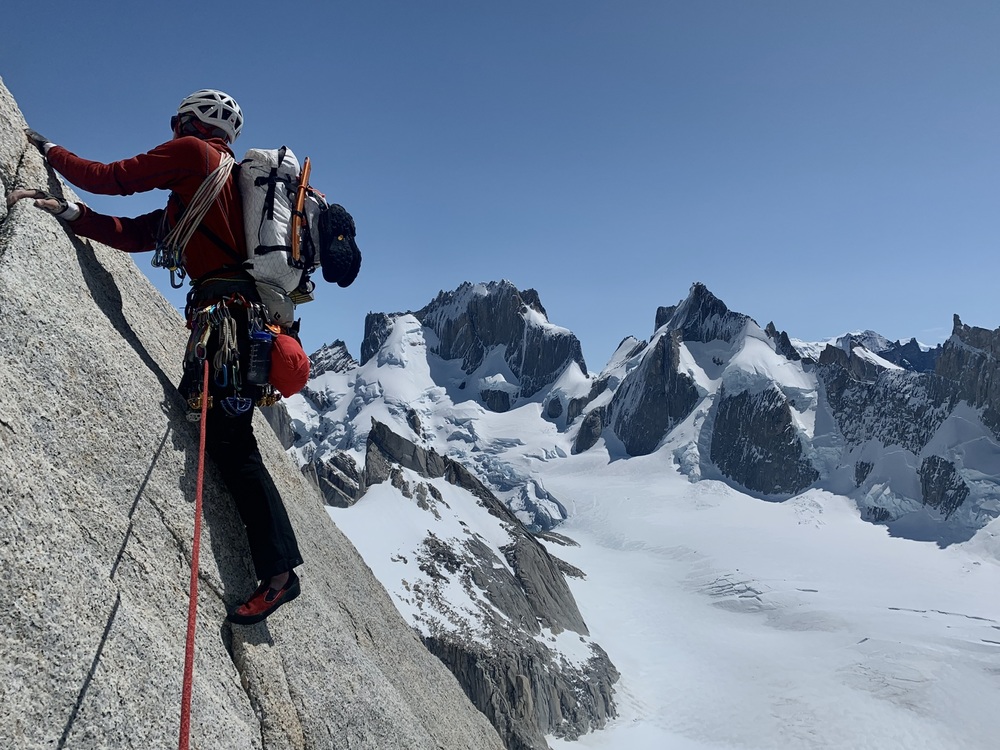 Yes, it’s very possible. Here’s a 22L Tufa Mochila pack with 4 days of supplies. Notice everything used throughout the day is on the outside on my harness: water, belay jacket, rack, approach shoes. We approached the route with a larger pack carrying everything inside, then left them at a basecamp. I had the following in the pack: -4 days 3 nights of food. Bacon, cheese, bars, cookies, cream cheese and bread. (Note that none of this was dehydrated meals as they aren’t readily available in Argentina.) -3/4 length foam pad on the outside -small first aid/repair kit/inReach mini -extra puffy layer -extra set of gloves -extra pair of socks -Ultralight hardshell (Patagonia M10 Anorak) -Jetboil w/fuel -ultralight sil-nylon tarp ~10x10ft ish Notice there’s no sleeping bag, my partner and I shared one so it was in his bag, which was around 30-35L to accommodate the extra space, but our bags weighed around the same. We would switch the 22L pack to the leader for whoever was leading. |
|
|
Now we're down to one sleeping bag between two guys? This is turning into a "who can suffer the most" contest. "Yeah, but look how small my pack is." |


